

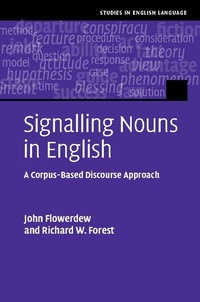
Signalling Nouns in English
A Corpus-Based Discourse Approach
Published on 22. January 2015
Book
Hardback
306 pages
978-1-107-02211-9 (ISBN)
Description
Signalling nouns (SNs) are abstract nouns like 'fact', 'idea', 'problem' and 'result', which are non-specific in their meaning when considered in isolation and specific in their meaning by reference to their linguistic context. SNs contribute to cohesion and evaluation in discourse. This work offers the first book-length study of the SN phenomenon to treat the functional and discourse features of the category as primary. Using a balanced corpus of authentic data, the book explores the lexicogrammatical and discourse features of SNs in academic journal articles, textbooks, and lectures across a range of disciplines in the natural and social sciences. The book will be essential reading for researchers and advanced students of semantics, syntax, corpus linguistics and discourse analysis, in addition to scholars and teachers in the field of English for academic purposes.
Reviews / Votes
'Powerfully evidenced throughout with reference to a wide range of corpus sources, this is a very richly textured book of singular importance to our understanding of a core feature of discourse organisation, extending previous work with real insight and originality.' Ronald Carter, University of Nottingham 'This corpus-based description of the grammatical and discourse features of signaling nouns provides important insights into their use, and makes a critical contribution to exploring cohesion and coherence in texts. It's well worth reading!' Peter H. Fries, Professor Emeritus, Central Michigan University 'This book will be a valuable reference to those who are interested in the systematic functions of nouns and language educators within academic writing and reading.' Kevin Jiang, Functions of Language 'This book is a welcome addition to Cambridge University Press's excellent Studies in English Language series. For John Flowerdew it represents the culmination of work on a set of nouns that he first identified and named in 1994 and on which, often with Ph.D. students and other research associates, he has been working ever since.' Susan Hunston, English Language and LinguisticsMore details
Series
Language
English
Place of publication
Cambridge
United Kingdom
Target group
Professional and scholarly
Illustrations
Worked examples or Exercises; 85 Tables, black and white; 1 Line drawings, black and white
Dimensions
Height: 235 mm
Width: 157 mm
Thickness: 21 mm
Weight
596 gr
ISBN-13
978-1-107-02211-9 (9781107022119)
Copyright in bibliographic data and cover images is held by Nielsen Book Services Limited or by the publishers or by their respective licensors: all rights reserved.
Schweitzer Classification
Other editions
Additional editions
Book
05/2017
Cambridge University Press
€49.20
Shipment within 15-20 days
E-Book
01/2015
Cambridge University Press
€24.49
Available for download
E-Book
12/2014
Cambridge University Press
€27.99
Available for download
Persons
John Flowerdew is a Professor in the Department of English at City University of Hong Kong. Richard W. Forest is an Assistant Professor in the Department of English Language and Literature at Central Michigan University.
Content
1. Introduction; 2. Grammatical features of signalling nouns; 3. Semantic features; 4. Discourse features; 5. Criteria for determining what constitutes a signalling noun in this study; 6. Corpus, methodology, annotation system, and reporting of the data; 7. Set of examples; 8. Overview of signalling noun distributions in the corpus; 9. Overview of semantic categories; 10. Overview of lexicogrammatical and discourse pattern frequencies; 11. Conclusion; References; Appendix A. The overall structure of the corpus; Appendix B. List of texts that make up the corpus; Appendix C. Lemmatised SNs in descending order according to normalised frequency; Appendix D. Non-lemmatised SNs in descending order according to normalised frequency; Appendix E. Lemmatised SNs in alphabetical order; Appendix F. Non-lemmatised SNs in alphabetical order; Appendix G. Frequency of SNs in different semantic categories.