


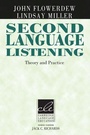
Second Language Listening
Theory and Practice
Published on 7. February 2005
Book
Hardback
238 pages
978-0-521-78135-0 (ISBN)
Description
Listening, an essential aspect of communicative competence, merits equal treatment with the skills of speaking, reading, and writing. Second Language Listening combines current theory in listening, a pedagogical model developed by the authors, and case studies presenting actual practice. Listening theory is exemplified throughout the book with a variety of tasks and activities. The authors also address testing and the role of technology in teaching listening. Teachers will benefit from the insights provided in this book, as will teacher educators and researchers. Second Language Listening will be of key interest for pre-service and in-service teachers who are involved in the teaching or the design of materials for listening.
More details
Language
English
Place of publication
Cambridge
United Kingdom
Target group
ELT/ESL
Dimensions
Height: 229 mm
Width: 152 mm
Thickness: 18 mm
Weight
441 gr
ISBN-13
978-0-521-78135-0 (9780521781350)
Copyright in bibliographic data and cover images is held by Nielsen Book Services Limited or by the publishers or by their respective licensors: all rights reserved.
Schweitzer Classification
Other editions
New editions
Book
02/2005
Cambridge University Press
€66.20
Article exhausted; check different version
Additional editions
E-Book
04/2009
1st Edition
Cambridge University Press
€19.99
Available for download
Book
02/2005
Cambridge University Press
€66.20
Article exhausted; check different version
Persons
Content
Part I. Historical Background: 1. Approaches to language teaching and the role of listening; 2. Models of listening; 3. Types of meaning for listening; 4. The nature of spoken language; 5. Learning styles and listening styles; Part II. A Pedagogical Model and Its Application: 6. A pedagogical model for second language listening; 7. Materials and the pedagogical model; 8. Case studies and their relation to the pedagogical model; 9. Developing listening skills through technology; 10. The role of questions in the teaching of listening; 11. Testing listening.