

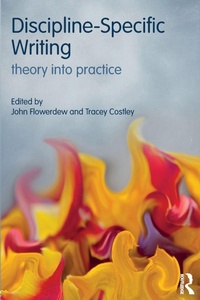
Discipline-Specific Writing
Theory into practice
1st Edition
Published on 30. September 2016
Book
Paperback/Softback
218 pages
978-1-138-90744-7 (ISBN)
Description
Discipline-Specific Writing provides an introduction and guide to the teaching of this topic for students and trainee teachers. This book highlights the importance of discipline-specific writing as a critical area of competence for students, and covers both the theory and practice of teaching this crucial topic. With chapters from practitioners and researchers working across a wide range of contexts around the world, Discipline-Specific Writing:
Explores teaching strategies in a variety of specific areas including science and technology, social science and business;
Discusses curriculum development, course design and assessment, providing a framework for the reader;
Analyses the teaching of language features including grammar and vocabulary for academic writing;
Demonstrates the use of genre analysis, annotated bibliographies and corpora as tools for teaching;
Provides practical suggestions for use in the classroom, questions for discussion and additional activities with each chapter.
Discipline-Specific Writing is key reading for students taking courses in English for Specific Purposes, Applied Linguistics, TESOL, TEFL and CELTA.
Explores teaching strategies in a variety of specific areas including science and technology, social science and business;
Discusses curriculum development, course design and assessment, providing a framework for the reader;
Analyses the teaching of language features including grammar and vocabulary for academic writing;
Demonstrates the use of genre analysis, annotated bibliographies and corpora as tools for teaching;
Provides practical suggestions for use in the classroom, questions for discussion and additional activities with each chapter.
Discipline-Specific Writing is key reading for students taking courses in English for Specific Purposes, Applied Linguistics, TESOL, TEFL and CELTA.
Reviews / Votes
"Flowerdew and Costley have brought together an outstanding group of authors for this volume. The chapters bring together theory and practice in a way that is both highly readable as well as extremely useful for teachers of discipline-specific writing. An excellent publication."Brian Paltridge, University of Sydney, Australia
"This book demonstrates the value of research-informed teaching. Research on disciplinary writing is extended into practical considerations for the teacher in the classroom. The multiple research perspectives, teaching strategies and pedagogic considerations raised in this book will make it an enormously useful resource for researchers and teachers."
Suganthi John, University of Birmingham, UK
More details
Language
English
Place of publication
London
United Kingdom
Publishing group
Taylor & Francis Ltd
Target group
ELT/ESL
Illustrations
6 s/w Photographien bzw. Rasterbilder, 6 s/w Zeichnungen, 20 s/w Tabellen
20 Tables, black and white; 6 Line drawings, black and white; 6 Halftones, black and white
Dimensions
Height: 234 mm
Width: 156 mm
Thickness: 13 mm
Weight
360 gr
ISBN-13
978-1-138-90744-7 (9781138907447)
Copyright in bibliographic data and cover images is held by Nielsen Book Services Limited or by the publishers or by their respective licensors: all rights reserved.
Schweitzer Classification
Other editions
Additional editions
Book
09/2016
1st Edition
Routledge
€241.80
Shipment within 10-20 days
E-Book
09/2016
Routledge
€73.49
Available for download
E-Book
09/2016
Routledge
€73.99
Available for download
Persons
John Flowerdew is Professor Emeritus at City University of Hong Kong and is now based in the UK, where he is a Visiting Professor at Lancaster University.
Tracey Costley is a Lecturer in the Department of English Language and Linguistics at the University of Essex, UK.
Tracey Costley is a Lecturer in the Department of English Language and Linguistics at the University of Essex, UK.
Content
1. Introduction
2. Investigating local sociocultural and institutional contexts for discipline-specific writing
3. Developing writing courses for specific academic purposes
4. The role of grammar in the discipline-specific writing curriculum
5. Approaches and perspectives on teaching vocabulary for discipline-specific academic writing
6. Using genre analysis to teach writing in the disciplines
7. Teaching writing for science and technology
8. Using annotated bibliographies to develop student writing in social sciences
9. Discipline-specific writing for business students: research, practice and pedagogy
10. Teaching English for Research Publication Purposes with a focus on genre, register, textual mentors and language re-use: a case study
11. Introducing corpora and corpus tools into the technical writing classroom through Data-Driven Learning (DDL)
12. Critical literacy writing in ESP: perspectives and approaches
13. Towards a specific writing language assessment at Hong Kong universities
2. Investigating local sociocultural and institutional contexts for discipline-specific writing
3. Developing writing courses for specific academic purposes
4. The role of grammar in the discipline-specific writing curriculum
5. Approaches and perspectives on teaching vocabulary for discipline-specific academic writing
6. Using genre analysis to teach writing in the disciplines
7. Teaching writing for science and technology
8. Using annotated bibliographies to develop student writing in social sciences
9. Discipline-specific writing for business students: research, practice and pedagogy
10. Teaching English for Research Publication Purposes with a focus on genre, register, textual mentors and language re-use: a case study
11. Introducing corpora and corpus tools into the technical writing classroom through Data-Driven Learning (DDL)
12. Critical literacy writing in ESP: perspectives and approaches
13. Towards a specific writing language assessment at Hong Kong universities