

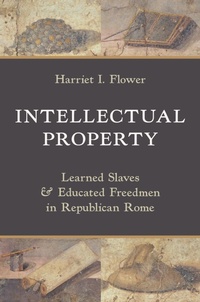
Intellectual Property
Learned Slaves and Educated Freedmen in Republican Rome
Published on 7. October 2025
Book
Hardback
264 pages
978-0-691-26616-9 (ISBN)
Description
The first in-depth account of the lives and careers of educated slaves and freedmen in ancient Rome
Slaves and freedmen played an important yet understudied role in the literary culture of the Roman Republic. Though their work went largely uncredited, they fulfilled vital roles as editors, researchers, and collaborators in the service of Rome's literary and political elite. Intellectual Property tells the stories of these gifted and highly educated young men, from Licinius the flute-player, who shaped the rhetorical style of the orator Gaius Gracchus, to the grammarian and teacher Tyrannio of Amisus, who was brought to Rome as a war captive.
Highlighting the unique social prestige of literary production and intellectual performance in a society pervaded by slave labor, Harriet Flower shows how the exorbitant prices paid for the highly educated encouraged a complex system of training young boys for the marketplace or acquiring educated captives as booty, and how they were treated as valuable assets to be deployed as prizes, gifts, or investments that could bestow financial and cultural capital. She demonstrates how enslaved and manumitted intellectuals, far from being menial workers, shared close relationships with leading Romans of the day. They came from a variety of backgrounds and were relied on as coauthors and collaborators in a range of genres, with some gaining fame as authors themselves.
With lively case studies and insightful new interpretations of the ancient sources, Intellectual Property paints a more nuanced picture of enslaved labor in ancient Rome, revealing how the contributions of enslaved intellectuals were closely linked to the ambitious development of Latin literary culture and the dissemination of knowledge.
Slaves and freedmen played an important yet understudied role in the literary culture of the Roman Republic. Though their work went largely uncredited, they fulfilled vital roles as editors, researchers, and collaborators in the service of Rome's literary and political elite. Intellectual Property tells the stories of these gifted and highly educated young men, from Licinius the flute-player, who shaped the rhetorical style of the orator Gaius Gracchus, to the grammarian and teacher Tyrannio of Amisus, who was brought to Rome as a war captive.
Highlighting the unique social prestige of literary production and intellectual performance in a society pervaded by slave labor, Harriet Flower shows how the exorbitant prices paid for the highly educated encouraged a complex system of training young boys for the marketplace or acquiring educated captives as booty, and how they were treated as valuable assets to be deployed as prizes, gifts, or investments that could bestow financial and cultural capital. She demonstrates how enslaved and manumitted intellectuals, far from being menial workers, shared close relationships with leading Romans of the day. They came from a variety of backgrounds and were relied on as coauthors and collaborators in a range of genres, with some gaining fame as authors themselves.
With lively case studies and insightful new interpretations of the ancient sources, Intellectual Property paints a more nuanced picture of enslaved labor in ancient Rome, revealing how the contributions of enslaved intellectuals were closely linked to the ambitious development of Latin literary culture and the dissemination of knowledge.
Reviews / Votes
"Flower's thematic arrangement of biographies is a readable and thought-provoking way to bring Rome's margins into plain view."---Signe Janoska-Bedi, Classical Journal "Compelling. . . . [Intellectual Property] is a highly readable, superbly documented collection of penetrating analyses, exploring a rarely investigated dimension of Roman literary culture: the realm of the servile knowledge worker. . . . Highly Recommended." * Choice *More details
Language
English
Place of publication
New Jersey
United States
Target group
College/higher education
Product notice
Trade binding
Illustrations
2 maps.
Dimensions
Height: 240 mm
Width: 161 mm
Thickness: 25 mm
Weight
544 gr
ISBN-13
978-0-691-26616-9 (9780691266169)
Copyright in bibliographic data and cover images is held by Nielsen Book Services Limited or by the publishers or by their respective licensors: all rights reserved.
Schweitzer Classification
Other editions
Additional editions
E-Book
10/2025
1st Edition
Princeton University Press
€39.49
Available for download
Person
Harriet I. Flower is the Andrew Fleming West Professor of Classics at Princeton University. Her many books include The Dancing Lares and the Serpent in the Garden: Religion at the Roman Street Corner and Roman Republics (both Princeton).