

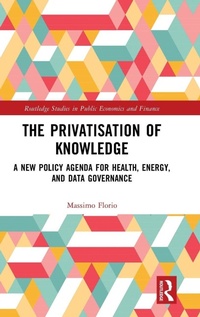
The Privatisation of Knowledge
A New Policy Agenda for Health, Energy, and Data Governance
1st Edition
Published on 14. September 2023
Book
Hardback
173 pages
978-1-032-46405-3 (ISBN)
Description
This book deals with the emergence of intellectual monopolies. It explores different ways of producing knowledge, thus showing alternatives to the current dominant paradigm which is based on turning knowledge produced collectively into intangible assets, owned by a few leading corporations. It discusses a paradox: knowledge creation by government-sponsored research infrastructures (RI) or by non-profit institutions, including universities, is increasingly appearing in the form of "open science" - ideas and data are widely available in the public domain. However, such knowledge is privatised downstream by new oligopolies. These oligopolies, such as the Tech Giants, are protected by legislation on intellectual property rights that restricts further access to knowledge. This process contributes to increasing social inequality.
The book suggests alternative policy options to counteract this process: the design of new players with a public mission and a coalition of governments as patient investors for the long-term benefit not just of the citizens of one jurisdiction but for creating global public goods. Proposals are presented for launching European R&D infrastructures related to three major long-term challenges: health risks, climate change and Big Data governance. These knowledge-intensive enterprises should offer innovation as a public good, for example in new biomedical fields underinvested by private firms, disruptive 'green' technologies, digital platforms based on transparent users' ownership of data.
Offering a balanced combination of theories and practical applications including interesting case studies, the book will appeal to students, scholars and researchers of public economics and governance. It will also find an audience among policymakers, practitioners and government officials.
The book suggests alternative policy options to counteract this process: the design of new players with a public mission and a coalition of governments as patient investors for the long-term benefit not just of the citizens of one jurisdiction but for creating global public goods. Proposals are presented for launching European R&D infrastructures related to three major long-term challenges: health risks, climate change and Big Data governance. These knowledge-intensive enterprises should offer innovation as a public good, for example in new biomedical fields underinvested by private firms, disruptive 'green' technologies, digital platforms based on transparent users' ownership of data.
Offering a balanced combination of theories and practical applications including interesting case studies, the book will appeal to students, scholars and researchers of public economics and governance. It will also find an audience among policymakers, practitioners and government officials.
More details
Series
Language
English
Place of publication
London
United Kingdom
Publishing group
Taylor & Francis Ltd
Target group
College/higher education
Postgraduate
Illustrations
1 s/w Tabelle
1 Tables, black and white
Dimensions
Height: 240 mm
Width: 161 mm
Thickness: 15 mm
Weight
452 gr
ISBN-13
978-1-032-46405-3 (9781032464053)
Copyright in bibliographic data and cover images is held by Nielsen Book Services Limited or by the publishers or by their respective licensors: all rights reserved.
Schweitzer Classification
Other editions
Additional editions
Massimo Florio
The Privatisation of Knowledge
A New Policy Agenda for Health, Energy, and Data Governance
Book
12/2024
1st Edition
Routledge
€60.90
Shipment within 10-20 days
Massimo Florio
The Privatisation of Knowledge
A New Policy Agenda for Health, Energy, and Data Governance
E-Book
09/2023
1st Edition
Routledge
€53.99
Available for download
Massimo Florio
The Privatisation of Knowledge
A New Policy Agenda for Health, Energy, and Data Governance
E-Book
09/2023
1st Edition
Routledge
€53.99
Available for download
Person
Massimo Florio is Professor of Public Economics at the University of Milan, Italy and co-Chair of the Jean Monnet Centre of Excellence on European research and innovation policy.
Content
List of Tables. Preface. Acknowledgements. Introduction: science and social justice. Knowledge as an intangible asset. Where is knowledge produced? Innovation and financialisation. The role of government. Science and gambling. Policy failures. A new policy agenda. Notes. The places of knowledge: from Big Science to research infrastructure. Big Science and the military?industrial complex. The "Geneva model" and its evolution. How university research is changing. How R&D is changing within firms. The social impact of research infrastructure. Science for scientists and the creation of human capital. Direct impact on businesses. Cultural impact and social attitudes towards science. Summing up. Notes. Science, inequality, and public policy. The channels of privatisation of knowledge. The new oligopoly and inequality. Corrective policies. Rethinking public enterprise. Internalisation of missions. Ownership and legal form. Governance. Funding. Notes. Biomed Europa: medicines that no one else will give us. Priorities. Industry. Governments. Lessons from the pandemic. A proposal. Social benefits and costs. Appendix: some proposals from the European Commission. Notes. Green Europa: science and technology for saving the planet. What's wrong with the planet? And why we don't know enough about the cure. The European Commission's strategy and its limitations. The role of cutting-edge research and innovation. The role of the European Union and a proposal. Appendix: The European Space Agency model. Notes. Digital Europa: how to get our data back. Introduction. A short history of bits. The digital oligopoly. Missed opportunities. European Commission initiatives and a new proposal. Appendix: Digital Markets Act and Digital Services Act. Appendix: the Fraunhofer model. Notes. Conclusion: what can be done? Note. Bibliography. Index.