

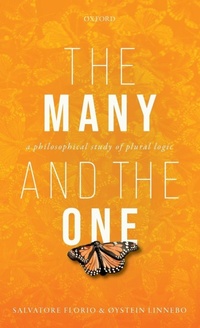
The Many and the One
A Philosophical Study of Plural Logic
Published on 22. July 2021
Book
Hardback
330 pages
978-0-19-879152-2 (ISBN)
Description
Plural expressions found in natural languages allow us to talk about many objects simultaneously. Plural logic -- a logical system that takes plurals at face value -- has seen a surge of interest in recent years. This book explores its broader significance for philosophy, logic, and linguistics. What can plural logic do for us? Are the bold claims made on its behalf correct? After introducing plural logic and its main applications, the book provides a systematic analysis of the relation between this logic and other theoretical frameworks such as set theory, mereology, higher-order logic, and modal logic. The applications of plural logic rely on two assumptions, namely that this logic is ontologically innocent and has great expressive power. These assumptions are shown to be problematic. The result is a more nuanced picture of plural logic's applications than has been given thus far. Questions about the correct logic of plurals play a central role in the final chapters, where traditional plural logic is rejected in favor of a "critical" alternative. The most striking feature of this alternative is that there is no universal plurality. This leads to a novel approach to the relation between the many and the one. In particular, critical plural logic paves the way for an account of sets capable of solving the set-theoretic paradoxes.
Reviews / Votes
The volume by Florio and Linnebo is a most welcome contribution, and I believe it will be valuable not only for philosophers of logic and philosophical logicians, but also for philosophers of mathematics who are interested in the possible applications of plural logic to logico-mathematical theories and the broadly philosophical issues that these applications give rise to. * Francesca Boccuni, Philosophia Mathematica *More details
Language
English
Place of publication
Oxford
United Kingdom
Target group
Professional and scholarly
Dimensions
Height: 222 mm
Width: 145 mm
Thickness: 21 mm
Weight
548 gr
ISBN-13
978-0-19-879152-2 (9780198791522)
Copyright in bibliographic data and cover images is held by Nielsen Book Services Limited or by the publishers or by their respective licensors: all rights reserved.
Schweitzer Classification
Other editions
Additional editions
E-Book
07/2021
1st Edition
OUP eBook
€0.00
Available for download
Persons
Salvatore Florio is a Senior Lecturer in Philosophy at the University of Birmingham. He specializes in philosophy of language, philosophical logic, and philosophy of mathematics. His published work, which focuses on questions about the nature of logic and the foundations of semantics, has appeared in journals such as Australasian Journal of Philosophy, Mind, Nous, Philosophers' Imprint, and Philosophy and Phenomenological Research. Since 2019 he has been an editor of The Review of Symbolic Logic.
Oystein Linnebo is Professor of Philosophy at the University of Oslo. His main research interests lie in the philosophies of logic and mathematics, metaphysics, and early analytic philosophy (especially Frege). A recipient of an ERC Starting Grant, he has published more than sixty scientific articles and is the author of Philosophy of Mathematics (Princeton University Press, 2017) and Thin Objects: An Abstractionist Account (Oxford University Press, 2018).
Oystein Linnebo is Professor of Philosophy at the University of Oslo. His main research interests lie in the philosophies of logic and mathematics, metaphysics, and early analytic philosophy (especially Frege). A recipient of an ERC Starting Grant, he has published more than sixty scientific articles and is the author of Philosophy of Mathematics (Princeton University Press, 2017) and Thin Objects: An Abstractionist Account (Oxford University Press, 2018).
Content
1: Introduction
I. Primitive Plurals
2: Taking Plurals At Face Value
3: The Refutation of Singularism?
II. Comparisons
4: Plurals and Set Theory
5: Plurals and Mereology
6: Plurals and Second-Order Logic
III. Plurals and Semantics
7: The Semantics of Plurals
8: On the Innocence and Determinacy of Plural Quantification
9: Superplurals
IV. The Logic and Metaphysics of Plurals
10: Plurals and Modals
11: Absolute Generality and Singularization
12: Critical Plural Logic
I. Primitive Plurals
2: Taking Plurals At Face Value
3: The Refutation of Singularism?
II. Comparisons
4: Plurals and Set Theory
5: Plurals and Mereology
6: Plurals and Second-Order Logic
III. Plurals and Semantics
7: The Semantics of Plurals
8: On the Innocence and Determinacy of Plural Quantification
9: Superplurals
IV. The Logic and Metaphysics of Plurals
10: Plurals and Modals
11: Absolute Generality and Singularization
12: Critical Plural Logic