

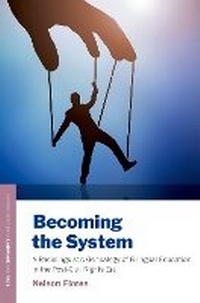
Becoming the System
A Raciolinguistic Genealogy of Bilingual Education in the Post-Civil Rights Era
Published on 1. September 2024
Book
Hardback
168 pages
978-0-19-751681-2 (ISBN)
Description
Bilingual education is usually framed as a tool of antiracism. In Becoming the System, author Nelson Flores challenges that framework by examining the ways that institutionalizing bilingual education in the post-Civil Rights Era in the United States has served to maintain rather than challenge racial hierarchies. He adopts a methodology that he terms raciolinguistic genealogy as a point of entry for arguing that the institutionalization of bilingual education was part of a broader reconfiguration of race in the postcolonial era. This reconfiguration located the root of racial inequities within a psychologically damaged racialized subject who, after having experienced multiple generations of racial oppression, had either from a liberal perspective developed a culture of poverty or a radical perspective developed colonized mindset that prevented racial progress. After examining the ways that this psychologically damaged racialized subject provided the ideological foundation for the Bilingual Education Act (BEA), Flores then examines how institutionalizing the BEA produced a cadre of Latinx professionals who were afforded contingent proximity to whiteness in exchange for their acceptance of deficit framings of Latinx communities.
He goes on to examine the ways that this institutionalization helped pave the way for neoliberal educational reforms that serve to maintain the racial status quo. This has culminated in the exponential growth of dual language education as a commodity for affluent monolingual white families even as the bilingualism of Latinx communities continue to be pathologized and policed. Flores concludes by implicating himself as a Latinx professional working in bilingual education in this political incorporation and posits the present volume as resistance to the commodification and weaponization of Latinx bilingualism.
He goes on to examine the ways that this institutionalization helped pave the way for neoliberal educational reforms that serve to maintain the racial status quo. This has culminated in the exponential growth of dual language education as a commodity for affluent monolingual white families even as the bilingualism of Latinx communities continue to be pathologized and policed. Flores concludes by implicating himself as a Latinx professional working in bilingual education in this political incorporation and posits the present volume as resistance to the commodification and weaponization of Latinx bilingualism.
More details
Series
Language
English
Place of publication
New York
United States
Target group
Professional and scholarly
Dimensions
Height: 235 mm
Width: 156 mm
Weight
830 gr
ISBN-13
978-0-19-751681-2 (9780197516812)
Copyright in bibliographic data and cover images is held by Nielsen Book Services Limited or by the publishers or by their respective licensors: all rights reserved.
Schweitzer Classification
Other editions
Additional editions
Nelson Flores
Becoming the System
A Raciolinguistic Genealogy of Bilingual Education in the Post-Civil Rights Era
Book
09/2024
Oxford University Press Inc
€30.50
Shipment within 15-20 days
Nelson Flores
Becoming the System
A Raciolinguistic Genealogy of Bilingual Education in the Post-Civil Rights Era
E-Book
07/2024
OUP eBook
€70.49
Available for download
Nelson Flores
Becoming the System
A Raciolinguistic Genealogy of Bilingual Education in the Post-Civil Rights Era
E-Book
07/2024
OUP eBook
€70.49
Available for download
Person
Nelson Flores is an associate professor in educational linguistics at the University of Pennsylvania. His research examines the intersection of language, race, and the political economy in shaping U.S. educational policies and practices. He has been the recipient of many academic awards including a 2017 Spencer Postdoctoral Fellowship, the 2019 James Alatis Prize for Research on Language Planning and Policy in Educational Contexts and the 2022 AERA Early Career Award.
Content
Chapter 1: One School's Journey through the Post-Civil Rights Era
Chapter 2: Raciolinguistic Genealogy as Method
Chapter 3: From Community Control to Neoliberalism
Chapter 4: Producing Deficiency and Erasing Colonialism in the Bilingual Education Act
Chapter 5: Accountable to Semilingualism
Chapter 6: The Bilingual Revolution Will Not Be Funded
Chapter 7: Becoming an Entrenched Bureaucracy
Chapter 8: Demanding Bilingual Choices, Receiving Bilingual Scraps
Chapter 9: Selling Bilingual Education, Inheriting Racial Inequality
Chapter 10: A Raciolinguistic Genealogy of the Self
Notes
Chapter 2: Raciolinguistic Genealogy as Method
Chapter 3: From Community Control to Neoliberalism
Chapter 4: Producing Deficiency and Erasing Colonialism in the Bilingual Education Act
Chapter 5: Accountable to Semilingualism
Chapter 6: The Bilingual Revolution Will Not Be Funded
Chapter 7: Becoming an Entrenched Bureaucracy
Chapter 8: Demanding Bilingual Choices, Receiving Bilingual Scraps
Chapter 9: Selling Bilingual Education, Inheriting Racial Inequality
Chapter 10: A Raciolinguistic Genealogy of the Self
Notes