

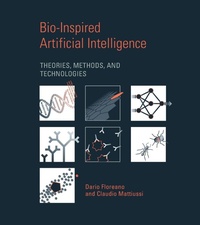
Bio-Inspired Artificial Intelligence
Theories, Methods, and Technologies
Published on 4. April 2023
Book
Paperback/Softback
674 pages
978-0-262-54773-4 (ISBN)
Description
A comprehensive introduction to new approaches in artificial intelligence and robotics that are inspired by self-organizing biological processes and structures.
New approaches to artificial intelligence spring from the idea that intelligence emerges as much from cells, bodies, and societies as it does from evolution, development, and learning. Traditionally, artificial intelligence has been concerned with reproducing the abilities of human brains; newer approaches take inspiration from a wider range of biological structures that that are capable of autonomous self-organization. Examples of these new approaches include evolutionary computation and evolutionary electronics, artificial neural networks, immune systems, biorobotics, and swarm intelligence—to mention only a few. This book offers a comprehensive introduction to the emerging field of biologically inspired artificial intelligence that can be used as an upper-level text or as a reference for researchers. Each chapter presents computational approaches inspired by a different biological system; each begins with background information about the biological system and then proceeds to develop computational models that make use of biological concepts. The chapters cover evolutionary computation and electronics; cellular systems; neural systems, including neuromorphic engineering; developmental systems; immune systems; behavioral systems—including several approaches to robotics, including behavior-based, bio-mimetic, epigenetic, and evolutionary robots; and collective systems, including swarm robotics as well as cooperative and competitive co-evolving systems. Chapters end with a concluding overview and suggested reading.
New approaches to artificial intelligence spring from the idea that intelligence emerges as much from cells, bodies, and societies as it does from evolution, development, and learning. Traditionally, artificial intelligence has been concerned with reproducing the abilities of human brains; newer approaches take inspiration from a wider range of biological structures that that are capable of autonomous self-organization. Examples of these new approaches include evolutionary computation and evolutionary electronics, artificial neural networks, immune systems, biorobotics, and swarm intelligence—to mention only a few. This book offers a comprehensive introduction to the emerging field of biologically inspired artificial intelligence that can be used as an upper-level text or as a reference for researchers. Each chapter presents computational approaches inspired by a different biological system; each begins with background information about the biological system and then proceeds to develop computational models that make use of biological concepts. The chapters cover evolutionary computation and electronics; cellular systems; neural systems, including neuromorphic engineering; developmental systems; immune systems; behavioral systems—including several approaches to robotics, including behavior-based, bio-mimetic, epigenetic, and evolutionary robots; and collective systems, including swarm robotics as well as cooperative and competitive co-evolving systems. Chapters end with a concluding overview and suggested reading.
More details
Series
Language
English
Place of publication
Cambridge (Massachusetts)
United States
Publishing group
MIT Press Ltd
Target group
College/higher education
Interest Age: From 18 years
Product notice
Paperback (trade)
Illustrations
130 ILLUS.
Dimensions
Height: 229 mm
Width: 203 mm
Thickness: 36 mm
Weight
1281 gr
ISBN-13
978-0-262-54773-4 (9780262547734)
Copyright in bibliographic data and cover images is held by Nielsen Book Services Limited or by the publishers or by their respective licensors: all rights reserved.
Schweitzer Classification
Other editions
Additional editions
Dario Floreano | Claudio Mattiussi
Bio-Inspired Artificial Intelligence
Theories, Methods, and Technologies
E-Book
08/2008
MIT Press
€78.49
Available for download
Persons
Dario Floreano is Director of the Laboratory of Intelligent Systems at the Swiss Federal Institute of Technology Lausanne (EPFL). He is the coauthor of Evolutionary Robotics and Bio-Inspired Artificial Intelligence (both published by the MIT Press).
Claudio Mattiussi is an independent researcher. His research interests include computational intelligence, probabilistic engineering, and the consistent numerical formulation of physical field problems.
Claudio Mattiussi is an independent researcher. His research interests include computational intelligence, probabilistic engineering, and the consistent numerical formulation of physical field problems.
Content
Preface xi
Acknowledgments xiii
1 Evolutionary Systems 1
2 Cellular Systems 101
3 Neural Systems 163
4 Developmental Systems 269
5 Immune Systems 335
6 Behavioral Systems 399
7 Collective Systems 515
Conclusion 585
References 587
Index 651
Acknowledgments xiii
1 Evolutionary Systems 1
2 Cellular Systems 101
3 Neural Systems 163
4 Developmental Systems 269
5 Immune Systems 335
6 Behavioral Systems 399
7 Collective Systems 515
Conclusion 585
References 587
Index 651