

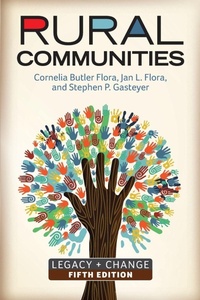
Rural Communities
Legacy + Change
5th Edition
Published on 4. August 2015
Book
Paperback/Softback
504 pages
978-0-8133-4971-8 (ISBN)
Description
Communities in rural America are a complex mixture of peoples and cultures, ranging from miners who have been laid off in West Virginia, to Laotian immigrants relocating in Kansas to work at a beef processing plant, to entrepreneurs drawing up plans for a world-class ski resort in California's Sierra Nevada. Rural Communities: Legacy and Change uses its unique Community Capitals framework to examine how America's diverse rural communities use their various capitals (natural, cultural, human, social, political, financial, and built) to address the modern challenges that face them.
Each chapter opens with a case study of a community facing a particular challenge, and is followed by a comprehensive discussion of sociological concepts to be applied to understanding the case. This narrative, topical approach makes the book accessible and engaging for undergraduate students, while its integrative approach provides them with a framework for understanding rural society based on the concepts and explanations of social science.
This fifth edition is updated throughout with 2013 census data and features new and expanded coverage of health and health care, food systems and alternatives, the effects of neoliberalism and globalization on rural communities, as well as an expanded resource and activity section at the end of each chapter.
Each chapter opens with a case study of a community facing a particular challenge, and is followed by a comprehensive discussion of sociological concepts to be applied to understanding the case. This narrative, topical approach makes the book accessible and engaging for undergraduate students, while its integrative approach provides them with a framework for understanding rural society based on the concepts and explanations of social science.
This fifth edition is updated throughout with 2013 census data and features new and expanded coverage of health and health care, food systems and alternatives, the effects of neoliberalism and globalization on rural communities, as well as an expanded resource and activity section at the end of each chapter.
Reviews / Votes
"I have used this book since the first edition came out. The key strength of that edition and each edition that followed has been the conceptual framework of community capitals that helps students understand the connectivity between social, cultural, economic, and political issues and how they relate to the built and natural environments. This framework allows students to comprehend the complexity of community and to identify strengths and weaknesses in their own communities that can be used in promoting purposeful and positive change." --Conner Bailey, Auburn University "Rural Communities is the most complete textbook that I know of for the social science approach to understanding communities. The Floras are successful in combining basic concepts and theories of community with practical examples that students and professionals can use for their work and in their own communities. The book challenges students to take a critical look at communities, including underlying processes and structures that exist in all communities." --Richard Maurer, University of Kentucky "Rural Communities: Legacy and Change is a well-organized, highly readable text introducing students to rural sociology. The use of personal vignettes to illustrate key concepts and the theoretical Community Capitals Framework to facilitate discussion of critical components of rural communities help students come to understand the dynamics of stability and change in those communities." --Liza Kuecker, Western New Mexico University "...a cogent overview of the theory, issues, and applications that drive current-day rural studies. The book is very readable, and provides adequate, thorough coverage. If [undergraduate students] engage the material they will find a wealth of stories and case studies that illustrate and highlight the issues facing rural communities today." --Ben Amsden, Plymouth State University "The Floras have provided creative and useful sociological analysis of rural populations and rural living which is deeply and convincingly argued." --Kathryn Hovey, New Mexico State University Praise for the Previous Editions: "This text contributes to pedagogical effectiveness, student learning and empowered community practice. The text is well written, clearly organized, engaging, insightful and readable for a wide range of audiences." --Teaching SociologyMore details
Edition
5th edition
Language
English
Place of publication
Oxford
United States
Publishing group
Taylor & Francis Inc
Target group
College/higher education
Dimensions
Height: 229 mm
Width: 152 mm
Thickness: 28 mm
Weight
725 gr
ISBN-13
978-0-8133-4971-8 (9780813349718)
Copyright in bibliographic data and cover images is held by Nielsen Book Services Limited or by the publishers or by their respective licensors: all rights reserved.
Schweitzer Classification
Other editions
Additional editions
Book
07/2019
5th Edition
Routledge
€208.20
Shipment within 15-20 days
E-Book
03/2018
5th Edition
Routledge
€80.49
Available for download
E-Book
03/2018
5th Edition
Routledge
€80.49
Available for download
Previous edition

Book
07/2012
4th Edition
Westview Press Inc
€57.19
Article exhausted; check for reprint
Persons
Cornelia Butler Flora is Charles F. Curtis Distinguished Professor of Sociology and Agriculture and Life Sciences at at Iowa State University.Jan L. Flora is professor in the Department of Sociology at Iowa State University.Stephen P. Gasteyer is assistant professor in the Department of Sociology at Michigan State University.
Content
Preface -- Introduction -- Community Capitals and the Rural Landscape -- Components of Rural Communities: The Community Capitals -- Natural Capital -- Cultural Capital -- Human Capital -- Social Capital and Community -- Political Capital -- Financial Capital -- Built Capital -- Community Capitals and Community Development in a Changing World -- The Global Economy -- Consumption in Rural America -- Governance -- Generating Community Change