

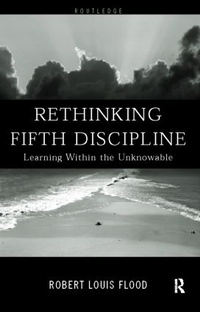
Rethinking the Fifth Discipline
Learning Within the Unknowable
1st Edition
Published on 22. July 1999
Book
Hardback
230 pages
978-0-415-18529-5 (ISBN)
Description
'Fifth Discipline' is one of the very few approaches to management that has attained position on the International Hall of Fame. Professor Flood's book explains and critiques the ideas in straight forward terms. This book makes significant and fundamental improvements to the core discipline - systemic thinking. It establishes crucial developments in systemic thinking in the context of the learning organisation, including creativity and organisational transformation. It is therefore a very important text for strategic planners, organisational change agents and consultants.
The main features of the book include:
* a review and critique of 'Fifth Discipline' and systemic thinking
* an introduction to the gurus of systemic thinking - Senge, Bertalanffy, Beer, Ackoff, Checkland, and Churchman
*a redefinition of management through systemic thinking
*a guide to choosing, implementing and evaluating improvement strategies
*Practical illustrations.
Robert Flood is a renowned and authoritative expert in the field of management. He has implemented systemic management in a wide range of organisations in many continents and lectured by invitation in 25 countries, including Japan and the USA. Professor Flood has featured on many radio and TV programs. His book Beyond TQM was nominated for the 'IMC Management Book of the Year 1993'.
The main features of the book include:
* a review and critique of 'Fifth Discipline' and systemic thinking
* an introduction to the gurus of systemic thinking - Senge, Bertalanffy, Beer, Ackoff, Checkland, and Churchman
*a redefinition of management through systemic thinking
*a guide to choosing, implementing and evaluating improvement strategies
*Practical illustrations.
Robert Flood is a renowned and authoritative expert in the field of management. He has implemented systemic management in a wide range of organisations in many continents and lectured by invitation in 25 countries, including Japan and the USA. Professor Flood has featured on many radio and TV programs. His book Beyond TQM was nominated for the 'IMC Management Book of the Year 1993'.
Reviews / Votes
'An important book, deserves to be read widely' Jennifer Wilby, Systemic Practice and Action ResearchMore details
Language
English
Place of publication
London
United Kingdom
Publishing group
Taylor & Francis Ltd
Target group
College/higher education
Professional and scholarly
Illustrations
4 s/w Tabellen
4 Tables, black and white
Dimensions
Height: 234 mm
Width: 156 mm
Weight
590 gr
ISBN-13
978-0-415-18529-5 (9780415185295)
Copyright in bibliographic data and cover images is held by Nielsen Book Services Limited or by the publishers or by their respective licensors: all rights reserved.
Schweitzer Classification
Other editions
Additional editions
E-Book
01/2002
1st Edition
Routledge
€72.49
Available for download
E-Book
01/2002
1st Edition
Routledge
€72.49
Available for download
Book
07/1999
1st Edition
Routledge
€84.36
Shipment within 15-20 days
Person
Robert Louis Flood is a renowned and authoritative expert in the field of management. He has implemented systemic management in a wide range of organisations in many continents and lectured by invitation in twenty-five countries, including Japan and the USA. Professor Flood has featured on a number of radio and TV programmes. His book Beyond TQM (Wiley) was nominated for the 1993 MCA Management Book of the Year.
Content
Chapter 1 Introduction; Part I Part I; Chapter 2 Senge's The Fifth Discipline; Chapter 3 Bertalanffy's open systems theory; Chapter 4 Beer's organisational cybernetics; Chapter 5 Ackoff's interactive planning; Chapter 6 Checkland's soft systems approach; Chapter 7 Churchman's critical systemic thinking; Chapter 8 Senge's The Fifth Discipline revisited; Part II Concepts; Chapter 9 Towards systemic thinking; Chapter 10 The demise of problems, solutions and normal organisational life; Chapter 11 Getting to grips with complexity; Chapter 12 Deepening systemic appreciation; Chapter 13 Window 1; Chapter 14 Window 2; Chapter 15 Window 3; Chapter 16 Window 4; Chapter 17 Prismatic thought; Part 3 Approach; Chapter 18 Organisational learning and transformation; Chapter 19 Systemic evaluation; Chapter 20 Instrumental and experiential action; Part 4 Practical animation; Chapter 21 Local Area Policing (LAP) in York, UK; Chapter 22 Reflections and key insights of systemic thinking;