

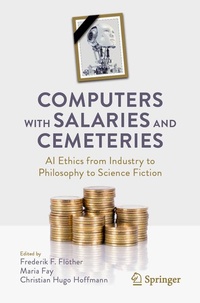
Computers with Salaries and Cemeteries
Description
What does it mean to compete against machines-can it still be called sport? Would you trust AI to manage your finances? Can AI follow Buddhist teachings? And what does the history of robot fiction reveal about our current ethical challenges? At a time when AI systems increasingly shape our work and personal decisions, engaging with such questions is no longer optional. This book explores the evolving landscape of AI ethics through the insights of 30 practitioners and academics from around the world. It offers a multidisciplinary lens by incorporating real-world applications, philosophical viewpoints, and imaginative interpretations from science fiction and art.
The editors have worked closely with organizations addressing both the opportunities and risks created by AI, quantum, and other emerging technologies. Contributors to the book come from a wide range of leading international institutions, including the United Nations, ABB, Julius Baer, Nestlé, NTT DATA, Stellenbosch University, and the University of Oxford. Bringing together experience from industry, entrepreneurship, and science, these diverse perspectives ensure the book is grounded in both practical and theoretical understanding.
More details
Persons
Dr. Frederik F. Flöther is Chief Quantum Officer at QuantumBasel and a member of the University of Basel Center for Quantum Computing and Quantum Coherence (QC2). Frederik previously held roles at IBM and was responsible for healthcare and life sciences at IBM Quantum. He was also elected to the IBM Academy of Technology and appointed Master Inventor and Qiskit Advocate. Frederik's research interests include technological applications as well as philosophical and societal implications of quantum computing and AI. He holds a PhD in physics with a focus on photonic quantum computing from the University of Cambridge as well as a professional certificate in quantum computing applications from the Massachusetts Institute of Technology. Frederik has authored over 50 filed patents, peer-reviewed publications, book chapters, and white papers.
Dr. Maria Fay is AI Lead at SAP Switzerland AG and Guest Researcher at the European Research Center for Information Systems / University of Münster. With over a decade of global experience in business and technology consulting, Maria has been advising organizations on the adoption of emerging technologies, most recently focusing on AI. She holds degrees in business economics, informatics, and sustainability, and earned her PhD researching how big data analytics creates business value. Maria has lectured on digital business models and serves on multiple advisory boards. She is also a podcast host on sustainability topics, an active mentor, and a passionate advocate for ethical and inclusive innovation.
Dr. Christian Hugo Hoffmann is an AI entrepreneur. He holds a PhD in finance from the University of St. Gallen. His first company, based on his doctoral project, was dedicated to a risk management solution using AI. Specifically, it integrated non-classical approaches of formal epistemology such as Wolfgang Spohn's ranking theory or fuzzy logic for medium-sized and smaller banks. Since then, Christian has worked in executive positions in Switzerland and has co-founded companies in Germany, Switzerland, and Malawi. His current enterprises include the real estate company House of Lab Science, and he also serves as head of the AI Startup Center in Zurich. He actively advocates more AI responsibility in his writings, speeches, and practical entrepreneurship.
Content
Part I: Introduction .- Chapter 1: Governing AI in sport: playing against algorithms?.- Chapter 2: Navigating Ethical AI Challenges in the Industrial Sector: Balancing Innovation and Responsibility.- Chapter 3: Moments of truth: the indispensable human touch in private banking in the age of AI.- Part II: AI ethics in industry .- Chapter 4: Responsible AI deployment to employees, customers, and consumers in the consumer packaged goods industry.- Chapter 5: A Roadmap to Successful AI Adoption: A Responsible Approach.- Chapter 6: GenAI, Art, and Creativity.- Part III: AI ethics in philosophy .- Chapter 7: AI's Energy Appetite - Challenges and Opportunities Ahead and Ethical Implications.- Chapter 8: Artificial Intelligence and Human Rights.- Chapter 9: The Ethical Implications of AI in Human Longevity.- Part IV: AI ethics in science fiction .- Chapter 10: Contemporary Perspectives on AI and Neurocomputational Ethics.- Chapter 11: Functionalism in AI consciousness: ethical reflections on the relevance of the biological body.- Chapter 12: The Convergence of Fundamental Physics, Neurotechnology, Artificial Intelligence (AI), and Consciousness: The Safe and Responsible AI Perspective.- Chapter 13: A Teleological Ethics for AI.- Chapter 14: The social construction of artificial intelligence - how narratives and discourse shape technology.- Chapter 15: From Ethics to Cosm-Ethics: How the Narrative Shapes Reflections on Ethics Applied to Artificial Intelligence Systems.- Chapter 16: What Good is Superintelligent AI?.- Chapter 17: Algorithmic Resurrection: Ethical Dilemmas in the Digital Resurrection of Historical Figures.- Chapter 18: The AI Monoculture: Preserving Human Diversity in the Age of Artificial Intelligence.- Chapter 19: From Prometheus to AI: Shaping Humanity's Future.- Chapter 20: From metallic slaves to humanoid AIs: Robot imaginary evolves through science fiction.- Chapter 21: In algorithms we trust: when AI becomes God.- Chapter 22: Giving AI a voice.