

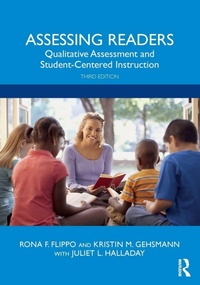
Assessing Readers
Qualitative Assessment and Student-Centered Instruction
3rd Edition
Published on 29. June 2021
Book
Paperback/Softback
312 pages
978-1-138-04938-3 (ISBN)
Description
The third edition of Assessing Readers continues to bridge the gap between authentic, informal, and formative assessments and more traditional quantitative and summative assessment approaches. Designed to assist educators and reading specialists in making informed decisions about not only what to assess, but also how, it provides teachers with a menu of qualitative assessment options, encouraging them to consider their own values and beliefs in light of the goals they have for the students they teach. Building on nearly four decades of theory, research, and practice, it is up to date with current research and offers specific assessment, instruction, and organizational ideas and strategies.
With an emphasis on comprehension, motivation and engagement, and developing strategic knowledge, Assessing Readers offers a road map for teachers trying to meet the demands of increasingly rigorous standards. Features include examples of student-centered assessment, ideas for organizing and managing differentiated instruction, sample lesson plans, and authentic case studies.
Accessible and practical, the third edition empowers pre-service and in-service teachers alike, encouraging them to think about the importance of their assessment and instructional choices and supporting them with the tools they need to achieve their goals and meet the needs of all students.
Changes in the Third Edition:
A new focus on literacy development and developmentally responsive instruction
Expanded coverage of emergent literacy and the assessment of foundational skills, including concepts about print, storybook reading, phonological and phonemic awareness, alphabet knowledge, and concept of word in text
A new section on assessing vocabulary and morphological knowledge
Expanded coverage of response to instruction/intervention (RTI)
New information on assessment and instruction of culturally and linguistically diverse students
Increased attention to issues of social justice, educational equity, and anti-bias practices
With an emphasis on comprehension, motivation and engagement, and developing strategic knowledge, Assessing Readers offers a road map for teachers trying to meet the demands of increasingly rigorous standards. Features include examples of student-centered assessment, ideas for organizing and managing differentiated instruction, sample lesson plans, and authentic case studies.
Accessible and practical, the third edition empowers pre-service and in-service teachers alike, encouraging them to think about the importance of their assessment and instructional choices and supporting them with the tools they need to achieve their goals and meet the needs of all students.
Changes in the Third Edition:
A new focus on literacy development and developmentally responsive instruction
Expanded coverage of emergent literacy and the assessment of foundational skills, including concepts about print, storybook reading, phonological and phonemic awareness, alphabet knowledge, and concept of word in text
A new section on assessing vocabulary and morphological knowledge
Expanded coverage of response to instruction/intervention (RTI)
New information on assessment and instruction of culturally and linguistically diverse students
Increased attention to issues of social justice, educational equity, and anti-bias practices
More details
Edition
3rd edition
Language
English
Place of publication
London
United Kingdom
Publishing group
Taylor & Francis Ltd
Target group
College/higher education
Postgraduate and Undergraduate
Illustrations
49 s/w Abbildungen, 49 s/w Zeichnungen
49 Line drawings, black and white; 49 Illustrations, black and white
Dimensions
Height: 254 mm
Width: 178 mm
Thickness: 18 mm
Weight
637 gr
ISBN-13
978-1-138-04938-3 (9781138049383)
Copyright in bibliographic data and cover images is held by Nielsen Book Services Limited or by the publishers or by their respective licensors: all rights reserved.
Schweitzer Classification
Other editions
Additional editions
Rona F. Flippo | Kristin M. Gehsmann | Juliet L. Halladay
Assessing Readers
Qualitative Assessment and Student-Centered Instruction
Book
06/2021
3rd Edition
Routledge
€206.40
Shipment within 10-20 days
Rona F. Flippo | Kristin M. Gehsmann | Juliet L. Halladay
Assessing Readers
Qualitative Assessment and Student-Centered Instruction
E-Book
06/2021
3rd Edition
Routledge
€69.99
Available for download
Rona F. Flippo | Kristin M. Gehsmann | Juliet L. Halladay
Assessing Readers
Qualitative Assessment and Student-Centered Instruction
E-Book
06/2021
3rd Edition
Routledge
€69.99
Available for download
Persons
Rona F. Flippo is Professor of Education in the Department of Curriculum and Instruction at the University of Massachusetts Boston, USA.
Kristin M. Gehsmann is Professor of Literacy Studies and Director of the School of Education at Virginia Tech, USA.
Juliet L. Halladay is Associate Professor in the Department of Education at the University of Vermont, USA.
Kristin M. Gehsmann is Professor of Literacy Studies and Director of the School of Education at Virginia Tech, USA.
Juliet L. Halladay is Associate Professor in the Department of Education at the University of Vermont, USA.
Content
Preface
Acknowledgements
Meet the Authors
Part One: Student-Centered Assessment
Chapter 1: The Classroom Teacher's Role
Chapter 2: Understanding Standardized Tests and Quantitative Assessment Data
Chapter 3: Assessing Early Literacy, Developmental Spelling, Fluency, and Linguistic
Knowledge
Chapter 4: Assessing Comprehension, Cognitive Strategies, Vocabulary Knowledge, and the
Affective Dimensions of Reading
Part Two: Organization and Instruction in the Classroom
Chapter 5: Organizing, Analyzing, and Using Assessment Data
Chapter 6: Organizing Classrooms and Groups for Literacy Instruction
Chapter 7: Assessment, Instruction, and Learning in the Classroom
Appendix A: Portfolio Assessment Templates
Appendix B: Sample Teacher-Developed Assessments
Appendix C: Sample Teacher-Developed Lesson Plans
Glossary
References: Professional References and Suggested Readings
References: Children's Literature References
Index
Acknowledgements
Meet the Authors
Part One: Student-Centered Assessment
Chapter 1: The Classroom Teacher's Role
Chapter 2: Understanding Standardized Tests and Quantitative Assessment Data
Chapter 3: Assessing Early Literacy, Developmental Spelling, Fluency, and Linguistic
Knowledge
Chapter 4: Assessing Comprehension, Cognitive Strategies, Vocabulary Knowledge, and the
Affective Dimensions of Reading
Part Two: Organization and Instruction in the Classroom
Chapter 5: Organizing, Analyzing, and Using Assessment Data
Chapter 6: Organizing Classrooms and Groups for Literacy Instruction
Chapter 7: Assessment, Instruction, and Learning in the Classroom
Appendix A: Portfolio Assessment Templates
Appendix B: Sample Teacher-Developed Assessments
Appendix C: Sample Teacher-Developed Lesson Plans
Glossary
References: Professional References and Suggested Readings
References: Children's Literature References
Index