

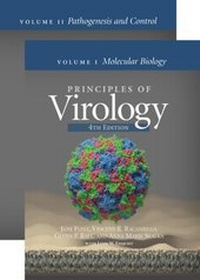
Principles of Virology. 2 Vol set
2 Vol set - Bundle
4th Edition
Published on 1. August 2015
Book
Paperback/Softback
1011 pages
978-1-55581-951-4 (ISBN)
Description
Principles of Virology is the leading virology textbook because it does more than collect and present facts about individual viruses. Instead, it facilitates an understanding of basic virology by examining the shared processes and capabilities of viruses. Using a set of representative viruses to present the complexity and diversity of a myriad of viruses, this rational approach enables students to understand how reproduction is accomplished by known viruses and provides the tools for future encounters with new or understudied viruses.
This fully updated edition represents the rapidly changing field of virology. A major new feature is the inclusion of 26 video interviews with leading scientists who have made significant contributions to the field of virology.
This fully updated edition represents the rapidly changing field of virology. A major new feature is the inclusion of 26 video interviews with leading scientists who have made significant contributions to the field of virology.
Reviews / Votes
"Principles of Virology is an extremely valuable and highly informative textbook that describes virology at the interface of modern cell biology. Instead of teaching virus groups individually, the authors elegantly compile the molecular and cell biological aspects that orchestrate virus replication in general and how infections with these pathogens cause cell damage and diseases. As a teacher of Master students in Biosciences and in human medicine, I highly recommend this textbook." Ralf Bartenschlager, Department Head and Professor, Molecular Virology, University of HeidelbergMore details
Series
Edition
4th edition. Revised
Language
English
Place of publication
Washington DC
United States
Target group
College/higher education
Edition type
New edition
Dimensions
Height: 274 mm
Width: 214 mm
Thickness: 45 mm
Weight
666 gr
ISBN-13
978-1-55581-951-4 (9781555819514)
Schweitzer Classification
Other editions
New editions

Book
10/2020
5th Edition
American Society for Microbiology
€168.50
Shipment within 3-4 weeks
Additional editions
Book
approx. 09/2015
4th Edition
Science Publishers,U.S.
€163.42
Not yet published
Persons
Jane Flint is a Professor of Molecular Biology at Princeton University. Dr. Flint's research focuses on investigation of the molecular mechanisms by which gene products of adenoviruses modulate host cell pathways and anti-viral defenses to allow efficient reproduction in normal human cells. Vincent Racaniello is Higgins Professor of Microbiology & Immunology at Columbia University Medical Center. Dr. Racaniello has been studying viruses for over 35 years, including poliovirus, rhinovirus, enteroviruses, and hepatitis C virus. Dr. Racaniello blogs about viruses at virology.ws and is host of the popular science program This Week in Virology.
Content
Volume I Molecular Biology
Part I The Science of Virology
1 Foundations
2 The Infectious Cycle
Part II Molecular Biology
3 Genomes and Genetics
4 Structure
5 Attachment and Entry
6 Synthesis of RNA from RNA Templates
7 Reverse Transcription and Integration
8 Synthesis of RNA from DNA Templates
9 Replication of DNA Genomes
10 Processing of Viral Pre-mRNA
11 Protein Synthesis
12 Intracellular Trafficking
13 Assembly, Exit, and Maturation
14 The Infected Cell
Appendix Structure, genome organization, and infectious cycles
Glossary
Index
Volume II Pathogenesis and Control
1 Infections of Populations: History and Epidemiology
2 Barriers to Infection
3 The Early Host Response: Cell-Autonomous and Innate Immunity
4 Adaptive Immunity and the Establishment of Memory
5 Mechanisms of Pathogenesis
6 Cellular Transformation and Oncogenesis
7 Human Immunodeficiency Virus Pathogenesis
8 Vaccines
9 Antiviral Drugs
10 Evolution
11 Emergence
12 Unusual Infectious Agents
Appendix Diseases, Epidemiology, and Disease Mechanisms of Selected Animal Viruses Discussed in This Book
Glossary
Index
Part I The Science of Virology
1 Foundations
2 The Infectious Cycle
Part II Molecular Biology
3 Genomes and Genetics
4 Structure
5 Attachment and Entry
6 Synthesis of RNA from RNA Templates
7 Reverse Transcription and Integration
8 Synthesis of RNA from DNA Templates
9 Replication of DNA Genomes
10 Processing of Viral Pre-mRNA
11 Protein Synthesis
12 Intracellular Trafficking
13 Assembly, Exit, and Maturation
14 The Infected Cell
Appendix Structure, genome organization, and infectious cycles
Glossary
Index
Volume II Pathogenesis and Control
1 Infections of Populations: History and Epidemiology
2 Barriers to Infection
3 The Early Host Response: Cell-Autonomous and Innate Immunity
4 Adaptive Immunity and the Establishment of Memory
5 Mechanisms of Pathogenesis
6 Cellular Transformation and Oncogenesis
7 Human Immunodeficiency Virus Pathogenesis
8 Vaccines
9 Antiviral Drugs
10 Evolution
11 Emergence
12 Unusual Infectious Agents
Appendix Diseases, Epidemiology, and Disease Mechanisms of Selected Animal Viruses Discussed in This Book
Glossary
Index