

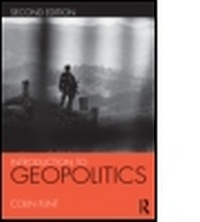
Introduction to Geopolitics
2nd Edition
Published on 20. December 2011
Book
Paperback/Softback
298 pages
978-0-415-66773-9 (ISBN)
Description
This clear and concise introductory textbook guides students through their first engagement with geopolitics. It offers a clear framework for understanding contemporary conflicts by showing how geography provides opportunities and limits upon the actions of countries, national groups, and terrorist organizations.
This second edition is fundamentally restructured to emphasize geopolitical agency, and non-state actors. The text is fully revised, containing a brand new chapter on environmental geopolitics, which includes discussion of climate change and resource conflicts. The text contains updated case studies, such as the Korean conflict, Israel-Palestine and Chechnya and Kashmir, to emphasize the multi-faceted nature of conflict. These, along with guided exercises, help explain contemporary global power struggles, environmental geopolitics, the global military actions of the United States, the persistence of nationalist conflicts, the changing role of borders, and the new geopolitics of terrorism, and peace movements. Throughout, the readers are introduced to different theoretical perspectives, including feminist contributions, as both the practice and representation of geopolitics are discussed.
Introduction to Geopolitics is an ideal introductory text which provides a deeper and critical understanding of current affairs, geopolitical structures and agents. The text is extensively illustrated with diagrams, maps, photographs and end of chapter further reading. Both students and general readers alike will find this book an essential stepping-stone to understanding contemporary conflicts.
This second edition is fundamentally restructured to emphasize geopolitical agency, and non-state actors. The text is fully revised, containing a brand new chapter on environmental geopolitics, which includes discussion of climate change and resource conflicts. The text contains updated case studies, such as the Korean conflict, Israel-Palestine and Chechnya and Kashmir, to emphasize the multi-faceted nature of conflict. These, along with guided exercises, help explain contemporary global power struggles, environmental geopolitics, the global military actions of the United States, the persistence of nationalist conflicts, the changing role of borders, and the new geopolitics of terrorism, and peace movements. Throughout, the readers are introduced to different theoretical perspectives, including feminist contributions, as both the practice and representation of geopolitics are discussed.
Introduction to Geopolitics is an ideal introductory text which provides a deeper and critical understanding of current affairs, geopolitical structures and agents. The text is extensively illustrated with diagrams, maps, photographs and end of chapter further reading. Both students and general readers alike will find this book an essential stepping-stone to understanding contemporary conflicts.
Reviews / Votes
"In the face of rapidly shifting international alignments and new sources of conflict, geopolitics has never been more relevant. Yet the term is vague and its varying meanings little understood. Flint's book steps into this void, offering a wide-ranging, thought-provoking, and accessible overview of the subject. The book is conceptually grounded, but rooted in a rich array of well explained real-world examples. Flint has written are remarkably lucid, insightful introduction to a key concept of our day." Alexander B. Murphy, University of Oregon"Flint situates geopolitics within wider debates in contemporary human geography to provide a vibrant account illustrated throughout with accessible and thought-provoking examples." Dr Joanne Sharp, University of Glasgow
More details
Edition
2nd New edition
Language
English
Place of publication
London
United Kingdom
Publishing group
Taylor & Francis Ltd
Target group
College/higher education
Edition type
New edition
Illustrations
11 s/w Tabellen, 5 s/w Photographien bzw. Rasterbilder, 44 s/w Zeichnungen
44 Line drawings, black and white; 5 Halftones, black and white; 11 Tables, black and white
Dimensions
Height: 246 mm
Width: 171 mm
Weight
635 gr
ISBN-13
978-0-415-66773-9 (9780415667739)
Copyright in bibliographic data and cover images is held by Nielsen Book Services Limited or by the publishers or by their respective licensors: all rights reserved.
Schweitzer Classification
Other editions
New editions
Colin Flint
Introduction to Geopolitics
Book
10/2016
3rd Edition
Routledge
€73.22
Article exhausted; check for reprint
Additional editions
Colin Flint
Introduction to Geopolitics
Book
12/2011
2nd Edition
Routledge
€141.13
Article exhausted; check for reprint
Previous edition

Colin Flint
Introduction to Geopolitics
Book
06/2006
Routledge
€58.37
Article exhausted; check for reprint
Person
Colin Flint is a Professor of Geography at the University of Illinois at Urbana-Champaign, USA.
Content
Prologue 1. A Framework for Understanding Geopolitics 2. Geopolitical Agency: The Concept of Geopolitical Codes 3. Justifying Geopolitical Agency: Representing Geopolitical Codes 4. Embedding Geopolitics Within National Identity 5. Territorial Geopolitics: Shaky Foundations of the World Political Map? 6. Network Geopolitics: Social Movements and Terrorists 7. Global Geopolitical Structure: Framing Agency 8. Environmental Geopolitics: Security and Sustainability 9. Messy Geopolitics: Agency and Multiple Structures