

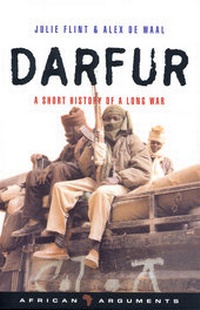
Darfur
A Short History of a Long War
Published on 30. September 2005
Book
Paperback/Softback
176 pages
978-1-84277-697-1 (ISBN)
Description
Sudan's westernmost region, Darfur, sprang from oblivion into sudden notoriety early in 2004, when a war of hideous proportions unleashed what the United Nations called 'the world's worst humanitarian crisis' and the United States labelled 'genocide.' For the last two years, the conflict has been simplified to pictures of immense sprawling refugee camps and lurid accounts of 'Arabs' murdering 'Africans.'
Behind these images lies a complex and fascinating story of a unique and remote region of Africa, home to Muslim peoples with a unique history. In the 20th century, Darfur became synonymous with poverty and neglect, culminating in famine and a series of undeclared and unacknowledged wars in the 1980s and '90s. This book details the history of Darfur, its conflicts, and the designs on the region by the governments in Khartoum and Tripoli.
Much of the story of the war in Darfur has remained untold until now. This book investigates the identity of the infamous 'Janjawiid' militia, tracing its origins, organization and ideology. It inquires into the nature of the insurrection launched by two rebel groups, the radical Sudan Liberation Army and the more Islamist-oriented Justice and Equality Movement. It charts the unfolding crisis and the confused international response, including the African Union's first major venture into peacemaking and peacekeeping. The book concludes by asking what the future holds in store for Darfur.
Behind these images lies a complex and fascinating story of a unique and remote region of Africa, home to Muslim peoples with a unique history. In the 20th century, Darfur became synonymous with poverty and neglect, culminating in famine and a series of undeclared and unacknowledged wars in the 1980s and '90s. This book details the history of Darfur, its conflicts, and the designs on the region by the governments in Khartoum and Tripoli.
Much of the story of the war in Darfur has remained untold until now. This book investigates the identity of the infamous 'Janjawiid' militia, tracing its origins, organization and ideology. It inquires into the nature of the insurrection launched by two rebel groups, the radical Sudan Liberation Army and the more Islamist-oriented Justice and Equality Movement. It charts the unfolding crisis and the confused international response, including the African Union's first major venture into peacemaking and peacekeeping. The book concludes by asking what the future holds in store for Darfur.
Reviews / Votes
'The best introduction is 'Darfur: A Short History of a Long War' by Julie Flint and Alex de Waal. Both writers are intimately familiar with Darfur - Ms Flint reportedly came close to getting herself killed there when travelling with rebels in 2004 - and their accounts are as readable as they are tragic'Nicholas D. Kristof, The New York Review of Books
'....carries the message to the reader much more effectively than any turgid encyclopaedic compilation of facts. For the general and the well-informed readers this short history is a very good beginning.'
Robert O. Collins, University of California Santa Barbara
'Flint and de Waal provide a clear and well-written overview, based on first-hand contacts and observations.'
Rene Wadlow, Transnational Perspectives
'Flint and de Waal have produced an extremely useful and readable summary of the background to the war, using testimony from interviews with people directly involved...good value for money.'
Bob Wood, Labour Left Briefing
'Flint and de Waal explicitly seek to narrate Darfur's history on its own terms...and their account is especially strong on the local dynamics of the conflict. They provide a wealth of information about Darfuri politics and history, including biographical accounts of rebel and militia leaders, as well as nuanced discussions of political lineages and movements in the region.'
Perspectives on Politics
'...a very clear-sighted account...the book I would give first to anyone wanting to become acquainted with the crisis in Darfur.'
Rex Sean O'Fahey, African Affairs
'Fast-moving, insightful, elaborate and intriguing...for anyone who wants to understand the politics of Sudan, the history of the suffering peoples and the possible solutions, this is the right book.'
The Monitor
'The book is a masterpiece.'
David Kilgour, Independent MP for Edmonton, Mill Woods, Beaumont
More details
Series
Language
English
Place of publication
United Kingdom
Publishing group
Bloomsbury Publishing PLC
Target group
College/higher education
Professional and scholarly
Illustrations
Black and white photographs; 22 Illustrations
ISBN-13
978-1-84277-697-1 (9781842776971)
Copyright in bibliographic data and cover images is held by Nielsen Book Services Limited or by the publishers or by their respective licensors: all rights reserved.
Schweitzer Classification
Other editions
New editions
Book
04/2008
2nd Edition
Zed Books Ltd
€30.50
Shipment within 3-4 weeks
Persons
Alex de Waal is a writer and activist on African issues. He is a fellow of the Global Equity Initiative, Harvard; Director of the Social Science Research Council program on AIDS and social transformation; and a director of Justice Africa in London. In his twenty-year career, he has studied the social, political and health dimensions of famine, war, genocide and the HIV/AIDS epidemic, especially in the Horn of Africa and the Great Lakes. He has been at the forefront of mobilizing African and international responses to these problems. His books include, Famine that Kills: Darfur Sudan (2004), Famine Crimes: Politics and the Disaster Relief Industry in Africa (1997) and Islamism and Its Enemies in the Horn of Africa (2004).
Julie Flint is a journalist and film-maker who divides her time between London and the Middle East. In a thirty-year career, she has worked on four continents, from Colombia to China, and won awards for newspapers, radio and television. She has been writing about Sudan since 1992, initially as Horn of Africa correspondent for the Guardian and later as a freelance with a special interest in human rights. She has written extensively on the Nuba of Sudan, the oil war in southern Sudan and, most recently, Darfur. Her work includes Sudan's Secret War (1995), The Scorched Earth (2000) and Darfur Destroyed (2004).
Julie Flint is a journalist and film-maker who divides her time between London and the Middle East. In a thirty-year career, she has worked on four continents, from Colombia to China, and won awards for newspapers, radio and television. She has been writing about Sudan since 1992, initially as Horn of Africa correspondent for the Guardian and later as a freelance with a special interest in human rights. She has written extensively on the Nuba of Sudan, the oil war in southern Sudan and, most recently, Darfur. Her work includes Sudan's Secret War (1995), The Scorched Earth (2000) and Darfur Destroyed (2004).
Content
Preface
1. The People of Darfur
Dor Village
A History of Statehood and Ethnicity
Islam in Darfur
Becoming Sudanese
2. The Government of Sudan
3. The Janjawiid
Musa Hilal, A Big Sheikh
Roots of the Northern Janjawiid
The Death of the Old Order
The Arab Gathering
The Masalit War: 'The beginning of the organization of the Janjawiid'
From Aamo to Misteriha
4. The Rebels
The Fur Resistance
The Zaghawa Link
When Did the Insurrection Begin?
Looking for Friends
Search for a Cohesive Leadership
The Justice and Equality Movement
From The Black Book to Guerrilla Operations
5. The War
6. Endgame
Forward to the Past
The UN and the Genocide Question
Bibliography
Index
1. The People of Darfur
Dor Village
A History of Statehood and Ethnicity
Islam in Darfur
Becoming Sudanese
2. The Government of Sudan
3. The Janjawiid
Musa Hilal, A Big Sheikh
Roots of the Northern Janjawiid
The Death of the Old Order
The Arab Gathering
The Masalit War: 'The beginning of the organization of the Janjawiid'
From Aamo to Misteriha
4. The Rebels
The Fur Resistance
The Zaghawa Link
When Did the Insurrection Begin?
Looking for Friends
Search for a Cohesive Leadership
The Justice and Equality Movement
From The Black Book to Guerrilla Operations
5. The War
6. Endgame
Forward to the Past
The UN and the Genocide Question
Bibliography
Index