

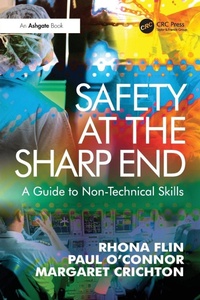
Safety at the Sharp End
A Guide to Non-Technical Skills
1st Edition
Published on 28. January 2008
Book
Paperback/Softback
336 pages
978-0-7546-4600-6 (ISBN)
Description
Many 21st century operations are characterised by teams of workers dealing with significant risks and complex technology, in competitive, commercially-driven environments. Informed managers in such sectors have realised the necessity of understanding the human dimension to their operations if they hope to improve production and safety performance. While organisational safety culture is a key determinant of workplace safety, it is also essential to focus on the non-technical skills of the system operators based at the 'sharp end' of the organisation. These skills are the cognitive and social skills required for efficient and safe operations, often termed Crew Resource Management (CRM) skills. In industries such as civil aviation, it has long been appreciated that the majority of accidents could have been prevented if better non-technical skills had been demonstrated by personnel operating and maintaining the system. As a result, the aviation industry has pioneered the development of CRM training. Many other organisations are now introducing non-technical skills training, most notably within the healthcare sector. Safety at the Sharp End is a general guide to the theory and practice of non-technical skills for safety. It covers the identification, training and evaluation of non-technical skills and has been written for use by individuals who are studying or training these skills on CRM and other safety or human factors courses. The material is also suitable for undergraduate and post-experience students studying human factors or industrial safety programmes.
Reviews / Votes
'The text is lively and well illustrated with relevant figures and tables. Very interesting, informative and exploratory, it manages to balance the strictly technical and the non-technical with a welcome sense of humour and a refreshing degree of caring sensitivity to human rights and behaviour. Another Ashgate book which opens doors for new solutions to old and new safety problems.' The RoSPA Occupational Safety & Health Journal, May 2008 ' Beginners and students in the human error field may benefit the most because this book is easy to read but without ignoring the significant details. Nevertheless, all the professionals in high risk organizations and those who work in the name of justice may find this a thought provoking book and particularly as a guidance to build better safety systems where a just culture is practiced.' HFES Newsletter 2, 2008 'The book is easy to read because it is written very clearly and contains many illustrative examples. The chapters are kept brief and simple ( e.g. 23 pages for an overview of existing decision-making models and training methods), but contain a lot of references to studies, reports and books for further reading.' Human Factors & Ergonomics European Chapter Newsletter No 1/2008 'This book would be a good complement to standard introductory human factors textbooks. The authors have acknowledged that these nontechnical skills are often referred to as "soft" skills in industry, and the book serves to combat the disparaging tone that often accompanies this viewpoint. Thus, new managers who are trying to understand how their resources are affected by these nontechnical skills will gain valuable insight from this book.' Ergonomics in Design, Winter 2009More details
Language
English
Place of publication
Oxford
United Kingdom
Publishing group
Taylor & Francis Ltd
Target group
College/higher education
Academic and Professional Practice & Development
Dimensions
Height: 234 mm
Width: 156 mm
Thickness: 18 mm
Weight
512 gr
ISBN-13
978-0-7546-4600-6 (9780754646006)
Copyright in bibliographic data and cover images is held by Nielsen Book Services Limited or by the publishers or by their respective licensors: all rights reserved.
Schweitzer Classification
Other editions
New editions
Book
11/2025
2nd Edition
CRC Press
€80.90
Shipment within 10-20 days
Additional editions
Book
01/2008
1st Edition
Ashgate Publishing Limited
€215.41
Shipment within 10-20 days
Persons
Rhona Flin (BSc, PhD Psychology) is Professor of Applied Psychology in the School of Psychology at the University of Aberdeen, UK. She is a Chartered Psychologist, a Fellow of the British Psychological Society and of the Royal Society of Edinburgh. Paul O'Connor (BSc, MSc, PhD Psychology) has carried out human factors research in a number of high risk industries and the military. Margaret Crichton (MA, MSc, PhD Psychology) was a Chartered Psychologist and founder of People Factor Consultants Ltd. She has published in both academic and industry journals.
Content
List of Figures, List of Tables, Acknowledgements, 1. Introduction, 2. Situation awareness, 3. Decision-Making, 4. Communication, 5. Team Working, 6. Leadership, 7. Managing Stress, 8. Coping with fatigue, 9. Identifying non-technical Skills, 10. Training Methods for non-technical Skills, 11. Assessing non-technical Skills, Index