


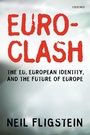
Euroclash
The EU, European Identity, and the Future of Europe
Published on 10. April 2008
Book
Hardback
296 pages
978-0-19-954256-7 (ISBN)
Description
This is an open access title. It is available to read and download as a free PDF version on Oxford Academic and is made available under a Creative Commons Attribution-NonCommercial 4.0 International licence.
The European Union's market integration project has dramatically altered economic activity around Europe. This book presents extensive evidence on how trade has increased, jobs have been created, and European business has been reorganized. However, changes in the economy have been accompanied by dramatic changes in how people from different societies interact. In this book Neil Fligstein argues provocatively that these changes have produced a truly transnational - European - society.
The book explores the nature of that society and its relationship to the creation of a European identity, popular culture, and politics. Much of the current political conflict around Europe can be attributed to who is and who is not involved in European society. Business owners, managers, professionals, white-collar workers, the educated, and the young have all benefited from European economic integration, specifically by interacting more and more with their counterparts in other societies. They tend to think of themselves as Europeans. Older, poorer, less-educated, and blue-collar citizens have benefited less. They view the EU as intrusive on national sovereignty, or they fear its pro-business orientation will overwhelm the national welfare states. They have maintained national identities. There is a third group of mainly-middle class citizens who see the EU in mostly positive terms and sometimes - but not always - think of themselves as Europeans. It is this swing group that is most critical for the future of the European project. If they favor more European cooperation, politicians will oblige. But, if they prefer that policies remain wedded to the nation, European cooperation will stall. Written in an accessible style this is a major new interpretation of the drive to European integration and essential reading for all those with an interest in the topic.
The European Union's market integration project has dramatically altered economic activity around Europe. This book presents extensive evidence on how trade has increased, jobs have been created, and European business has been reorganized. However, changes in the economy have been accompanied by dramatic changes in how people from different societies interact. In this book Neil Fligstein argues provocatively that these changes have produced a truly transnational - European - society.
The book explores the nature of that society and its relationship to the creation of a European identity, popular culture, and politics. Much of the current political conflict around Europe can be attributed to who is and who is not involved in European society. Business owners, managers, professionals, white-collar workers, the educated, and the young have all benefited from European economic integration, specifically by interacting more and more with their counterparts in other societies. They tend to think of themselves as Europeans. Older, poorer, less-educated, and blue-collar citizens have benefited less. They view the EU as intrusive on national sovereignty, or they fear its pro-business orientation will overwhelm the national welfare states. They have maintained national identities. There is a third group of mainly-middle class citizens who see the EU in mostly positive terms and sometimes - but not always - think of themselves as Europeans. It is this swing group that is most critical for the future of the European project. If they favor more European cooperation, politicians will oblige. But, if they prefer that policies remain wedded to the nation, European cooperation will stall. Written in an accessible style this is a major new interpretation of the drive to European integration and essential reading for all those with an interest in the topic.
Reviews / Votes
Review from previous edition ...An important contribution... [The] book is written in a very accessible style, illustrating well this new interpretation of the drive to European integration... * Journal of Common Market Studies * ...characteristically wide ranging, original and theoretically sophisticated addition to the literature on European integration... it opens up genuinely new terrain, making a powerful, provocative and timely case for a new more holistic and deeply socialized understanding of the process of European integration... * Socio-Economic Review * As this brief overview indicates, Euroclash is a rich book and worthwhile reading... the most systematic study of European identity to date, and it strikes a fine balance between theoretical ideas and empirical work. * Economic Sociology the european electronic newsletter *More details
Language
English
Place of publication
Oxford
United Kingdom
Target group
College/higher education
Professional and scholarly
Illustrations
numerous tables and figures
Dimensions
Height: 240 mm
Width: 161 mm
Thickness: 21 mm
Weight
611 gr
ISBN-13
978-0-19-954256-7 (9780199542567)
Copyright in bibliographic data and cover images is held by Nielsen Book Services Limited or by the publishers or by their respective licensors: all rights reserved.
Schweitzer Classification
Other editions
Additional editions
Book
10/2009
Oxford University Press
€56.20
Shipment within 15-20 days
E-Book
10/2009
1st Edition
OUP eBook
€23.99
Available for download
Person
Neil Fligstein is the Class of 1939 Chancellor's Professor in the Department of Sociology at the University of California. He is the author of five books and over 50 papers. He has made scholarly contributions to the fields of organizational and economic sociology, political sociology, and the study of the European Union. His most recent books include The Architecture of Markets (Princeton University Press, 2001) and The Institutionalization of Europe (with Alec Stone Sweet and Wayne Sandholtz, Oxford University Press, 2001.
Content
1. The Dynamics of European Society ; 2. Constructing Markets and Politics: The Formation of the European Union, 1958-2004 ; 3. Economic Transformation of Europe ; 4. The Creation of Markets: The Cases of the Defense, Telecommunications, and Football Industries ; 5. Who are the Europeans? ; 6. What is European Society? ; 7. The Structure of European Politics ; 8. Conclusions