

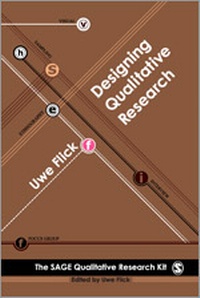
Designing Qualitative Research
1st Edition
Published on 5. March 2008
Book
Paperback/Softback
120 pages
978-0-7619-4976-3 (ISBN)
Description
Providing a comprehensive guide to devising an effective research design, Uwe Flick discusses each stage of the process of designing qualitative research in detail, including formulating a research design, selecting an appropriate strategy, conceptual framework and data source, and collecting and analyzing data.
More details
Series
Language
English
Place of publication
Thousand Oaks
United States
Target group
College/higher education
Dimensions
Height: 234 mm
Width: 156 mm
Weight
226 gr
ISBN-13
978-0-7619-4976-3 (9780761949763)
Copyright in bibliographic data and cover images is held by Nielsen Book Services Limited or by the publishers or by their respective licensors: all rights reserved.
Schweitzer Classification
Other editions
New editions
Uwe Flick
Designing Qualitative Research
Book
10/2018
2nd Edition
SAGE Publications Ltd
€79.70
Shipment within 15-20 days
Person
Uwe Flick is Senior Professor of Qualitative Research in Social Science and Education at the Freie Universitaet Berlin, Germany. He is a trained psychologist and sociologist and received his PhD from the Freie Universitaet Berlin in 1988 and his Habilitation from the Technical University Berlin in 1994. He has been Professor of Qualitative Research at Alice Salomon University of Applied Sciences in Berlin, Germany and at the University of Vienna, Austria. Previously, he was Adjunct Professor at the Memorial University of Newfoundland in St. John's, Canada; a Lecturer in research methodology at the Freie Universitaet Berlin; a Reader and Assistant Professor in qualitative methods and evaluation at the Technical University Berlin; and Associate Professor and Head of the Department of Medical Sociology at the Hannover Medical School. He has held visiting appointments at the London School of Economics, the Ecole des Hautes Etudes en Sciences Sociales in Paris, Cambridge University (UK), Memorial University of St John's (Canada), University of Lisbon (Portugal), Institute of Higher Studies in Vienna, in Italy and Sweden, and the School of Psychology at Massey University, Auckland (New Zealand). His main research interests are qualitative methods, social representations in the fields of individual and public health, vulnerability in fields like youth homelessness or (forced) migration and chronical illness in everyday live. He is the editor of The SAGE Handbook of Qualitative Research Design (2 Vols.; Sage 2022). The SAGE Handbook of Qualitative Data Analysis (Sage, 2014), The SAGE Qualitative Research Kit (Sage, 2nd edn, 2018), A Companion to Qualitative Research (Sage, 2004), Psychology of the Social (Cambridge University Press, 1998). His most recent publications are the seventh edition of An Introduction to Qualitative Research (Sage, 2023), Doing Grounded Theory (Sage, 2018), Doing Triangulation and Mixed Methods (Sage, 2018), The SAGE Handbook of Qualitative Data Collection (editor, Sage, 2018), the third edition of Introducing Research Methodology - Thinking Your Way through Your Research Project (Sage, 2020) and Doing Interview Research - The Essential How To Guide (Sage 2022). In 2019, Uwe Flick received the Lifetime Award in Qualitative Inquiry at the 15th International Congress of Qualitative Inquiry.
Content
What Is Qualitative Research
From an Idea to a Research Question
Sampling, Selecting and Access
Qualitative Research Designs
Resources and Stepping Stones
Quality in Qualitative Research
Ethics in Qualitative Research
Verbal Data
Ethnographic and Visual Data
Analysing Qualitative Data
Designing Qualitative Research
Some Conclusions
From an Idea to a Research Question
Sampling, Selecting and Access
Qualitative Research Designs
Resources and Stepping Stones
Quality in Qualitative Research
Ethics in Qualitative Research
Verbal Data
Ethnographic and Visual Data
Analysing Qualitative Data
Designing Qualitative Research
Some Conclusions