

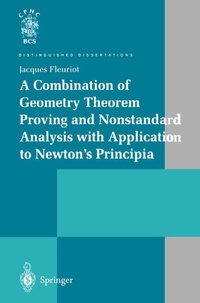
A Combination of Geometry Theorem Proving and Nonstandard Analysis with Application to Newton's Principia
With Application to Newton's Principia
Published on 8. June 2001
Book
Hardback
XIII, 140 pages
978-1-85233-466-6 (ISBN)
Description
Sir Isaac Newton's philosophi Naturalis Principia Mathematica'(the Principia) contains a prose-style mixture of geometric and limit reasoning that has often been viewed as logically vague.
In A Combination of Geometry Theorem Proving and Nonstandard Analysis , Jacques Fleuriot presents a formalization of Lemmas and Propositions from the Principia using a combination of methods from geometry and nonstandard analysis. The mechanization of the procedures, which respects much of Newton's original reasoning, is developed within the theorem prover Isabelle. The application of this framework to the mechanization of elementary real analysis using nonstandard techniques is also discussed.
In A Combination of Geometry Theorem Proving and Nonstandard Analysis , Jacques Fleuriot presents a formalization of Lemmas and Propositions from the Principia using a combination of methods from geometry and nonstandard analysis. The mechanization of the procedures, which respects much of Newton's original reasoning, is developed within the theorem prover Isabelle. The application of this framework to the mechanization of elementary real analysis using nonstandard techniques is also discussed.
More details
Series
Edition
2001
Language
English
Place of publication
London
United Kingdom
Target group
Professional and scholarly
Research
Illustrations
XIII, 140 p.
Dimensions
Height: 241 mm
Width: 160 mm
Thickness: 14 mm
Weight
412 gr
ISBN-13
978-1-85233-466-6 (9781852334666)
DOI
10.1007/978-0-85729-329-9
Schweitzer Classification
Other editions
Additional editions
Jacques Fleuriot
A Combination of Geometry Theorem Proving and Nonstandard Analysis with Application to Newton's Principia
Book
09/2012
Springer
€106.99
Shipment within 15-20 days
Content
1. Introduction.- 1.1 A Brief History of th e Infinitesimal.- 1.2 The Principia and its Methods.- 1.3 On Nonstandard Analysis.- 1.4 Objectives.- 1.5 Achieving our Goals.- 1.6 Organisation of this Book.- 2. Geometry Theorem Proving.- 2.1 Historical Background.- 2.2 Algebraic Techniques.- 2.3 Coordinate-Free Techniques.- 2.4 Formalizing Geometry in Isabelle.- 2.5 Concluding Remarks.- 3. Constructing the Hyperreals.- 3.1 Isabelle/HOL.- 3.2 Propertiesof an Infinitesimal Calculus.- 3.3 Internal Set Theory.- 3.4 Constructions Leading to the Reals.- 3.5 Filters and Ultrafilters.- 3.6 Ultrapower Construction of the Hyperreals.- 3.7 Structure of the Hyperreal Number Line.- 3.8 The Hypernatural Numbers.- 3.9 An Alternative Construction for the Reals.- 3.10 Related Work.- 3.11 Concluding Remarks.- 4. Infinitesimal and Analytic Geometry.- 4.1 Non-Archimedean Geometry.- 4.2 New Definitions and Relations.- 4.3 Infinitesimal Geometry Proofs.- 4.4 Verifying the Axioms of Geometry.- 4.5 Concluding Remarks.- 5. Mechanizing Newton's Principia.- 5.1 Formalizing Newton's Properties.- 5.2 Mechanized Propositions and Lemmas.- 5.3 Ratios of Infinitesimals.- 5.4 Case Study : Propositio Kepleriana.- 6. Nonstandard Real Analysis.- 6.1 Extending a Relation to the Hyperreals.- 6.2 Towards an Intuitive Calculus.- 6.3 Real Sequences and Series.- 6.4 Some Elementary Topology of the Reals.- 6.5 Limits and Continuity.- 6.6 Differentiation.- 6.7 On the Transfer Principle.- 6.8 Related Work and Conclusions.- 7. Conclusions.- 7.1 Geometry, Newton , and the Principia.- 7.2 Hyperreal Analysis.- 7.3 Further Work.- 7.4 Concluding Remarks.