

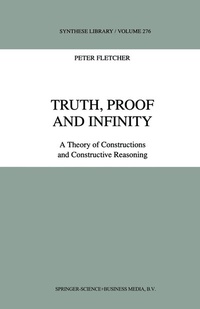
Truth, Proof and Infinity
A Theory of Constructive Reasoning
Published on 31. October 1998
Book
Hardback
X, 470 pages
978-0-7923-5262-4 (ISBN)
Description
Constructive mathematics is based on the thesis that the meaning of a mathematical formula is given, not by its truth-conditions, but in terms of what constructions count as a proof of it. However, the meaning of the terms `construction' and `proof' has never been adequately explained (although Kriesel, Goodman and Martin-Löf have attempted axiomatisations). This monograph develops precise (though not wholly formal) definitions of construction and proof, and describes the algorithmic substructure underlying intuitionistic logic. Interpretations of Heyting arithmetic and constructive analysis are given.
The philosophical basis of constructivism is explored thoroughly in Part I. The author seeks to answer objections from platonists and to reconcile his position with the central insights of Hilbert's formalism and logic.
Audience: Philosophers of mathematics and logicians, both academic and graduate students, particularly those interested in Brouwer and Hilbert; theoretical computer scientists interested in the foundations of functional programming languages and program correctness calculi.
The philosophical basis of constructivism is explored thoroughly in Part I. The author seeks to answer objections from platonists and to reconcile his position with the central insights of Hilbert's formalism and logic.
Audience: Philosophers of mathematics and logicians, both academic and graduate students, particularly those interested in Brouwer and Hilbert; theoretical computer scientists interested in the foundations of functional programming languages and program correctness calculi.
More details
Series
Edition
1998 ed.
Language
English
Place of publication
Dordrecht
Netherlands
Target group
Professional and scholarly
Research
Product notice
sewn/stitched
Cloth over boards
With dust jacket
Illustrations
X, 470 p.
Dimensions
Height: 234 mm
Width: 156 mm
Thickness: 27 mm
Weight
835 gr
ISBN-13
978-0-7923-5262-4 (9780792352624)
DOI
10.1007/978-94-017-3616-9
Schweitzer Classification
Other editions
Additional editions
E-Book
06/2013
Springer
€181.89
Available for download
Book
12/2010
Springer
€192.59
Shipment within 15-20 days
Content
1. Introduction and Statement of the Problem.- 2. What's Wrong with Set Theory?.- 3. What's Wrong with Infinite Quantifiers?.- 4. Abstraction and Idealisation.- 5. What are Constructions?.- 6. Truth and Proof of Logical Formulae.- 7. The Need for a Theory of Constructions.- 8. Theories of Constructions.- 9. Hilbert's Formalism.- 10. Open-endedness.- 11. Analysis.- 12. Introduction to Part II.- 13. Design of the Term Language.- 14. The Term Language.- 15. From the Term Language to the Expanded Term Language.- 16. The Expanded Term Language.- 17. The Protological Sequent Calculus.- 18. Commentary on the Protological Axioms and Rules.- 19. From Protologic to Expanded Protologic.- 20. Expanded Protologic.- 21. From Expanded Protologic to the Coding of Trees.- 22. The Coding of Trees.- 23. The Expanded Term Language as a Functional Programming Language.- 24. Introduction to Part III.- 25. From the Coding of Trees to Logic.- 26. Logic.- 27. From Logic to the Calculus of Proof Functions.- 28. Calculus of Proof Functions.- 29. From Calculus of Proof Functions to the Logic of Partial Terms.- 30. Logic of Partial Terms.- 31. From Logic of Partial Terms to Heyting Arithmetic.- 32. Heyting Arithmetic.- 33. From Heyting Arithmetic to Peano Arithmetic.- 34. Peano Arithmetic.- 35. Conclusions on Arithmetic.- 36. Introduction to Part IV.- 37. From Expanded Protologic to the Second-Order Coding of Trees.- 38. The Second-Order Coding of Trees.- 39. From the Second-Order Coding of Trees to Second-Order Logic.- 40. Second-Order Logic.- 41. From Second-Order Logic to Second-Order Calculus of Proof Functions.- 42. Second-Order Calculus of Proof Functions.- 43. From Second-Order Calculus of Proof Functions to Second-Order Logic of Partial Terms.- 44. Second-Order Logic of PartialTerms.- 45. From Second-Order Logic of Partial Terms to Second-Order Heyting Arithmetic.- 46. Second-Order Heyting Arithmetic.- 47. From Second-Order Heyting Arithmetic to Second-Order Peano Arithmetic.- 48. Second-Order Peano Arithmetic.- 49. Conclusions on Analysis.- References.- Index of symbols.- Index of axioms, theorems and rules of inference.- Index of names.- Index of topics.