

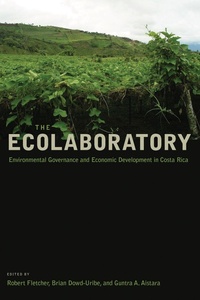
The Ecolaboratory
Environmental Governance and Economic Development in Costa Rica
Published on 19. September 2023
Book
Paperback/Softback
384 pages
978-0-8165-5324-2 (ISBN)
Description
Despite its tiny size and seeming marginality to world affairs, the Central American republic of Costa Rica has long been considered an important site for experimentation in cutting-edge environmental policy. From protected area management to ecotourism to payment for environmental services (PES) and beyond, for the past half-century the country has successfully positioned itself at the forefront of novel trends in environmental governance and sustainable development. Yet the increasingly urgent dilemma of how to achieve equitable economic development in a world of ecosystem decline and climate change presents new challenges, testing Costa Rica's ability to remain a leader in innovative environmental governance.
This book explores these challenges, how Costa Rica is responding to them, and the lessons this holds for current and future trends regarding environmental governance and sustainable development. It provides the first comprehensive assessment of successes and challenges as they play out in a variety of sectors, including agricultural development, biodiversity conservation, water management, resource extraction, and climate change policy.
By framing Costa Rica as an "ecolaboratory," the contributors in this volume examine the lessons learned and offer a path for the future of sustainable development research and policy in Central America and beyond.
This book explores these challenges, how Costa Rica is responding to them, and the lessons this holds for current and future trends regarding environmental governance and sustainable development. It provides the first comprehensive assessment of successes and challenges as they play out in a variety of sectors, including agricultural development, biodiversity conservation, water management, resource extraction, and climate change policy.
By framing Costa Rica as an "ecolaboratory," the contributors in this volume examine the lessons learned and offer a path for the future of sustainable development research and policy in Central America and beyond.
Reviews / Votes
The collection will appeal to scholars of environmental studies, Latin American studies, and environmental governance. In particular, many of the chapters here will serve as apt tools in the classroom to introduce political ecology to undergraduates." - Rocio Gomez, Virginia Commonwealth University, Environmental History 26"Bringing together experts from a range of disciplines under a shared analytical umbrella of political ecology, this collection of case studies fractures the narrative of Costa Rican environmental exceptionalism, while also providing important lessons on environmental policy, governance, and sustainability that can be applied elsewhere." - Keri Brondo, author of Land Grab: Green Neoliberalism, Gender, and Garifuna Resistance
More details
Language
English
Place of publication
Tucson
United States
Target group
Professional and scholarly
Product notice
Paperback (trade)
Unsewn / adhesive bound
Illustrations
10 b&w illustrations, 4 maps, 16 tables
Dimensions
Height: 224 mm
Width: 150 mm
Thickness: 24 mm
Weight
526 gr
ISBN-13
978-0-8165-5324-2 (9780816553242)
Copyright in bibliographic data and cover images is held by Nielsen Book Services Limited or by the publishers or by their respective licensors: all rights reserved.
Schweitzer Classification
Persons
Robert Fletcher is an associate professor in the Sociology of Development and Change group at Wageningen University in the Netherlands. He is the author of Romancing the Wild: Cultural Dimensions of Ecotourism and co-editor of Nature (TM) Inc.: Environmental Conservation in the Neoliberal Age.Brian Dowd-Uribe is an associate professor in the International Studies Department at the University of San Francisco and currently directs the MA program in international studies. Formerly he was an assistant professor and chair of the Department of Environment and Development at the University for Peace in Costa Rica.
Guntra A. Aistara is an associate professor in the Department of Environmental Sciences and Policy at Central European University in Budapest, Hungary. She is the author of Organic Sovereignties: Struggles over Farming in an Age of Free Trade.
Guntra A. Aistara is an associate professor in the Department of Environmental Sciences and Policy at Central European University in Budapest, Hungary. She is the author of Organic Sovereignties: Struggles over Farming in an Age of Free Trade.
Content
Introduction: Negotiating Environmental Governance and Economic Development in the Green Republic
Robert Fletcher, Guntra A. Aistara, and Brian Dowd-Uribe
PART I. GOVERNING THE AGRARIAN ECONOMY
1. The Costa Rican Agrifood System, 1961-2014: Assessing Neoliberalism's Impacts on Agriculture and Diets
Ryan E. Galt
2. Agrarian Questions, Neoliberalism, and the Persistence of the Costa Rican Coffee Peasantry
Nicholas Babin
3. Costa Rica's Farmers' Market Program: Aiding Farmer Livelihoods and Urban Food Security?
Brian Dowd-Uribe and Erin Raser
4. Gender and Climate Change in Smallholder Family Farms of Tierra Blanca, Cartago
Carolina Castillo EcheverrIa
5. Understanding the Impact of Costa Rica's Protectionist Rice Economy on Smallholder Farmers in Semi-arid Northwest Costa Rica
Benjamin P. Warner and Christopher P. Kuzdas
6. Seeding Organic Sovereignties in the Face of Free Trade
Guntra A. Aistara
PART II. CONTESTING ENVIRONMENTAL CONSERVATION
7. Paying for PES: Taxes, Tariffs, and the World Bank in Costa Rica
Brett S. Matulis and Robert Fletcher
8. Costa Rica's Forest Transition Revisited
Jan Breitling
David M. Hoffman
10. An Ecolaboratory for Climate Politics? Costa Rica's 2007 Carbon-Neutral Pledge
Julia A. Flagg
11. Bonds, Bridges, and Links to Development in Osa and Golfito, Costa Rica
Carter A. Hunt, William H. Durham, and Claire M. Menke
12. Waves of Development: Surf Tourism on Trial in Costa Rica
Tara Ruttenberg and J. Peter Brosius
13. Ecotourism-as- Conservation: Exploring the Decline of Leatherback Sea Turtles in Playa Grande, Costa Rica
Emily Benton Hite
PART III. NEGOTIATING RESOURCE CONFLICTS
14. REDD+, Social Inclusion, and Indigenous Peoples in Costa Rica
Alonso RamIrez Cover
15. Peace Parks: Nation Branding and Soft Power in Costa Rica
Karina Barquet and Ida Andersson
16. Of Dams and Development: Debating "Green" Energy Production in Costa Rica
Robert Fletcher and Jernej Frece
17. Conflict and Cooperation in Costa Rica's Water Sector: Lessons for Water Management
Christopher P. Kuzdas and Benjamin P. Warner
18. The Mining Ban Movement and the Role of Democratization in Costa Rica, El Salvador, and Honduras
Lynn Holland
Conclusion: Limits to Exceptionalism and Lessons from the Laboratory
Guntra A. Aistara, Robert Fletcher, and Brian Dowd-Uribe
References
Contributors
Index
Robert Fletcher, Guntra A. Aistara, and Brian Dowd-Uribe
PART I. GOVERNING THE AGRARIAN ECONOMY
1. The Costa Rican Agrifood System, 1961-2014: Assessing Neoliberalism's Impacts on Agriculture and Diets
Ryan E. Galt
2. Agrarian Questions, Neoliberalism, and the Persistence of the Costa Rican Coffee Peasantry
Nicholas Babin
3. Costa Rica's Farmers' Market Program: Aiding Farmer Livelihoods and Urban Food Security?
Brian Dowd-Uribe and Erin Raser
4. Gender and Climate Change in Smallholder Family Farms of Tierra Blanca, Cartago
Carolina Castillo EcheverrIa
5. Understanding the Impact of Costa Rica's Protectionist Rice Economy on Smallholder Farmers in Semi-arid Northwest Costa Rica
Benjamin P. Warner and Christopher P. Kuzdas
6. Seeding Organic Sovereignties in the Face of Free Trade
Guntra A. Aistara
PART II. CONTESTING ENVIRONMENTAL CONSERVATION
7. Paying for PES: Taxes, Tariffs, and the World Bank in Costa Rica
Brett S. Matulis and Robert Fletcher
8. Costa Rica's Forest Transition Revisited
Jan Breitling
David M. Hoffman
10. An Ecolaboratory for Climate Politics? Costa Rica's 2007 Carbon-Neutral Pledge
Julia A. Flagg
11. Bonds, Bridges, and Links to Development in Osa and Golfito, Costa Rica
Carter A. Hunt, William H. Durham, and Claire M. Menke
12. Waves of Development: Surf Tourism on Trial in Costa Rica
Tara Ruttenberg and J. Peter Brosius
13. Ecotourism-as- Conservation: Exploring the Decline of Leatherback Sea Turtles in Playa Grande, Costa Rica
Emily Benton Hite
PART III. NEGOTIATING RESOURCE CONFLICTS
14. REDD+, Social Inclusion, and Indigenous Peoples in Costa Rica
Alonso RamIrez Cover
15. Peace Parks: Nation Branding and Soft Power in Costa Rica
Karina Barquet and Ida Andersson
16. Of Dams and Development: Debating "Green" Energy Production in Costa Rica
Robert Fletcher and Jernej Frece
17. Conflict and Cooperation in Costa Rica's Water Sector: Lessons for Water Management
Christopher P. Kuzdas and Benjamin P. Warner
18. The Mining Ban Movement and the Role of Democratization in Costa Rica, El Salvador, and Honduras
Lynn Holland
Conclusion: Limits to Exceptionalism and Lessons from the Laboratory
Guntra A. Aistara, Robert Fletcher, and Brian Dowd-Uribe
References
Contributors
Index