

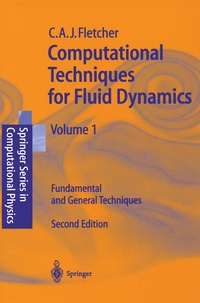
Computational Techniques for Fluid Dynamics 1
Fundamental and General Techniques
2nd Edition
Published on 10. April 1991
Book
Paperback/Softback
XIII, 401 pages
978-3-540-53058-9 (ISBN)
Description
This well-known 2-volume textbook provides senior undergraduate and postgraduate engineers, scientists and applied mathematicians with the specific techniques, and the framework to develop skills in using the techniques in the various branches of computational fluid dynamics. A solutions manual to the exercises is in preparation.
Reviews / Votes
From the reviews"In summary, a book of considerable utlity both in the classroom and as a reference volume ... Fletcher's book is sure to become an invaluable tool for student and researcher alike, and a trusted introduction and guide to the rapidly evolving field of CFD."
(H. Aref in: Journal of Fluid Mechanics)
More details
Series
Edition
Second Edition 1998
Language
English
Place of publication
Berlin
Germany
Publishing group
Springer Berlin
Target group
Primary & secondary/elementary & high school
Graduate
Illustrations
2 s/w Abbildungen
XIII, 401 p. 2 illus.
Dimensions
Height: 235 mm
Width: 155 mm
Thickness: 23 mm
Weight
628 gr
ISBN-13
978-3-540-53058-9 (9783540530589)
DOI
10.1007/978-3-642-58229-5
Schweitzer Classification
Other editions
Additional editions
E-Book
12/2012
2nd Edition
Springer
€80.24
Available for download
Previous edition
Book
10/1988
Springer
€85.55
Article exhausted; check for reprint
Content
1. Computational Fluid Dynamics: An Introduction.- 1.1 Advantages of Computational Fluid Dynamics.- 1.2 Typical Practical Problems.- 1.3 Equation Structure.- 1.4 Overview of Computational Fluid Dynamics.- 1.5 Further Reading.- 2. Partial Differential Equations.- 2.1 Background.- 2.2 Hyperbolic Partial Differential Equations.- 2.3 Parabolic Partial Differential Equations.- 2.4 Elliptic Partial Differential Equations.- 2.5 Traditional Solution Methods.- 2.6 Closure.- 2.7 Problems.- 3. Preliminary Computational Techniques.- 3.1 Discretisation.- 3.2 Approximation to Derivatives.- 3.3 Accuracy of the Discretisation Process.- 3.4 Wave Representation.- 3.5 Finite Difference Method.- 3.6 Closure.- 3.7 Problems.- 4. Theoretical Background.- 4.1 Convergence.- 4.2 Consistency.- 4.3 Stability.- 4.4 Solution Accuracy.- 4.5 Computational Efficiency.- 4.6 Closure.- 4.7 Problems.- 5. Weighted Residual Methods.- 5.1 General Formulation.- 5.2 Finite Volume Method.- 5.3 Finite Element Method and Interpolation.- 5.4 Finite Element Method and the Sturm-Liouville Equation.- 5.5 Further Applications of the Finite Element Method.- 5.6 Spectral Method.- 5.7 Closure.- 5.8 Problems.- 6. Steady Problems.- 6.1 Nonlinear Steady Problems.- 6.2 Direct Methods for Linear Systems.- 6.3 Iterative Methods.- 6.4 Pseudotransient Method.- 6.5 Strategies for Steady Problems.- 6.6 Closure.- 6.7 Problems.- 7. One-Dimensional Diffusion Equation.- 7.1 Explicit Methods.- 7.2 Implicit Methods.- 7.3 Boundary and Initial Conditions.- 7.4 Method of Lines.- 7.5 Closure.- 7.6 Problems.- 8. Multidimensional Diffusion Equation.- 8.1 Two-Dimensional Diffusion Equation.- 8.2 Multidimensional Splitting Methods.- 8.3 Splitting Schemes and the Finite Element Method.- 8.4 Neumann Boundary Conditions.- 8.5 Method of Fractional Steps.- 8.6 Closure.- 8.7 Problems.- 9. Linear Convection-Dominated Problems.- 9.1 One-Dimensional Linear Convection Equation.- 9.2 Numerical Dissipation and Dispersion.- 9.3 Steady Convection-Diffusion Equation.- 9.4 One-Dimensional Transport Equation.- 9.5 Two-Dimensional Transport Equation.- 9.6 Closure.- 9.7 Problems.- 10. Nonlinear Convection-Dominated Problems.- 10.1 One-Dimensional Burgers' Equation.- 10.2 Systems of Equations.- 10.3 Group Finite Element Method.- 10.4 Two-Dimensional Burgers' Equation.- 10.5 Closure.- 10.6 Problems.- Appendix A.1 Empirical Determination of the Execution Time of Basic Operations.- A.2 Mass and Difference Operators.- References.