

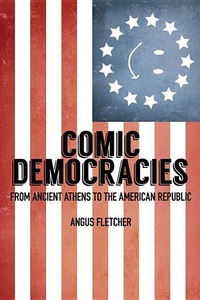
Comic Democracies
From Ancient Athens to the American Republic
Will be published approx. on 25. July 2016
Book
Hardback
224 pages
978-1-4214-1934-3 (ISBN)
Description
For two thousand years, democratic authors treated comedy as a toolkit of rhetorical practices for encouraging problem-solving, pluralism, risk-taking, and other civic behaviors that increased minority participation in government. Over the past two centuries, this pragmatic approach to extending the franchise has gradually been displaced by more idealistic democratic philosophies that focus instead on promoting liberal principles and human rights. But in the wake of the recent "democracy recession" in the Middle East, the Third World, and the West itself, there has been renewed interest in finding practical sources of popular rule. Comic Democracies joins in the search by exploring the value of the old comic tools for growing democracy today. Drawing on new empirical research from the political and cognitive sciences, Angus Fletcher deftly analyzes the narrative elements of two dozen stage plays, novels, romances, histories, and operas written by such authors as Aristophanes, Menander, Plautus, Ariosto, Machiavelli, Cervantes, Shakespeare, Ben Jonson, William Congreve, John Gay, Henry Fielding, and Washington Irving.
He unearths five comic techniques that were used to foster democratic behaviors in antiquity and the Renaissance, then traces the role of these techniques in Tom Paine's Common Sense, Thomas Jefferson's preamble to the Declaration of Independence, George Washington's farewell address, Mercy Otis Warren's federalist history of the Revolution, Frederick Douglass's abolitionist orations, and other key documents that played a pivotal role in the development of the early American Republic. After recovering these lost chapters of our democratic past, Comic Democracies concludes with a draft for the future, using the old methods of comedy to envision a modern democracy rooted in the diversity, ingenuity, and power of popular art.
He unearths five comic techniques that were used to foster democratic behaviors in antiquity and the Renaissance, then traces the role of these techniques in Tom Paine's Common Sense, Thomas Jefferson's preamble to the Declaration of Independence, George Washington's farewell address, Mercy Otis Warren's federalist history of the Revolution, Frederick Douglass's abolitionist orations, and other key documents that played a pivotal role in the development of the early American Republic. After recovering these lost chapters of our democratic past, Comic Democracies concludes with a draft for the future, using the old methods of comedy to envision a modern democracy rooted in the diversity, ingenuity, and power of popular art.
Reviews / Votes
Fletcher's main theory is convincing and will open up new fields of inquiry. This accessible work is for those interested in political science, cultural history, and comic theory as well as classical literature. ChoiceMore details
Language
English
Place of publication
Baltimore, MD
United States
Target group
College/higher education
Product notice
sewn/stitched
Cloth over boards
Dimensions
Height: 233 mm
Width: 158 mm
Thickness: 21 mm
Weight
436 gr
ISBN-13
978-1-4214-1934-3 (9781421419343)
DOI
10.1353/book.47462
Copyright in bibliographic data and cover images is held by Nielsen Book Services Limited or by the publishers or by their respective licensors: all rights reserved.
Schweitzer Classification
Other editions
Additional editions

E-Book
07/2016
Johns Hopkins University Press
€37.99
Available for download
Person
Angus Fletcher is a professor of English and a core member of Project Narrative at The Ohio State University. He is the author of Evolving Hamlet: Seventeenth-Century English Tragedy and the Ethics of Natural Selection.
Content
Preface
Acknowledgments
Introduction
1. The Ancient History of Comedy and Demokratia
2. Fortune Favors the Impetuous
3. The Virtu of Imitation
4. The Pursuit of Indolence
5. Quixotic Governance
6. Amending Ourselves
7. Demokratia at Denshawai
Conclusion
The Futures of Comic Democracy
Notes
Index
Acknowledgments
Introduction
1. The Ancient History of Comedy and Demokratia
2. Fortune Favors the Impetuous
3. The Virtu of Imitation
4. The Pursuit of Indolence
5. Quixotic Governance
6. Amending Ourselves
7. Demokratia at Denshawai
Conclusion
The Futures of Comic Democracy
Notes
Index