

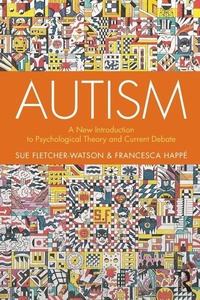
Autism
A New Introduction to Psychological Theory and Current Debate
2nd Edition
Published on 25. February 2019
Book
Paperback/Softback
194 pages
978-1-138-10612-3 (ISBN)
Description
Based on Francesca Happe's best-selling textbook, Autism: An Introduction to Psychological Theory, this completely new edition provides a concise overview of contemporary psychological theories about autism. Fletcher-Watson and Happe explore the relationship between theories of autism at psychological (cognitive), biological and behavioural levels, and consider their clinical and educational impact.
The authors summarise what is known about the biology and behavioural features of autism, and provide concise but comprehensive accounts of all influential psychological models including 'Theory of Mind' (ToM) models, early social development models and alternative information processing models such as 'weak central coherence' theory. The book also discusses more recent attempts to understand autism, including the 'Double Empathy Problem' and Bayesian theories. In each case, the authors describe the theory, review the evidence and provide critical analysis of its value and impact. Recognising the multiplicity of theoretical views, and rapidly changing nature of autism research, each chapter considers current debates and major questions that remain for the future.
Importantly, the book includes the voices of autistic people, including parents and practitioners, who were asked to provide commentaries on each chapter, helping to contextualise theory and research evidence with accounts of real-life experience. The book embraces neurodiversity whilst recognising the real needs of autistic people and their families. Thus Autism: A New Introduction to Psychological Theory and Current Debate provides the reader with a critical overview of psychological theory but also embeds this within community perspectives, making it a relevant and progressive contribution to understanding autism, and essential reading for students and practitioners across educational, clinical and social settings.
The authors summarise what is known about the biology and behavioural features of autism, and provide concise but comprehensive accounts of all influential psychological models including 'Theory of Mind' (ToM) models, early social development models and alternative information processing models such as 'weak central coherence' theory. The book also discusses more recent attempts to understand autism, including the 'Double Empathy Problem' and Bayesian theories. In each case, the authors describe the theory, review the evidence and provide critical analysis of its value and impact. Recognising the multiplicity of theoretical views, and rapidly changing nature of autism research, each chapter considers current debates and major questions that remain for the future.
Importantly, the book includes the voices of autistic people, including parents and practitioners, who were asked to provide commentaries on each chapter, helping to contextualise theory and research evidence with accounts of real-life experience. The book embraces neurodiversity whilst recognising the real needs of autistic people and their families. Thus Autism: A New Introduction to Psychological Theory and Current Debate provides the reader with a critical overview of psychological theory but also embeds this within community perspectives, making it a relevant and progressive contribution to understanding autism, and essential reading for students and practitioners across educational, clinical and social settings.
Reviews / Votes
"If you read one book on autism, this should be the one! There is no other account of psychological theories that is as clear, as engaging and as succinct. The authors not only explain what research has revealed about the nature of this complex condition, they critically analyse the impact of the research on the life of people with autism and their families. They break new ground by exploring the consequences of the still new concept of neurodiversity for a future research agenda, and true to their principles, they constructively incorporate comments by autistic people from all walks of life." - Uta Frith, Emeritus Professor of Cognitive Development, University College London."This book gives an accessible overview of psychological theory in regard to autism, including recent developments and controversies. The highlight however is the commentary remarks at the end of each chapter by autistic people. A must read for all those studying autism and those working with autistic people." - Damian Milton, Lecturer in Intellectual and Developmental Disability, Tizard Centre, University of Kent, UK.
"For more than two decades, Francesca Happe has led the way in explaining the psychology of autistic people to students and experts alike. Now joining forces with Sue Fletcher-Watson, this new introduction brings the voices of autistic people themselves, their families and communities to the forefront of their analysis. The result is a magnificent book that will cause us all to think anew about autistic psychology and experience." - Professor Liz Pellicano, Macquarie University, Australia
"This book is a must-read for everyone interested in understanding the current landscape of autism. It includes everything you will want to know from history to biology; from theory to practice; presented in a balanced and lucid style that will engage all readers. The book is remarkable achievement that will, like the first edition, become an instant classic." - Helen Tager-Flusberg, Ph.D., Boston University, USA.
"For many people, myself included, Francesca Happe's 1995 book was their gateway to autism research. This update, written with Sue Fletcher-Watson is much-needed and long overdue. Like the first edition, it provides a wonderfully lucid yet concise introduction to psychological accounts of autism. But it also serves as an historical document, reflecting the seismic changes in our understanding of and attitudes towards autism over the past quarter century and the growing voice of autistic people in challenging preconceptions about their own condition and influencing the priorities and goals of autism science." - Dr. Jon Brock, Macquarie University, Australia.
More details
Edition
2nd edition
Language
English
Place of publication
London
United Kingdom
Publishing group
Taylor & Francis Ltd
Target group
College/higher education
Professional and scholarly
General, Postgraduate, Professional, and Undergraduate
Illustrations
5 s/w Tabellen
5 Tables, black and white
Dimensions
Height: 234 mm
Width: 156 mm
Thickness: 12 mm
Weight
327 gr
ISBN-13
978-1-138-10612-3 (9781138106123)
Copyright in bibliographic data and cover images is held by Nielsen Book Services Limited or by the publishers or by their respective licensors: all rights reserved.
Schweitzer Classification
Other editions
Additional editions
Sue Fletcher-Watson | Francesca Happe
Autism
A New Introduction to Psychological Theory and Current Debate
Book
02/2019
2nd Edition
Routledge
€205.40
Shipment within 10-20 days
Sue Fletcher-Watson | Francesca Happe
Autism
A New Introduction to Psychological Theory and Current Debate
E-Book
01/2019
2nd Edition
Routledge
€53.99
Available for download
Sue Fletcher-Watson | Francesca Happe
Autism
A New Introduction to Psychological Theory and Current Debate
E-Book
01/2019
2nd Edition
Routledge
€53.99
Available for download
Previous edition
Book
06/1994
1st Edition
Routledge
€62.08
Article exhausted; check for reprint
Persons
Sue Fletcher-Watson is Senior Research Fellow at the Patrick Wild Centre, University of Edinburgh, and leads the Development/Autism/Research/Technology, or DART, lab group. She has been awarded the British Psychological Society Margaret Donaldson Prize and a certificate of excellence from Autism Rights Group Highland for "amplification and inclusion of autistic voices".
Francesca Happe (FBA FMedSci) is Professor of Cognitive Neuroscience and Director of the Social, Genetic and Developmental Psychiatry Centre at the Institute of Psychiatry, Psychology and Neuroscience, King's College London. She has worked in autism research for over 30 years, was President of the International Society for Autism Research and has been awarded the British Psychological Society Spearman Medal, the Experimental Psychology Society Prize and the Royal Society Rosalind Franklin Award.
Francesca Happe (FBA FMedSci) is Professor of Cognitive Neuroscience and Director of the Social, Genetic and Developmental Psychiatry Centre at the Institute of Psychiatry, Psychology and Neuroscience, King's College London. She has worked in autism research for over 30 years, was President of the International Society for Autism Research and has been awarded the British Psychological Society Spearman Medal, the Experimental Psychology Society Prize and the Royal Society Rosalind Franklin Award.
Content
Preface
Chapter 1 - Introduction
Chapter 2 - The History of Autism
Chapter 3 - Autism at the Behavioural Level?
Chapter 4 - Autism at the Biological Level
Chapter 5 - Autism at the Cognitive Level: What makes a Good Theory?
Chapter 6 - Autism at the Cognitive Level: Primary Deficit Models
Chapter 7 - Autism at the Cognitive Level: Developmental Trajectory Models
Chapter 8 - Autism at the Cognitive Level: Domain-General Information Processing Models
Chapter 9 - The Impact of Cognitive Models on Autism Understanding and Practice
Chapter 10 - Looking to the Future
Bibliography
Chapter 1 - Introduction
Chapter 2 - The History of Autism
Chapter 3 - Autism at the Behavioural Level?
Chapter 4 - Autism at the Biological Level
Chapter 5 - Autism at the Cognitive Level: What makes a Good Theory?
Chapter 6 - Autism at the Cognitive Level: Primary Deficit Models
Chapter 7 - Autism at the Cognitive Level: Developmental Trajectory Models
Chapter 8 - Autism at the Cognitive Level: Domain-General Information Processing Models
Chapter 9 - The Impact of Cognitive Models on Autism Understanding and Practice
Chapter 10 - Looking to the Future
Bibliography