

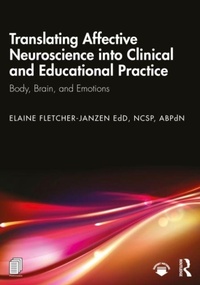
Translating Affective Neuroscience into Clinical and Educational Practice
Body, Brain, and Emotions
1st Edition
Will be published approx. on 20. August 2026
Book
Paperback/Softback
180 pages
978-1-041-25013-5 (ISBN)
Description
This book is accessible guide to understanding emotion through the lens of neuroscience. It provides a practical, developmentally informed framework with tools to translate affective neuroscience into everyday practice.
The author introduces a neuroscience-informed model of emotion grounded in the body-brain connection, explaining the theory of affective neuroscience and including practical strategies for use in both therapeutic and educational settings. Drawing on foundational work by Panksepp, Damasio, Craig, and others, the book emphasizes how seven core emotional systems drive human behavior, development, and relational experience. Describing the development and application of the Affective Inventory, it provides clinician-facing steps and reflective exercises. Through clear explanations, engaging examples, and powerful clinical insights, this book reveals how our body and brain work together to shape feeling, behavior, and connection-helping readers navigate emotion with compassion, clarity, and confidence. Downloadable client handouts are provided for practitioners and educators.
Translating Affective Neuroscience into Clinical and Educational Practice: Body, Brain, and Emotions will appeal to clinical psychologists, neuropsychologists, school psychologists, therapists, and counselors, as well as graduate students of neuroscience and neuropsychology, and education professionals.
The author introduces a neuroscience-informed model of emotion grounded in the body-brain connection, explaining the theory of affective neuroscience and including practical strategies for use in both therapeutic and educational settings. Drawing on foundational work by Panksepp, Damasio, Craig, and others, the book emphasizes how seven core emotional systems drive human behavior, development, and relational experience. Describing the development and application of the Affective Inventory, it provides clinician-facing steps and reflective exercises. Through clear explanations, engaging examples, and powerful clinical insights, this book reveals how our body and brain work together to shape feeling, behavior, and connection-helping readers navigate emotion with compassion, clarity, and confidence. Downloadable client handouts are provided for practitioners and educators.
Translating Affective Neuroscience into Clinical and Educational Practice: Body, Brain, and Emotions will appeal to clinical psychologists, neuropsychologists, school psychologists, therapists, and counselors, as well as graduate students of neuroscience and neuropsychology, and education professionals.
More details
Language
English
Place of publication
London
United Kingdom
Publishing group
Taylor & Francis Ltd
Target group
College/higher education
Professional and scholarly
Postgraduate, Professional Practice & Development, and Undergraduate Advanced
Illustrations
2 s/w Zeichnungen, 2 s/w Abbildungen, 11 s/w Tabellen
11 Tables, black and white; 2 Line drawings, black and white; 2 Illustrations, black and white
Dimensions
Height: 254 mm
Width: 178 mm
ISBN-13
978-1-041-25013-5 (9781041250135)
Copyright in bibliographic data and cover images is held by Nielsen Book Services Limited or by the publishers or by their respective licensors: all rights reserved.
Schweitzer Classification
Other editions
Additional editions
Elaine Fletcher-Janzen
Translating Affective Neuroscience into Clinical and Educational Practice
Body, Brain, and Emotions
Book
approx. 08/2026
1st Edition
Routledge
€185.50
Not yet published

Elaine Fletcher-Janzen
Translating Affective Neuroscience into Clinical and Educational Practice
Body, Brain, and Emotions
E-Book
approx. 08/2026
Routledge
€45.99
Not yet available
Elaine Fletcher-Janzen
Translating Affective Neuroscience into Clinical and Educational Practice
Body, Brain, and Emotions
E-Book
approx. 08/2026
Routledge
€45.99
Not yet available
Person
Elaine Fletcher-Janzen, EdD, NCSP, ABPdN, is a board-certified pediatric neuropsychologist and a nationally certified school psychologist. She is a professor, clinician, and author with over 40 years of experience in training professionals in neuropsychology, development, and clinical practice. She is recognized for translating affective neuroscience into practical tools for emotional healing, education, and clinical practice.
Content
Part 1: Translating Affective Neuroscience Theory
Chapter 1: Introduction and Theory
Chapter 2: History and Development of Affective Neuroscience
Chapter 3: Affective Neurodevelopment
Chapter 4: The Paradigm Shift: How Do We Feel?
Chapter 5: Essential Research on Affective Neuroscience
Part 2: Translating Panksepp's Seven Emotion Systems
Chapter 6: Translating Panksepp's SEEKING System
Chapter 7: Translating Panksepp's RAGE/ANGER System
Chapter 8: Translating Panksepp's PLAY System
Chapter 9: Translating Panksepp's PANIC/GRIEF System
Chapter 10: Translating Panksepp's CARE System
Chapter 11: Translating Panksepp's FEAR System
Chapter 12: Translating Panksepp's LUST System
Part 3: Translating Affective Neuroscience into Clinical Practice
Chapter 13: Clinical Translation and Practice
Chapter 14: Summary and Conclusions
Chapter 1: Introduction and Theory
Chapter 2: History and Development of Affective Neuroscience
Chapter 3: Affective Neurodevelopment
Chapter 4: The Paradigm Shift: How Do We Feel?
Chapter 5: Essential Research on Affective Neuroscience
Part 2: Translating Panksepp's Seven Emotion Systems
Chapter 6: Translating Panksepp's SEEKING System
Chapter 7: Translating Panksepp's RAGE/ANGER System
Chapter 8: Translating Panksepp's PLAY System
Chapter 9: Translating Panksepp's PANIC/GRIEF System
Chapter 10: Translating Panksepp's CARE System
Chapter 11: Translating Panksepp's FEAR System
Chapter 12: Translating Panksepp's LUST System
Part 3: Translating Affective Neuroscience into Clinical Practice
Chapter 13: Clinical Translation and Practice
Chapter 14: Summary and Conclusions