

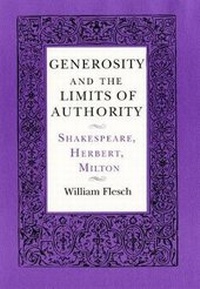
Generosity and the Limits of Authority
Shakespeare, Herbert, Milton
Published on 24. December 1992
Book
Hardback
296 pages
978-0-8014-2642-1 (ISBN)
Description
Generosity is an ambiguous quality, William Flesch observes; while receiving gifts is pleasant, gift-giving both displays the wealth and strength of the giver and places the receiver under an obligation. In provocative new readings of Shakespeare, Herbert, and Milton, Flesch illuminates the personal authority that is bound inextricably with acts of generosity.
Drawing on the work of such theorists as Mauss, Blanchot, Bourdieu, Wittgenstein, Bloom, Cavell, and Greenblatt, Flesch maintains that the literary power of Shakespeare, Herbert, and Milton is at its most intense when they are exploring the limits of generosity. He considers how in Herbert's Temple divine assurance of the possibility of redemption is put into question and how the poet approaches such a gift with the ambivalence of a beneficiary. In his readings of Shakespeare's Richard II, Henry IV, King Lear, Antony and Cleopatra, and the sonnets, Flesch examines the perspective of the benefactor-including Shakespeare himself-who confronts the decline of his capacity to give. Turning to Milton's Paradise Lost, Flesch identifies two opposing ways of understanding generosity-Satan's, on the one hand, and Adam and Eve's, on the other - and elaborates the different conceptions of poetry to which these understandings give rise.
Scholars of Shakespeare and of Renaissance culture, Miltonists, literary theorists, and others interested in the relationship between philosophy and literature will want to read this insightful and challenging book.
Drawing on the work of such theorists as Mauss, Blanchot, Bourdieu, Wittgenstein, Bloom, Cavell, and Greenblatt, Flesch maintains that the literary power of Shakespeare, Herbert, and Milton is at its most intense when they are exploring the limits of generosity. He considers how in Herbert's Temple divine assurance of the possibility of redemption is put into question and how the poet approaches such a gift with the ambivalence of a beneficiary. In his readings of Shakespeare's Richard II, Henry IV, King Lear, Antony and Cleopatra, and the sonnets, Flesch examines the perspective of the benefactor-including Shakespeare himself-who confronts the decline of his capacity to give. Turning to Milton's Paradise Lost, Flesch identifies two opposing ways of understanding generosity-Satan's, on the one hand, and Adam and Eve's, on the other - and elaborates the different conceptions of poetry to which these understandings give rise.
Scholars of Shakespeare and of Renaissance culture, Miltonists, literary theorists, and others interested in the relationship between philosophy and literature will want to read this insightful and challenging book.
More details
Language
English
Place of publication
Ithaca
United States
Target group
College/higher education
Dimensions
Height: 229 mm
Width: 152 mm
Weight
28 gr
ISBN-13
978-0-8014-2642-1 (9780801426421)
Copyright in bibliographic data and cover images is held by Nielsen Book Services Limited or by the publishers or by their respective licensors: all rights reserved.
Schweitzer Classification
Other editions
Additional editions
E-Book
10/2018
Cornell University Press
€129.99
Available for download
Person
William Flesch is Associate Professor of English at Brandeis University.