

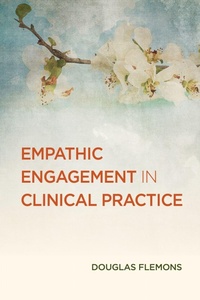
Empathic Engagement in Clinical Practice
Will be published approx. on 30. January 2026
Book
Paperback/Softback
195 pages
978-1-4338-4336-5 (ISBN)
Description
This guide for mental health professionals offers an insightful, conversational approach to mastering empathic communication with clients.
Douglas Flemons invites readers to join him in a dialogue that incorporates voices from clinical research and practice, philosophy (both Eastern and Western), neuroscience, and the arts.
He explains the nuts and bolts of empathy, and offers guidelines for how readers can make sense of the client's thoughts, feelings, and choices from inside their worldview. He also shows how the clinician, with compassion, curiosity, and an empathic imagination, can create a heartfelt connection that allows the client to feel respected and understood and that opens the way for collaboration and therapeutic change.
Innovative strategies for therapist self-care are thoroughly explored. Practitioners learn how to effectively engage in and safely disengage from close empathic relationships, even with clients who are deeply suffering or who present complex emotional challenges.
Douglas Flemons invites readers to join him in a dialogue that incorporates voices from clinical research and practice, philosophy (both Eastern and Western), neuroscience, and the arts.
He explains the nuts and bolts of empathy, and offers guidelines for how readers can make sense of the client's thoughts, feelings, and choices from inside their worldview. He also shows how the clinician, with compassion, curiosity, and an empathic imagination, can create a heartfelt connection that allows the client to feel respected and understood and that opens the way for collaboration and therapeutic change.
Innovative strategies for therapist self-care are thoroughly explored. Practitioners learn how to effectively engage in and safely disengage from close empathic relationships, even with clients who are deeply suffering or who present complex emotional challenges.
Reviews / Votes
Here is a book on empathy that is simultaneously theoretically sophisticated and highly practical. This refreshing new look at empathy describes how imaginative entry into the world of the other leads to the erasing of self-other boundaries and immersion in the client's inner world. Empathic engagement with the client from this inside vantage point leads to a reduction in the client's feeling of the therapist as an outsider and facilitates the client feeling safe and open. This book provides both theoretical explication of and practical skills for how to participate in this type of empathic engagement. It is a must-read for anyone interested in the process, the power, and the use of empathy in therapy, and is a highly worthwhile read for practitioners of all persuasions. - Leslie S. Greenberg, PhD, Distinguished Research Professor Emeritus, Department of Psychology, York University, Toronto, ON, CanadaSince Carl Rogers's early advocacy of empathy as key to effective therapy, confusion has followed about its meaning and professional use. Flemons clears up this confusion, drawing on useful everyday resources as well as providing recommendations derived from clinical research to enhance professional relationships, in ways that also promote better professional self-care. - Tom Strong, MEd, PhD, psychologist and professor emeritus, Counselling Psychology, University of Calgary, Calgary, AB, Canada
Douglas Flemons has taken on the seemingly impossible task of defining the nature of empathy, identifying its core components, and teaching the skills that are foundational to good psychotherapy. He has succeeded in every way! This is a book that considers empathy from many different current and historical perspectives, challenges conventional wisdom, and pokes at standard techniques that may sound reasonable but don't work all that well in real-life scenarios. The inspiring and practical perspectives and methods Flemons offers in this carefully crafted book deserve the attention of anyone and everyone who grasps the value of a meaningful connection with another human being. - Michael D. Yapko, PhD, clinical psychologist and author of Trancework (6th ed.) and The Discriminating Therapist
This book is a prism. It will not only help you to understand others but to help them feel understood by you. - Daryl Chow, PhD, author of Crossing Between Worlds and writer on Substack, Full Circles: Field Notes on the Inner and Outer Life
>Clearly written and carefully researched, this book will make you rethink what empathy is and how therapists and other health professionals can use it to promote therapeutic ends. A masterful weaving of current psychological research, philosophy of mind and neuroscience, and insights from decades of clinical experience, makes this short and accessible book a must-read for health professionals aspiring to be more effective and relationally attuned with their patients and clients. Highly recommended. - Ronald Epstein, MD, University of Rochester, Rochester, NY, United States; author of Attending: Medicine, Mindfulness, and Humanity
More details
Language
English
Place of publication
Washington DC
United States
Target group
Professional and scholarly
Product notice
Paperback (trade)
Dimensions
Height: 152 mm
Width: 229 mm
Thickness: 14 mm
Weight
304 gr
ISBN-13
978-1-4338-4336-5 (9781433843365)
Copyright in bibliographic data and cover images is held by Nielsen Book Services Limited or by the publishers or by their respective licensors: all rights reserved.
Schweitzer Classification
Person
Douglas Flemons, PhD, is professor emeritus at Nova Southeastern University (NSU). He is an American Association for Marriage and Family Therapy clinical fellow and approved supervisor. He directed a family therapy training clinic for 5 years and created and directed the NSU Student Counseling Center for another 6 years. Douglas has authored five other books, and 60 articles and book chapters that develop and illuminate systemic approaches to learning and practicing brief therapy, clinical hypnosis, supervision, suicide assessment, academic writing, and qualitative research. He and his wife, with whom he coedited a handbook on brief sex therapy, live in Asheville, NC.
Content
Introduction: The Process of Empathy
Acknowledgments
Chapter 1. The Invention, Evolution, and Differentiation of Empathy
Chapter 2. Developing Empathic Curiosity
Chapter 3. Practicing Therapist Self-Care
Chapter 4. Orienting Empathically to Clients
Chapter 5. Skills of Empathic Engagement
Epilogue: Leave-Taking
References
Index
About the Author
Acknowledgments
Chapter 1. The Invention, Evolution, and Differentiation of Empathy
Chapter 2. Developing Empathic Curiosity
Chapter 3. Practicing Therapist Self-Care
Chapter 4. Orienting Empathically to Clients
Chapter 5. Skills of Empathic Engagement
Epilogue: Leave-Taking
References
Index
About the Author