

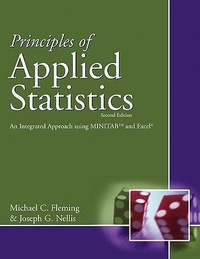
Principles of Applied Statistics
An Integrated Approach using MINITAB and Excel
2nd Edition
Published on 21. September 2000
Book
Paperback/Softback
480 pages
978-1-86152-586-4 (ISBN)
Description
Designed for anyone who needs a comprehensive introduction to the principles of statistical methods and their applications, this text is written in a practical, non-threatening style. Step-by-step worked examples are used to illustrate the use of statistical techniques in solving practical problems while self-study exercises test students' knowledge. The use of Excel and MINITAB? is fully integrated throughout the book to demonstrate the application of computer packages to solve a wide range of statistical problems. Presented alongside manual methods, these computer solutions include detailed instructions and annotated print outs where appropriate. The second edition retains the straightforward writing style and practical illustration of manual and computer methods which made the previous book successful for a wide range of courses.
Reviews / Votes
List of Figures in Main Text List of Tables in Main Text List of Worked Examples Preface 1. Introduction PART 1: DESCRIPTIVE STATISTICS 2. Describing Data - Tables, Charts and Graphs 3. Describing Data - Central Tendency 4. Describing Data - Variability 5. Exploratory Data Analysis PART 2: PROBABILITY AND PROBABILITY DISTRIBUTIONS 6. Probability Concepts 7. Binomial Probability Distribution 8. Poisson Probability Distribution 9. Normal Probability Distribution PART 3: STATISTICAL INFERENCE 10. Statistical Inference - An Overview 11. Sampling Distributions 12. Estimation 13. Estimation and the t Distribution 14. Hypothesis Testing: Single Population Mean 15. Hypothesis Testing: Two Population Means 16. Estimation and Hypothesis Testing: Proportions 17. Analysis of Variance (ANOVA) PART 4: RELATIONSHIPS BETWEEN VARIABLES 18. Simple Linear Regression and Correlation 19. Multiple Linear Regression and Correlation 20. Tests of Goodness-of-Fit and Independence PART 5: TIME SERIES AND INDEX NUMBERS 21. Time Series Analysis 22. Index Numbers References for Further Reading APPENDIX A: STATISTICAL TABLES APPENDIX B: DESCRIPTION OF Minitab AND ITS APPLICATION APPENDIX C: DESCRIPTION OF MICROSOFT EXCEL AND ITS APPLICATION Answers to Self-Study Exercises Glossary IndexMore details
Edition
2nd edition
Language
English
Place of publication
London
United Kingdom
Target group
College/higher education
Professional and scholarly
Edition type
Annotated edition
Product notice
Paperback (trade)
Unsewn / adhesive bound
Dimensions
Height: 239 mm
Width: 187 mm
Thickness: 29 mm
Weight
920 gr
ISBN-13
978-1-86152-586-4 (9781861525864)
Copyright in bibliographic data and cover images is held by Nielsen Book Services Limited or by the publishers or by their respective licensors: all rights reserved.
Schweitzer Classification
Other editions
Previous edition

M.C. Fleming | Joseph G. Nellis
Principles of Applied Statistics and Information Management
Book
05/1994
Cengage Learning EMEA
€49.70
Article exhausted; check for reprint
Persons
Michael C. Fleming is affiliated with Loughborough University. Joseph G. Nellis is at the Cranfield School of Management.
Content
1. Introduction.
PART 1: DESCRIPTIVE STATISTICS.
2. Describing Data - Tables, Charts and Graphs.
3. Describing Data - Central Tendency.
4. Describing Data - Variability.
5. Exploratory Data Analysis.
PART 2: PROBABILITY AND PROBABILITY DISTRIBUTIONS.
6. Probability Concepts.
7. Binomial Probability Distribution.
8. Poisson Probability Distribution.
9. Normal Probability Distribution.
PART 3: STATISTICAL INFERENCE.
10. Statistical Inference - An Overview.
11. Sampling Distributions.
12. Estimation.
13. Estimation and the t Distribution.
14. Hypothesis Testing: Single Population Mean.
15. Hypothesis Testing: Two Population Means.
16. Estimation and Hypothesis Testing: Proportions.
17. Analysis of Variance (ANOVA).
PART 4: RELATIONSHIPS BETWEEN VARIABLES.
18. Simple Linear Regression and Correlation.
19. Multiple Linear Regression and Correlation.
20. Tests of Goodness-of-Fit and Independence.
PART 5: TIME SERIES AND INDEX NUMBERS.
21. Time Series Analysis.
22. Index Numbers.
References for Further Reading.
APPENDIX A: STATISTICAL TABLES.
APPENDIX B: DESCRIPTION OF Minitab? AND ITS APPLICATION.
APPENDIX C: DESCRIPTION OF MICROSOFT EXCEL AND ITS APPLICATION.
Answers to Self-Study Exercises.
Glossary.
Index.
PART 1: DESCRIPTIVE STATISTICS.
2. Describing Data - Tables, Charts and Graphs.
3. Describing Data - Central Tendency.
4. Describing Data - Variability.
5. Exploratory Data Analysis.
PART 2: PROBABILITY AND PROBABILITY DISTRIBUTIONS.
6. Probability Concepts.
7. Binomial Probability Distribution.
8. Poisson Probability Distribution.
9. Normal Probability Distribution.
PART 3: STATISTICAL INFERENCE.
10. Statistical Inference - An Overview.
11. Sampling Distributions.
12. Estimation.
13. Estimation and the t Distribution.
14. Hypothesis Testing: Single Population Mean.
15. Hypothesis Testing: Two Population Means.
16. Estimation and Hypothesis Testing: Proportions.
17. Analysis of Variance (ANOVA).
PART 4: RELATIONSHIPS BETWEEN VARIABLES.
18. Simple Linear Regression and Correlation.
19. Multiple Linear Regression and Correlation.
20. Tests of Goodness-of-Fit and Independence.
PART 5: TIME SERIES AND INDEX NUMBERS.
21. Time Series Analysis.
22. Index Numbers.
References for Further Reading.
APPENDIX A: STATISTICAL TABLES.
APPENDIX B: DESCRIPTION OF Minitab? AND ITS APPLICATION.
APPENDIX C: DESCRIPTION OF MICROSOFT EXCEL AND ITS APPLICATION.
Answers to Self-Study Exercises.
Glossary.
Index.