

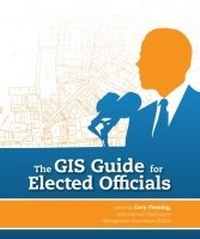
The GIS Guide for Elected Officials
Published on 6. January 2014
Book
Paperback/Softback
260 pages
978-1-58948-272-2 (ISBN)
Description
The GIS Guide for Elected Officials is a go-to resource for government officials who want to better understand how the power of GIS can be leveraged to answer their constituents' questions. Such questions often require location-based information for answers: Can work crews respond more efficiently to service calls? Where do police and fire department calls for service originate? Does citizen satisfaction with city services vary across the community? Are calls for service originating from the same neighbourhood about the same problem, and why?
Including more than fifty real-life use cases, these stories offer ample evidence of the wide range of problems GIS can help solve. Examples include stories about determining potential markets for a start-up business in Littleton, Colorado; responding to the needs of special populations groups within the community during a disaster in Fort Worth, Texas; and identifying urban food deserts in Chattanooga, Tennessee. Designed as a peer-to-peer information sharing effort to enable governments to learn from the experience of others, this volume also includes a review of what it takes to build and maintain a strong GIS programme especially in light of rapidly changing technology and shrinking government budgets.
Including more than fifty real-life use cases, these stories offer ample evidence of the wide range of problems GIS can help solve. Examples include stories about determining potential markets for a start-up business in Littleton, Colorado; responding to the needs of special populations groups within the community during a disaster in Fort Worth, Texas; and identifying urban food deserts in Chattanooga, Tennessee. Designed as a peer-to-peer information sharing effort to enable governments to learn from the experience of others, this volume also includes a review of what it takes to build and maintain a strong GIS programme especially in light of rapidly changing technology and shrinking government budgets.
More details
Language
English
Place of publication
Redlands
United States
Illustrations
105 illustrations
ISBN-13
978-1-58948-272-2 (9781589482722)
Copyright in bibliographic data and cover images is held by Nielsen Book Services Limited or by the publishers or by their respective licensors: all rights reserved.
Schweitzer Classification
Other editions
Additional editions
Cory Fleming
The GIS Guide for Elected Officials
E-Book
01/2014
1st Edition
Esri Press
from
€42.69
Available for download
Person
Cory Fleming directs ICMA's 311/CRM Technical Assistance Services, providing contract services to local governments implementing 311/CRM systems including community readiness assessments, definition of system requirements, RFP development, and system planning. Fleming has written about the use of data for improved local government service delivery and performance measurement in various capacities. She taught survey management for the George Washington University's Survey Design and Analysis Graduate Certificate Program from 2002-2004. She served as the editor of The GIS Guide for Local Government Officials, a joint publication produced by ESRI and ICMA released in 2005.
Content
Part 1. Understanding GIS
Geographic Information Systems (GIS) technology offers vast analytic capability. Part 1 highlights the evolution of GIS technology and includes interviews with leaders in government who discuss advances in the use of GIS technology for a wide variety of purposes.
Part 2. Using GIS to Support Policy Decisions
From making decisions about land use planning or managing natural resources to identifying where food deserts exist in an urban area, GIS gives decision makers an important tool for better understanding the impacts of their decisions and explaining those decisions to their constituents. Part 2 features case studies that highlight the many different GIS applications that governments at all levels have developed to make better policy.
Part 3. Streamlining Government Operations with GIS
Part 3 focuses on how GIS technology can help streamline government operations. From a ground-breaking study that explores return on investment (ROI) resulting from the development of the GIS program in King County, Washington, to numerous examples of how new efficiencies were achieved using GIS, the case studies in this section offer important lessons in what can be accomplished with a little creativity and innovation.
Part 4. Building a Strong GIS Program
The final section to this volume outlines what elected officials need to know in order to provide much needed support to their own GIS program. Decisions makers need not become technical wizards in order to make decisions that result in a robust GIS program.
Geographic Information Systems (GIS) technology offers vast analytic capability. Part 1 highlights the evolution of GIS technology and includes interviews with leaders in government who discuss advances in the use of GIS technology for a wide variety of purposes.
Part 2. Using GIS to Support Policy Decisions
From making decisions about land use planning or managing natural resources to identifying where food deserts exist in an urban area, GIS gives decision makers an important tool for better understanding the impacts of their decisions and explaining those decisions to their constituents. Part 2 features case studies that highlight the many different GIS applications that governments at all levels have developed to make better policy.
Part 3. Streamlining Government Operations with GIS
Part 3 focuses on how GIS technology can help streamline government operations. From a ground-breaking study that explores return on investment (ROI) resulting from the development of the GIS program in King County, Washington, to numerous examples of how new efficiencies were achieved using GIS, the case studies in this section offer important lessons in what can be accomplished with a little creativity and innovation.
Part 4. Building a Strong GIS Program
The final section to this volume outlines what elected officials need to know in order to provide much needed support to their own GIS program. Decisions makers need not become technical wizards in order to make decisions that result in a robust GIS program.