

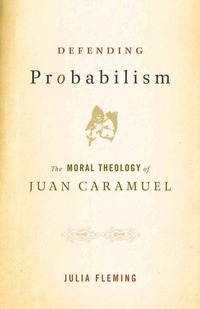
Defending Probabilism
The Moral Theology of Juan Caramuel
Will be published approx. on 1. November 2006
Book
Hardback
224 pages
978-1-58901-113-7 (ISBN)
Description
Through the centuries, at the heart of Catholic moral theology is a fundamental question: How do we behave responsibly in the face of moral uncertainty? Attempts to resolve problems of everyday life led to the growth of a variety of moral systems, one of which emerged in the early 17th century and was known as "probabilism." This method of solving difficult moral cases allowed the believer to rely upon a view that was judged defensible in terms of its arguments or the authorities behind it, even if the opposite opinion was supported by stronger arguments or more authorities. The theologian Juan Caramuel, a Spanish Cistercian monk whom Alphonso Liguori famously characterized as "the prince of laxists," has been regarded as one of the more extreme - and notorious - proponents of probabilism. As the only full-length English study of Caramuel's theological method, "Defending Probabilism" seeks to reappraise Caramuel's legacy, claiming that his model of moral thinking, if better understood, can actually be of help to the Church today.
Considered one of the most erudite theologians of his age, a scientist and scholar who published works on everything from astronomy and architecture to printing and Gregorian chant, Caramuel strove throughout his life to understand probabilism's theological and philosophical foundations as part of his broader analysis of the nature of human knowledge. In applying Caramuel's legacy to our own time, "Defending Probabilism" calls for a reconsideration of the value of provisional moral knowledge. Fleming's study shows that history matters, and that to attain any position on moral certitude is a difficult and painstaking process.
Considered one of the most erudite theologians of his age, a scientist and scholar who published works on everything from astronomy and architecture to printing and Gregorian chant, Caramuel strove throughout his life to understand probabilism's theological and philosophical foundations as part of his broader analysis of the nature of human knowledge. In applying Caramuel's legacy to our own time, "Defending Probabilism" calls for a reconsideration of the value of provisional moral knowledge. Fleming's study shows that history matters, and that to attain any position on moral certitude is a difficult and painstaking process.
Reviews / Votes
A valuable contribution to the library, or at least the reading list, of any Catholic moral theologian... A valuable insight into a period in the history of moral theology that is too little appreciated today... I would strongly recommend this text to every student or moral theology, but especially to candidate priest-confessors. -- Joseph. A. Selling LOUVAIN STUDIESMore details
Series
Language
English
Place of publication
Washington, DC
United States
Target group
Professional and scholarly
US School Grade: College Graduate Student and over
Product notice
Unsewn / adhesive bound
Paper over boards
With dust jacket
Illustrations
Not illustrated
Dimensions
Height: 224 mm
Width: 162 mm
Thickness: 20 mm
Weight
426 gr
ISBN-13
978-1-58901-113-7 (9781589011137)
Copyright in bibliographic data and cover images is held by Nielsen Book Services Limited or by the publishers or by their respective licensors: all rights reserved.
Schweitzer Classification
Persons
Julia Fleming is an associate professor of theology at Creighton University.
Content
Foreword by Charles E. CurranPrefaceAcknowledgments 1. Situating Probabilism: The Ethical Theory and Its Significance for Caramuel 2. Advocating Probabilism: Caramuel's Early Writings and the Proof-Texts They Provided for His Critics 3. Using Probabilism: Avoiding Improbable Warfare and Making Peace with Protestants 4. Protecting Probabilism: The Apologema as an Answer to Probabilism's Critics 5. Explaining Probabilism: The Apologema's Project of Education 6. Redefining Probabilism: The Dialexis de Non-Certitudine Afterword Remembring Probabilism: The Contemporary Significance of Caramuel's Legacy Notes Index