

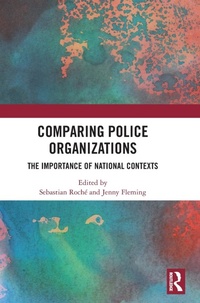
Comparing Police Organizations
The Importance of National Contexts
1st Edition
Published on 15. February 2024
Book
Hardback
200 pages
978-1-032-68875-6 (ISBN)
Description
Police citizen encounters do not occur in a vacuum. Police systems globally have similarities and/or differences which remain largely understudied and therefore underexplained. Comparative policing is a new frontier for policing research as it aims at integrating the institutional and/or macro determinants of police strategy and provides important insights into the context in which such strategies emerge. This volume shows how lessons and insights emerge from a comparative approach to policing research in various regions of the world. It demonstrates the explanatory power of cross-national studies, with a particular focus on politics, policies, and for what concerns the nature of police work and the legitimacy of policing.
The book presents comparative studies from different geographical locations such as Latin and Central America, Africa, India, and Europe, and offers insights on:
Police worker politics in India and Brazil
Police, non-state security actors, and political legitimacy in central America
Trust in the police and the militarization of law enforcement in Latin America
The origins of police legitimacy in Europe
How organizational contexts matter by analyzing police-adolescent encounters in France and Germany
Legitimacy and cooperation with the police in two African states.
Cross-state and cross-society research is desirable to increase our understanding of variations of the macro context in which police forces operate, what policing means for citizens and for police officers as professional workers. This insightful volume is a key resource for scholars and researchers of policing, criminology, sociology, and law. This book was originally published as the inaugural volume of Comparative Policing Review / Policing and Society.
The book presents comparative studies from different geographical locations such as Latin and Central America, Africa, India, and Europe, and offers insights on:
Police worker politics in India and Brazil
Police, non-state security actors, and political legitimacy in central America
Trust in the police and the militarization of law enforcement in Latin America
The origins of police legitimacy in Europe
How organizational contexts matter by analyzing police-adolescent encounters in France and Germany
Legitimacy and cooperation with the police in two African states.
Cross-state and cross-society research is desirable to increase our understanding of variations of the macro context in which police forces operate, what policing means for citizens and for police officers as professional workers. This insightful volume is a key resource for scholars and researchers of policing, criminology, sociology, and law. This book was originally published as the inaugural volume of Comparative Policing Review / Policing and Society.
More details
Language
English
Place of publication
London
United Kingdom
Publishing group
Taylor & Francis Ltd
Target group
College/higher education
Postgraduate, Undergraduate Advanced, and Undergraduate Core
Dimensions
Height: 250 mm
Width: 175 mm
Thickness: 16 mm
Weight
560 gr
ISBN-13
978-1-032-68875-6 (9781032688756)
Copyright in bibliographic data and cover images is held by Nielsen Book Services Limited or by the publishers or by their respective licensors: all rights reserved.
Schweitzer Classification
Other editions
Additional editions
Book
07/2025
1st Edition
Routledge
€67.10
Shipment within 10-20 days
E-Book
02/2024
1st Edition
Taylor & Francis
€60.49
Available for download
E-Book
02/2024
1st Edition
Taylor & Francis
€60.49
Available for download
Persons
Sebastian Roche is a CNRS Research Professor at Sciences Po Grenoble, University of Grenoble-Aples, France, specializing in comparative policing studies. He is the author, with Dietrich Oberwittler, of Police Citizens Relations Across the Word: Comparing Sources and Contexts of Trust and Legitimacy (2018).
Jenny Fleming is Professor of Criminology at the University of Southampton, UK and Editor in Chief of Policing and Society: An International Journal of Research and Policy. Her recent book, The International Handbook of Policing Ethnography was published in 2023.
Jenny Fleming is Professor of Criminology at the University of Southampton, UK and Editor in Chief of Policing and Society: An International Journal of Research and Policy. Her recent book, The International Handbook of Policing Ethnography was published in 2023.
Content
Foreword Preface-Why study policing comparatively? Introduction-Cross-national research: A new frontier for police studies 1. Police worker politics in India, Brazil, and beyond 2. Police, non-state actors, and political legitimacy in Central America 3. Trust in the police and the militarization of law enforcement in Latin America 4. Institutions, political attitudes or personal values? A multilevel investigation into the origins of police legitimacy in Europe 5. How national contexts matter: A Study of police-adolescent encounters in France and Germany 6. Legitimacy and cooperation with the police: Examining empirical relationships using data from Africa 7. The inevitable fallibility of policing