

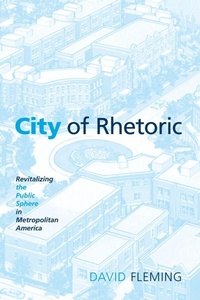
City of Rhetoric
Revitalizing the Public Sphere in Metropolitan America
Published on 1. July 2009
Book
Paperback/Softback
346 pages
978-0-7914-7650-5 (ISBN)
Description
Examines the relationship of civic discourse to built environments through a case study of the Cabrini Green urban revitalization project in Chicago.
Combining a detailed case study of Chicago's Cabrini Green urban revitalization project with the concerns of modern political philosophy and rhetorical education, David Fleming examines the relationship between public discourse and the built environment in the contemporary United States. For more than half a century, low-income African American residents of the Cabrini Green public housing project have struggled against the extreme spatial inequality of their metropolitan region. The author examines three different options considered as part of revitalization efforts for the neighborhood: the dispersal of the project's residents into the largely white suburbs of Chicago; the building of a low-rise, mixed-income "urban village" on the same site; and the conversion of one of the original buildings into a democratically governed, not-for-profit housing cooperative.
The author argues that each of these projects involves imagining the physical, socioeconomic, and rhetorical community of the contemporary city in dramatically different ways. Considered together, the projects provide evidence that places still matter in human flourishing, but show that the places of our contemporary landscape are unequal in resources and opportunities, and that our public philosophies support this inequality. Fleming reminds us, however, that these arrangements are plastic and can be redesigned to reflect a more equitable sharing of public problems and resources.
Combining a detailed case study of Chicago's Cabrini Green urban revitalization project with the concerns of modern political philosophy and rhetorical education, David Fleming examines the relationship between public discourse and the built environment in the contemporary United States. For more than half a century, low-income African American residents of the Cabrini Green public housing project have struggled against the extreme spatial inequality of their metropolitan region. The author examines three different options considered as part of revitalization efforts for the neighborhood: the dispersal of the project's residents into the largely white suburbs of Chicago; the building of a low-rise, mixed-income "urban village" on the same site; and the conversion of one of the original buildings into a democratically governed, not-for-profit housing cooperative.
The author argues that each of these projects involves imagining the physical, socioeconomic, and rhetorical community of the contemporary city in dramatically different ways. Considered together, the projects provide evidence that places still matter in human flourishing, but show that the places of our contemporary landscape are unequal in resources and opportunities, and that our public philosophies support this inequality. Fleming reminds us, however, that these arrangements are plastic and can be redesigned to reflect a more equitable sharing of public problems and resources.
Reviews / Votes
"City of Rhetoric is a well-researched, highly readable, and ambitious book." - JAC"Wide ranging in its conception, relevant in the problems it addresses, well-grounded in several intellectual traditions, and engaging in its detailed ethnographic analysis, City of Rhetoric probes the relationship between the built space and rhetorical possibility. This remarkable project explores civic rhetoric in situ. In so doing, David Fleming sheds new light on the 'place' of the public in our daily civic and rhetorical lives." - Rolf Norgaard, University of Colorado at Boulder
More details
Language
English
Place of publication
Albany, NY
United States
Target group
Professional and scholarly
US School Grade: College Graduate Student and over
Product notice
Paperback (trade)
Illustrations
2 Maps; 13 Tables, black and white; 1 Figures; 2 Illustrations, black and white
Dimensions
Height: 229 mm
Width: 152 mm
Thickness: 21 mm
Weight
565 gr
ISBN-13
978-0-7914-7650-5 (9780791476505)
Copyright in bibliographic data and cover images is held by Nielsen Book Services Limited or by the publishers or by their respective licensors: all rights reserved.
Schweitzer Classification
Other editions
Additional editions
E-Book
10/2008
1st Edition
De Gruyter
€37.99
Available for download
Person
David Fleming is Associate Professor of English and Director of the Writing Program at the University of Massachusetts Amherst.
Content
List of Illustrations
Preface
1. Introduction: Death Corner
Part One The Geography of Politics
2. The Placelessness of Political Theory
3. A New Civic Map for Our Time
Part Two Designing the Twenty-fi rst Century Public Sphere
4. Ghetto: Chicago, 1995
5. Suburbia: Schaumburg, Illinois
6. The New Urbanism: North Town Village
7. Home: 1230 North Burling Street
Part Three Lessons for Theory and Practice
8. Toward a New Sociospatial Dialectic
9. Cities of Rhetoric
10. Afterword
Acknowledgments
Appendix
Notes
Bibliography
Index
Preface
1. Introduction: Death Corner
Part One The Geography of Politics
2. The Placelessness of Political Theory
3. A New Civic Map for Our Time
Part Two Designing the Twenty-fi rst Century Public Sphere
4. Ghetto: Chicago, 1995
5. Suburbia: Schaumburg, Illinois
6. The New Urbanism: North Town Village
7. Home: 1230 North Burling Street
Part Three Lessons for Theory and Practice
8. Toward a New Sociospatial Dialectic
9. Cities of Rhetoric
10. Afterword
Acknowledgments
Appendix
Notes
Bibliography
Index