

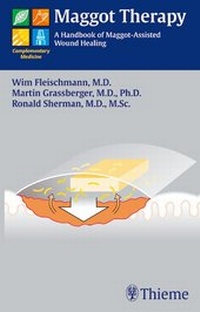
Maggot Therapy
A Handbook of Maggot-Assisted Wound Healing
1st Edition
Published on 10. December 2003
Book
Paperback/Softback
88 pages
978-3-13-136811-9 (ISBN)
Description
Impressive Results for Slow-healing Wounds
An Ancient Treatment - Rediscovered Fly larvae have been used for centuries to successfully treat wounds. However, once penicillin was discovered, and antibiotic therapy became common worldwide, maggot therapy was forgotten. But now that bacteria are becoming increasingly resistant to modern antibiotics, maggot therapy is experiencing a resurgence.
Maggots Promote Healing Fly larvae can debride and help heal chronic wounds in a form of "biosurgery." As strange as it sounds, maggot therapy is often a patient's last chance to prevent amputation of a limb. The results of maggot therapy have been impressive in treating diabetic foot ulcers, slow-healing wounds resulting from circulatory problems, and pressure sores in bed-bound patients: over a majority of these wounds - many of them in existence for years - heal without pain or side effects.
This text contains extensive, reader-friendly information on maggot therapy. There is an overview of the pertinent fly species, a history of maggot therapy, and information on maggots' mode of action and application. In addition to detailed descriptions of the clinical problems for which maggots can be used, there are case studies and questions and answers from medical practice.
An Ancient Treatment - Rediscovered Fly larvae have been used for centuries to successfully treat wounds. However, once penicillin was discovered, and antibiotic therapy became common worldwide, maggot therapy was forgotten. But now that bacteria are becoming increasingly resistant to modern antibiotics, maggot therapy is experiencing a resurgence.
Maggots Promote Healing Fly larvae can debride and help heal chronic wounds in a form of "biosurgery." As strange as it sounds, maggot therapy is often a patient's last chance to prevent amputation of a limb. The results of maggot therapy have been impressive in treating diabetic foot ulcers, slow-healing wounds resulting from circulatory problems, and pressure sores in bed-bound patients: over a majority of these wounds - many of them in existence for years - heal without pain or side effects.
This text contains extensive, reader-friendly information on maggot therapy. There is an overview of the pertinent fly species, a history of maggot therapy, and information on maggots' mode of action and application. In addition to detailed descriptions of the clinical problems for which maggots can be used, there are case studies and questions and answers from medical practice.
More details
Language
English
Place of publication
Stuttgart
Germany
Target group
College/higher education
Professional and scholarly
Ärzte
Product notice
Paperback (trade)
Illustrations
32
32 Abbildungen
Dimensions
Height: 19 cm
Width: 12 cm
Weight
162 gr
ISBN-13
978-3-13-136811-9 (9783131368119)
Schweitzer Classification
Other editions
Additional editions
Wim Fleischmann | Martin Grassberger | Ronald Sherman
Maggot Therapy
A Handbook of Maggot-Assisted Wound Healing
E-Book
12/2003
1st Edition
Thieme
€18.99
Available for download
Wim Fleischmann | Martin Grassberger | Ronald Sherman
Maggot Therapy
A Handbook of Maggot-Assisted Wound Healing
E-Book
12/2003
1st Edition
Thieme
€18.99
Available for download
Previous edition

Wim Fleischmann | Ronald Sherman | Martin Grassberger
Maggot Therapy
A Handbook of Maggot-Assisted Wound Healing
Book
12/2003
Thieme Publishers
€39.45
Withdrawn from sale
Persons
Fleischmann, Grassberger, Sherman
Content
1 Introduction
2 Maggots
3 Maggots and Wound Healing
4 Clinical Application of Maggots
5 Appendix
2 Maggots
3 Maggots and Wound Healing
4 Clinical Application of Maggots
5 Appendix