


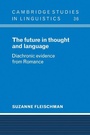
The Future in Thought and Language
Diachronic Evidence from Romance
Published on 8. April 1982
Book
Hardback
230 pages
978-0-521-24389-6 (ISBN)
Description
Questions about the development of the Romance future have engaged scholars since Thielmann's classic statement of 1885, yet a century later a number of the fundamental issues remain unresolved. Professor Fleischman suggests that this is in part due to the narrow sense in which the question has traditionally been formulated - as simply the history of the `future-tense' slot in the grammar - and in part the result of the investigative approach, which until recently has taken little account of important advances in general linguistics in the field of diachronic syntax. The present volume examines 'future' as a conceptual category and discusses the various strategies that have been used to map this conceptual category on to grammar in Romance. The data are taken in the main from Western Romance languages, particularly French, and frequent parallels are drawn with English. To account for the evolution of the future, Professor Fleischman proposes a network of interrelated, often cyclical developments in syntax and semantics, and seeks to place the individual diachronic events within a broader framework of syntactic typology and universal patterns of word-order change.
More details
Series
Language
English
Place of publication
Cambridge
United Kingdom
Target group
College/higher education
Illustrations
Worked examples or Exercises
Dimensions
Height: 228 mm
Width: 152 mm
Thickness: 17 mm
Weight
497 gr
ISBN-13
978-0-521-24389-6 (9780521243896)
Copyright in bibliographic data is held by Nielsen Book Services Limited or its licensors: all rights reserved.
Schweitzer Classification
Other editions
New editions
Book
03/2009
Cambridge University Press
€54.30
Shipment within 15-20 days
Additional editions
Book
03/2009
Cambridge University Press
€54.30
Shipment within 15-20 days
Content
1. Operational preliminaries; 2. Future as an ontological and grammatical category; 3. The Latin background; 4. Romance; 5. Syntheticity vs. analyticity in Romance futures and perfects; 6. Semantics of futurity in Romance; 7. Conclusions.