

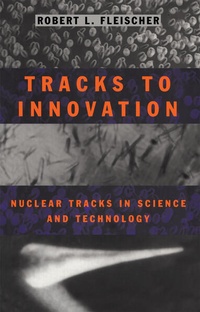
Tracks to Innovation
Nuclear Tracks in Science and Technology
Published on 12. January 1998
Book
Hardback
XIV, 193 pages
978-0-387-98342-4 (ISBN)
Description
A serendipitous discovery in nuclear physics has led to a useful tool in materials science. In the late 1950s, scientists at General Electric (among them the author) discovered that when mica is exposed to energetic charged particles (such as are emitted in radioactive decay or occur in cosmic rays), the particles leave latent tracks in the material. When such a material is chemically etched, the tracks are revealed as narrow, deep pits, whose size and shape is determined both by the particle that made the track and by the technique used in etching. It soon turned out that glass, plastics, or certain other materials can be similarly treated. This discovery paved the way not only for a new and useful method of measuring radioactivity, it has also found widespread applications in other fields, ranging from geology and materials science to archaeology and art history. Thus, for example, naturally produced tracks can be used to estimate the age of a mineral deposit or an archaeological material; and deliberately produced tracks can be used to make extremely fine filters. Fleischer presents the history of these developments and discusses the applications of the technique in a way that will be interesting to anyone with a minimal knowledge of physics.
More details
Edition
1998 ed.
Language
English
Place of publication
New York
United States
Target group
Professional and scholarly
Professional/practitioner
Product notice
sewn/stitched
Cloth over boards
Illustrations
XIV, 193 p.
Dimensions
Height: 242 mm
Width: 162 mm
Thickness: 14 mm
Weight
481 gr
ISBN-13
978-0-387-98342-4 (9780387983424)
DOI
10.1007/978-1-4612-4452-3
Schweitzer Classification
Other editions
Additional editions
Book
12/2011
Springer
€53.49
Shipment within 15-20 days
Content
1 Etching Nuclear Tracks.- 2 Hole Etching-From Filters to Counters.- 3 Radon-A Hazard and a Help.- 4 Tracks of Time.- 5 Cosmic Rays.- 6 Divergent Track Uses.- 7 Links of Science and Technology.- Further In-Depth Reading.- Author Index.