

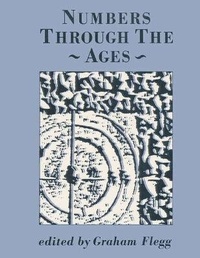
Numbers Through the Ages
Published on 18. September 1989
Book
Paperback/Softback
240 pages
978-0-333-49131-7 (ISBN)
Description
The material of this book originally formed part of the Open University course AM289 History of Mathematics. The book deals with the evolution of the concept of "number", with the representation of numbers by words and symbols and with the basic methods of calculation which have developed from ancient times to the present day. These aspects are of considerable general interest and the text is accessible to the general reader including people who are not mathematically inclined.
More details
Language
English
Place of publication
Basingstoke
United Kingdom
Target group
College/higher education
Illustrations
bibliography, index
Dimensions
Height: 246 mm
Width: 189 mm
Weight
520 gr
ISBN-13
978-0-333-49131-7 (9780333491317)
Copyright in bibliographic data and cover images is held by Nielsen Book Services Limited or by the publishers or by their respective licensors: all rights reserved.
Schweitzer Classification
Content
Part 1 Counting systems: decimal counting; primitive counting methods; remnants of ancient counting; finger and body counting; tallies and knots; the origin of counting. Part 2 Number words: linguistic principles; adjectives and the dual; reconstruction of original Indo-European words; the origins of "ten", "hundred", "thousand" and "million"; remnants of non-decimal number words. Part 3 Written numbers: Egyptian numerals; Sumerian and Babylonian numerals; Chinese numerals; Greek numerals and their derivatives; Roman numerals; Mayan numerals; early Hindu numerals; the introduction of place-value in India; Hindu numerals and the Arabs; Hindu-Arabic numerals in the West. Part 4 Fractions and calculation: natural and unit fractions; Egyptian calculation with fractions; Babylonian sexagesimal fractions and algebra; sexagesimal fractions and astronomy; fractions in Ancient Greece, China and India; decimal fractions in China and amongst the Arabs and in Western Europe. Part 5 Aids to calculation: the abacus in antiquity; the monastic abacus; calculation on the lines; the Chinese, Japanese and Russian abaci; early calculating machines; the automatic computer.