

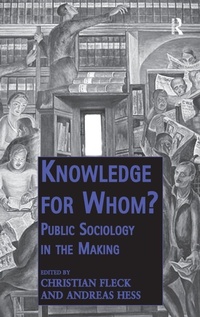
Knowledge for Whom?
Public Sociology in the Making
1st Edition
Published on 28. December 2013
Book
Hardback
340 pages
978-1-4094-3458-0 (ISBN)
Description
This ground-breaking volume is a follow-up to Intellectuals and Their Publics. In contrast to the earlier book, which was mainly concerned with the activity of intellectuals and how it relates to the public, this volume analyses what happens when sociology and sociologists engage with or serve various publics. More specifically, this problem will be studied from the following three angles: How does one become a public sociologist and prominent intellectual in the first place? (Part I) How complex and complicated are the stories of institutions and professional associations when they take on a public role or tackle a major social or political problem? (Part II) How can one investigate the relationship between individual sociologists and intellectuals and their various publics? (Part III) This book will be of interest to academics and students working in the fields of the sociology of knowledge and ideas, the history of social sciences, intellectual history, cultural sociology, and cultural studies.
Reviews / Votes
'What's the point of sociology? Sociology has long been the most self-questioning of disciplines. Recently, such self-interrogation has involved discussion about what kinds of audiences sociology reaches and should be reaching. This book constitutes a vast leap forward in the public sociology? debates, enriching them with historical depth, philosophical sophistication, and a truly global vision. An exceptionally attention-grabbing contribution.' David Inglis, University of Exeter, UK 'Hess and Fleck continue their important effort to return the debate over public sociology to where it belongs - the sociology of knowledge. This new collection is filled with probing contributions of striking interest.' Jeffrey Alexander, Yale University, USA 'The strength of the Fleck and Hess volume lies ... mainly in its critical intellectual engagement with the scholarly and conflict-ridden richness of sociological history itself ... an impressive contribution to the history of sociology and social science more generally'. International SociologyMore details
Series
Language
English
Place of publication
London
United Kingdom
Publishing group
Taylor & Francis Ltd
Target group
College/higher education
Academic
Product notice
sewn/stitched
Cloth over boards
Dimensions
Height: 234 mm
Width: 156 mm
Thickness: 21 mm
Weight
658 gr
ISBN-13
978-1-4094-3458-0 (9781409434580)
Copyright in bibliographic data and cover images is held by Nielsen Book Services Limited or by the publishers or by their respective licensors: all rights reserved.
Schweitzer Classification
Other editions
Additional editions
Book
10/2024
1st Edition
Routledge
€55.50
Shipment within 10-20 days
E-Book
04/2016
Routledge
€53.99
Available for download
E-Book
04/2016
Routledge
€53.99
Available for download
Persons
Christian Fleck is Professor of Sociology at the University of Graz in Austria. Andreas Hess is Senior Lecturer in Sociology at University College Dublin in Ireland.
Content
Introduction: Public Sociology in the Making, Christian Fleck, Andreas Hess; Part I Public Intellectuals and their Afterlives:Biography in the Social Sciences: The Case of Marcel Mauss, Marcel Fournier; Chapter 2 Making Sense of Individual Creativity: An Attempt to Trespass the Academic Boundaries of the Sociology of Ideas and Intellectual History, Andreas Hess; Chapter 3 Scholarly Publishing Projects in the Great Depression: The Works of G.H. Mead and the Payne Fund Studies, Daniel R. Huebner; Chapter 4 Psychology and Sociology in the Late 19th Century French Intellectual Field: The Case of the Revue Internationale de Sociologie, Marcia Cristina Consolim; Chapter 5 From Communicative Memory to Non-History - Czech and Polish Narratives of Sociology's Past, Jaros?aw Kilias; Part II Serving the Public or Serving the State?: Trials and Tribulations of Organizational and State-related Histories; Chapter 6 Research For Whom?: Changing Conceptions of Disciplinarity in the American University, Daniel Gordon; Chapter 7 The Making of "Excellence" in the European Research Area: How Research Funding Organizations Work, Barbara Hoenig; Chapter 8 Using Scientific Knowledge in Policy Making: The Importance of Organizational Culture, Sally Shortall; Chapter 9 Public Sociology in Taiwan, Hong Kong and Singapore, Albert Tzeng; Chapter 10 A Chapter in the History of Brazilian Sociology: UNESCO Research about Race Relations and the Unexpected Prejudice against Poles in Curitiba (Parana), Marcio de Oliveira; Part III Intellectuals and Their Audiences; Chapter 11 Blurring the Boundary Line: The Origins and Fate of Robert Bellah's Symbolic Realism, Matteo Bortolini; Chapter 12 How Spaces of Opinion Shape Public Intellectuals: A Field-based Approach to Project Syndicate-Op-Eds, Philipp Korom; Chapter 13 The Role of Public Intellectual in the Role-Set of Academics, Ragnvald Kalleberg; Chapter 14 Critics as Cultural Intermediaries, Thomas Crosbie, Jonathan Roberge; Chapter 15 World Sociology: The View from Atlantis, Andrew Abbott;