

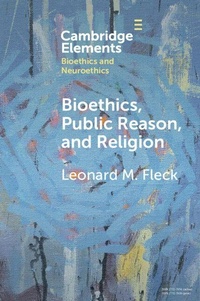
Bioethics, Public Reason, and Religion
The Liberalism Problem
Published on 1. September 2022
Book
Paperback/Softback
88 pages
978-1-009-07805-4 (ISBN)
Description
Can religious arguments provide a reasonable, justified basis for restrictive (coercive) public policies regarding numerous ethically and politically controversial medical interventions, such as research with human embryos, pre-implantation genetic diagnosis, or using artificial wombs? With Rawls, we answer negatively. Liberally reasonable policies must address these controversial technologies on the basis of public reasons accessible to all, even if not fully agreeable by all. Further, public democratic deliberation requires participants to construct these policies as citizens who are agnostic with respect to the truth of all comprehensive doctrines, whether secular or religious. The goal of these deliberations is practical, namely, to identify reasonable policy options that reflect fair terms of cooperation in a liberal, pluralistic society. Further, religious advocates may participate in formal policymaking processes as reasonable liberal citizens. Finally, public reason evolves through the deliberative process and all the novel technological challenges medicine generates for bioethics and related public policies.
More details
Series
Language
English
Place of publication
Cambridge
United Kingdom
Product notice
Paperback (trade)
Illustrations
Worked examples or Exercises
Dimensions
Height: 229 mm
Width: 152 mm
Thickness: 5 mm
Weight
127 gr
ISBN-13
978-1-009-07805-4 (9781009078054)
Copyright in bibliographic data and cover images is held by Nielsen Book Services Limited or by the publishers or by their respective licensors: all rights reserved.
Schweitzer Classification
Other editions
Additional editions
E-Book
09/2022
Cambridge University Press
€15.49
Available for download
E-Book
08/2022
Cambridge University Press
€15.49
Available for download
Person
Content
1. Introduction; 2. Rawlsian Political Liberalism; 3. Religion and Liberalism; 4. The Restraint Objection; 5. Public Reason: Criticisms from Religious Advocates; 6. Democratic Deliberation and the Evolution of Public Reason; 7. Conclusion; References.