

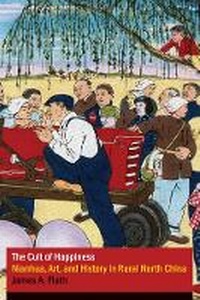
The Cult of Happiness
Nianhua, Art, and History in Rural North China
Will be published approx. on 15. March 2004
Book
Hardback
288 pages
978-0-7748-1034-0 (ISBN)
Description
History and art come together in this definitive discussion of the Chinese woodblock print form of nianhua, literally "New Year pictures." By analyzing the role of nianhua first in the home and later in commercial and political theatres, James Flath relates these artworks to the social, cultural, and political milieu of North China as it was between the late Qing dynasty and the early 1950s. Among the first studies in any field to treat folk art and folk print as historical text, The Cult of Happiness offers original insight into popular conceptions of domesticity, morality, gender, society, modernity, and the transformation of the genre as a propaganda tool under communism. An extraordinary account of the cultural life of rural North China over the period.
Reviews / Votes
This is a significant new book on the traditional New Year print (nianhua) in Norht China nad its modern transformations. Flath's book is based on a particularly thorough investigation of early (mostly nineteenth and early twentieth-century) European sources on popular prints. - David Holm, The University of Melbourne (The China Journal 55) There can be no doubt that this short book, densely packed with new information and well illustrated in colour as well as black and white, is an original contribution to the well-worked field of Late Imperial-Republican era Chinese history. James A. Flath brings to the history new material and a seriously interdisciplinary approach, one which draws on anthropology, folklore studies, and politics, as well as combing history with art history. - Ralph Croizier (University of Toronto Quarterly, vol. 75, no. 1, Winter 2006) This engagingly written and rigorously argued book on the nianhua, literally "New Year Pictures," produced in Shandong, Hebei, and Henan Provinces from about 1880 to 1950, is a welcome and important contribution to the study of China's visual culture ... The author's principal disciplinary identification is as a historian, and it is as historical texts that he engages with the seventy-four nianhua reproduced here (forty-three of them in good-quality color). However, his diligence in searching them out in collections in China and Europe, and the scrupulous attention paid to them also as material objects in their own right, with histories of production, distribution, and consumption practices all given their due weight is moreover a model of practice to art historians interested in addressing this material... The choice of cover illustration, a print from 1950 by Li Qi titled "Looking over the Tracktor," might lead the unwary to expect more discussion of the post-Liberation transformations of nianhua than the book provides. However, it is clear that James Flath is highly qualified to provide this discussion, and it is very much to be hoped that he continues to do so to the same high standard as he sets here. - Craig Clunas, Professor of Chinese and East Asian Art, School of Oriental and African Studies, London, China (Review International, Vol. 12, No.1, Spring 2005)More details
Series
Language
English
Place of publication
Vancouver
Canada
Target group
College/higher education
Professional and scholarly
Product notice
sewn/stitched
Illustrations
79 illustrations, 31 in colour
Dimensions
Height: 235 mm
Width: 159 mm
Weight
460 gr
ISBN-13
978-0-7748-1034-0 (9780774810340)
Copyright in bibliographic data and cover images is held by Nielsen Book Services Limited or by the publishers or by their respective licensors: all rights reserved.
Schweitzer Classification
Person
James A. Flath teaches in the Department of History at the University of Western Ontario.
Content
Introduction
1 The Production of Print Culture in North China
2 Home and Domesticity
3 State and Society
4 Retelling History through the Narrative Print
5 Print and the Cosmopolitan Mystique
6 The Politics of the Popular
7 Exorcising Modernity
Notes
Bibliography
Index
1 The Production of Print Culture in North China
2 Home and Domesticity
3 State and Society
4 Retelling History through the Narrative Print
5 Print and the Cosmopolitan Mystique
6 The Politics of the Popular
7 Exorcising Modernity
Notes
Bibliography
Index