

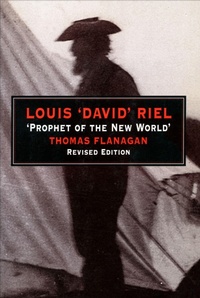
Louis 'David' Riel
Prophet of the New World
Published on 30. November 1996
Book
Paperback/Softback
240 pages
978-0-8020-7184-2 (ISBN)
Description
Louis Riel believed that on 8 December 1875 he received a divine commission authorizing him to save the Metis and reform the Catholic Church. He was a prophet, inspired by the Holy Spirit, and the Metis were the new chosen people. A new branch of the Catholic Church would be founded in North America, with its first Holy See in Montreal, and its second in Riel's birthplace of St. Vital.
When Riel expressed these views in 1876, he was committed to a lunatic asylum. After his release, he suppressed his ideas for several years, only to reveal them again to his Metis followers during the North-West Rebellion. The Rebellion thus became as much a religious as a political movement; Riel believed himself a prophet to the end of his life, and he went to his death thinking that he, like Christ, would be resurrected on the third day.
Earlier writers about Louis Riel have noted his religious beliefs but have not taken them seriously. They have usually dismissed Riel's attempt to found a new religion as the symptom of a deranged mind. Thomas Flanagan takes Riel's religion seriously and analyses it using categories developed in the literature about millenarian movements. He shows that Riel's religion, far from being simply individual madness, is typical of the nativistic and millenarian movements described by one author as the 'religions of the oppressed.'
This is also a biography, tracing Riel's thinking on religious subjects from his childhood to the end of his life and paying particular attention to events in his life that influenced his thinking. This developmental approach is necessary because Riel's ideas changed frequently; he never arrived at a fixed 'system.'
The research is based on primary sources throughout. Much new documentation has become available over the past thirty years and in the sixteen years since this volume was initially published. In particular, new information is presented about Riel's youth in Montreal, his time in insane asylums, his years in Montana, and the North-West Rebellion. Flanagan also re-interprets well-known documents. While this revised edition does not alter the fundamentals of his interpretation, it improves the historical backdrop against which it is presented through use of a wealth of new primary sources. Flanagan has updated his citings of Riel's manuscripts to current sources.
When Riel expressed these views in 1876, he was committed to a lunatic asylum. After his release, he suppressed his ideas for several years, only to reveal them again to his Metis followers during the North-West Rebellion. The Rebellion thus became as much a religious as a political movement; Riel believed himself a prophet to the end of his life, and he went to his death thinking that he, like Christ, would be resurrected on the third day.
Earlier writers about Louis Riel have noted his religious beliefs but have not taken them seriously. They have usually dismissed Riel's attempt to found a new religion as the symptom of a deranged mind. Thomas Flanagan takes Riel's religion seriously and analyses it using categories developed in the literature about millenarian movements. He shows that Riel's religion, far from being simply individual madness, is typical of the nativistic and millenarian movements described by one author as the 'religions of the oppressed.'
This is also a biography, tracing Riel's thinking on religious subjects from his childhood to the end of his life and paying particular attention to events in his life that influenced his thinking. This developmental approach is necessary because Riel's ideas changed frequently; he never arrived at a fixed 'system.'
The research is based on primary sources throughout. Much new documentation has become available over the past thirty years and in the sixteen years since this volume was initially published. In particular, new information is presented about Riel's youth in Montreal, his time in insane asylums, his years in Montana, and the North-West Rebellion. Flanagan also re-interprets well-known documents. While this revised edition does not alter the fundamentals of his interpretation, it improves the historical backdrop against which it is presented through use of a wealth of new primary sources. Flanagan has updated his citings of Riel's manuscripts to current sources.
More details
Edition
Revised edition
Language
English
Place of publication
Toronto
Canada
Target group
Professional and scholarly
Product notice
Paperback (trade)
Dimensions
Height: 229 mm
Width: 153 mm
Thickness: 20 mm
Weight
386 gr
ISBN-13
978-0-8020-7184-2 (9780802071842)
Copyright in bibliographic data and cover images is held by Nielsen Book Services Limited or by the publishers or by their respective licensors: all rights reserved.
Schweitzer Classification
Person
Thomas Flanagan is Professor of Political Science, University of Calgary. He is the author of several books including Louis 'David' Riel: 'Prophet of the New World', revised edition, UTP 1996.