

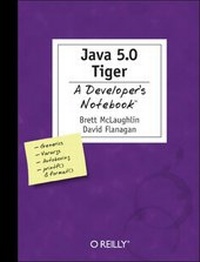
Java 5.0 Tiger: A Developer's Notebook
1st Edition
Published on 3. August 2004
Book
Paperback/Softback
200 pages
978-0-596-00738-6 (ISBN)
Description
Java 5.0, code-named "Tiger", promises to be the most significant new version of Java since the introduction of the language. With over a hundred substantial changes to the core language, as well as numerous library and API additions, developers have a variety of new features, facilities, and techniques available.
But with so many changes, where do you start? You could read through the lengthy, often boring language specification; you could wait for the latest 500 page tome on concepts and theory; you could even play around with the new JDK, hoping you figure things out--or you can get straight to work with Java 5.0 Tiger: A Developer's Notebook.
This no-nonsense, down-and-dirty guide by bestselling Java authors Brett McLaughlin and David Flanagan skips all the boring prose and lecture, and jumps right into Tiger. You'll have a handle on the important new features of the language by the end of the first chapter, and be neck-deep in code before you hit the halfway point. Using the task-oriented format of this new series, you'll get complete practical coverage of generics, learn how boxing and unboxing affects your type conversions, understand the power of varargs, learn how to write enumerated types and annotations, master Java's new formatting methods and the for/in loop, and even get a grip on concurrency in the JVM.
Light on theory and long on practical application, Java 5.0 Tiger: A Developer's Notebook allows you to cut to the chase, getting straight to work with Tiger's new features. The new Developer's Notebooks series from O'Reilly covers important new tools for software developers. Emphasizing example over explanation and practice over theory, they focus on learning by doing--you'll get the goods straight from the masters, in an informal and code-intensive style that suits developers. If you've been curious about Tiger, but haven't known where to start, this no-fluff, lab-style guide is the solution.
Reviews / Votes
In all, this book does a good job of introducing Tiger in all of its glory. For a fast but effective introduction to this new generation of Java, this is highly recommended.? ? Pan Pantziarka, Application Development Advisor, Jan 05More details
Language
English
Place of publication
Sebastopol
United States
Target group
Professional and scholarly
Java developers already familiar enugh with Java to just want to explore the new features in the 1.5 JDK
Product notice
Paperback (trade)
Unsewn / adhesive bound
Dimensions
Height: 247 mm
Width: 165 mm
Thickness: 13 mm
Weight
331 gr
ISBN-13
978-0-596-00738-6 (9780596007386)
Schweitzer Classification
Other editions
Additional editions
E-Book
06/2004
1st Edition
O'Reilly
€29.49
Available for download
Person
David Flanagan is a computer programmer who spends most of his time writing about JavaScript and Java. His books with O'Reilly include Java in a Nutshell, Java Examples in a Nutshell, Java Foundation Classes in a Nutshell, JavaScript: The Definitive Guide, and JavaScript Pocket Reference. David has a degree in computer science and engineering from the Massachusetts Institute of Technology. He lives with his wife and son in the U.S. Pacific Northwest bewteen the cities of Seattle, Washington and Vancouver, British ColumbiaBrett McLaughlin has been working in computers since the Logo days. (Remember the little triangle?) He currently specializes in building application infrastructure using Java and Java-related technologies. He has spent the last several years implementing these infrastructures at Nextel Communications and Allegiance Telecom, Inc. Brett is one of the co-founders of the Java Apache project Turbine, which builds a reusable component architecture for web application development using Java servlets. He is also a contributor of the EJBoss project, an open source EJB application server, and Cocoon, an open source XML web-publishing engine.
Content
Copyright;
The Developer's Notebook Series;
Notebooks Are...;
Notebooks Aren't...;
Organization;
Preface;
Organization;
How This Book Was Written;
About the Examples;
Conventions Used in This Book;
How to Contact Us;
Acknowledgments from Brett;
Acknowledgments from David;
Chapter 1: What's New?;
1.1 Working with Arrays;
1.2 Using Queues;
1.3 Ordering Queues Using Comparators;
1.4 Overriding Return Types;
1.5 Taking Advantage of Better Unicode;
1.6 Adding StringBuilder to the Mix;
Chapter 2: Generics;
2.1 Using Type-Safe Lists;
2.2 Using Type-Safe Maps;
2.3 Iterating Over Parameterized Types;
2.4 Accepting Parameterized Types as Arguments;
2.5 Returning Parameterized Types;
2.6 Using Parameterized Types as Type Parameters;
2.7 Checking for Lint;
2.8 Generics and Type Conversions;
2.9 Using Type Wildcards;
2.10 Writing Generic Types;
2.11 Restricting Type Parameters;
Chapter 3: Enumerated Types;
3.1 Creating an Enum;
3.2 Declaring Enums Inline;
3.3 Iterating Over Enums;
3.4 Switching on Enums;
3.5 Maps of Enums;
3.6 Sets of Enums;
3.7 Adding Methods to an Enum;
3.8 Implementing Interfaces with Enums;
3.9 Value-Specific Class Bodies;
3.10 Manually Defining an Enum;
3.11 Extending an Enum;
Chapter 4: Autoboxing and Unboxing;
4.1 Converting Primitives to Wrapper Types;
4.2 Converting Wrapper Types to Primitives;
4.3 Incrementing and Decrementing Wrapper Types;
4.4 Boolean Versus boolean;
4.5 Conditionals and Unboxing;
4.6 Control Statements and Unboxing;
4.7 Method Overload Resolution;
Chapter 5: varargs;
5.1 Creating a Variable-Length Argument List;
5.2 Iterating Over Variable-Length Argument Lists;
5.3 Allowing Zero-Length Argument Lists;
5.4 Specify Object Arguments Over Primitives;
5.5 Avoiding Automatic Array Conversion;
Chapter 6: Annotations;
6.1 Using Standard Annotation Types;
6.2 Annotating an Overriding Method;
6.3 Annotating a Deprecated Method;
6.4 Suppressing Warnings;
6.5 Creating Custom Annotation Types;
6.6 Annotating Annotations;
6.7 Defining an Annotation Type's Target;
6.8 Setting the Retention of an Annotation Type;
6.9 Documenting Annotation Types;
6.10 Setting Up Inheritance in Annotations;
6.11 Reflecting on Annotations;
Chapter 7: The for/in Statement;
7.1 Ditching Iterators;
7.2 Iterating over Arrays;
7.3 Iterating over Collections;
7.4 Avoiding Unnecessary Typecasts;
7.5 Making Your Classes Work with for/in;
7.6 Determining List Position and Variable Value;
7.7 Removing List Items in a for/in Loop;
Chapter 8: Static Imports;
8.1 Importing Static Members;
8.2 Using Wildcards in Static Imports;
8.3 Importing Enumerated Type Values;
8.4 Importing Multiple Members with the Same Name;
8.5 Shadowing Static Imports;
Chapter 9: Formatting;
9.1 Creating a Formatter;
9.2 Writing Formatted Output;
9.3 Using the format( ) Convenience Method;
9.4 Using the printf( ) Convenience Method;
Chapter 10: Threading;
10.1 Handling Uncaught Exceptions in Threads;
10.2 Using Thread-Safe Collections;
10.3 Using Blocking Queues;
10.4 Specifying Timeouts for Blocking;
10.5 Separating Thread Logic from Execution Logic;
10.6 Using Executor as a Service;
10.7 Using Callable Objects;
10.8 Executing Tasks Without an ExecutorService;
10.9 Scheduling Tasks;
10.10 Advanced Synchronizing;
10.11 Using Atomic Types;
10.12 Locking Versus Synchronization;
Colophon;
The Developer's Notebook Series;
Notebooks Are...;
Notebooks Aren't...;
Organization;
Preface;
Organization;
How This Book Was Written;
About the Examples;
Conventions Used in This Book;
How to Contact Us;
Acknowledgments from Brett;
Acknowledgments from David;
Chapter 1: What's New?;
1.1 Working with Arrays;
1.2 Using Queues;
1.3 Ordering Queues Using Comparators;
1.4 Overriding Return Types;
1.5 Taking Advantage of Better Unicode;
1.6 Adding StringBuilder to the Mix;
Chapter 2: Generics;
2.1 Using Type-Safe Lists;
2.2 Using Type-Safe Maps;
2.3 Iterating Over Parameterized Types;
2.4 Accepting Parameterized Types as Arguments;
2.5 Returning Parameterized Types;
2.6 Using Parameterized Types as Type Parameters;
2.7 Checking for Lint;
2.8 Generics and Type Conversions;
2.9 Using Type Wildcards;
2.10 Writing Generic Types;
2.11 Restricting Type Parameters;
Chapter 3: Enumerated Types;
3.1 Creating an Enum;
3.2 Declaring Enums Inline;
3.3 Iterating Over Enums;
3.4 Switching on Enums;
3.5 Maps of Enums;
3.6 Sets of Enums;
3.7 Adding Methods to an Enum;
3.8 Implementing Interfaces with Enums;
3.9 Value-Specific Class Bodies;
3.10 Manually Defining an Enum;
3.11 Extending an Enum;
Chapter 4: Autoboxing and Unboxing;
4.1 Converting Primitives to Wrapper Types;
4.2 Converting Wrapper Types to Primitives;
4.3 Incrementing and Decrementing Wrapper Types;
4.4 Boolean Versus boolean;
4.5 Conditionals and Unboxing;
4.6 Control Statements and Unboxing;
4.7 Method Overload Resolution;
Chapter 5: varargs;
5.1 Creating a Variable-Length Argument List;
5.2 Iterating Over Variable-Length Argument Lists;
5.3 Allowing Zero-Length Argument Lists;
5.4 Specify Object Arguments Over Primitives;
5.5 Avoiding Automatic Array Conversion;
Chapter 6: Annotations;
6.1 Using Standard Annotation Types;
6.2 Annotating an Overriding Method;
6.3 Annotating a Deprecated Method;
6.4 Suppressing Warnings;
6.5 Creating Custom Annotation Types;
6.6 Annotating Annotations;
6.7 Defining an Annotation Type's Target;
6.8 Setting the Retention of an Annotation Type;
6.9 Documenting Annotation Types;
6.10 Setting Up Inheritance in Annotations;
6.11 Reflecting on Annotations;
Chapter 7: The for/in Statement;
7.1 Ditching Iterators;
7.2 Iterating over Arrays;
7.3 Iterating over Collections;
7.4 Avoiding Unnecessary Typecasts;
7.5 Making Your Classes Work with for/in;
7.6 Determining List Position and Variable Value;
7.7 Removing List Items in a for/in Loop;
Chapter 8: Static Imports;
8.1 Importing Static Members;
8.2 Using Wildcards in Static Imports;
8.3 Importing Enumerated Type Values;
8.4 Importing Multiple Members with the Same Name;
8.5 Shadowing Static Imports;
Chapter 9: Formatting;
9.1 Creating a Formatter;
9.2 Writing Formatted Output;
9.3 Using the format( ) Convenience Method;
9.4 Using the printf( ) Convenience Method;
Chapter 10: Threading;
10.1 Handling Uncaught Exceptions in Threads;
10.2 Using Thread-Safe Collections;
10.3 Using Blocking Queues;
10.4 Specifying Timeouts for Blocking;
10.5 Separating Thread Logic from Execution Logic;
10.6 Using Executor as a Service;
10.7 Using Callable Objects;
10.8 Executing Tasks Without an ExecutorService;
10.9 Scheduling Tasks;
10.10 Advanced Synchronizing;
10.11 Using Atomic Types;
10.12 Locking Versus Synchronization;
Colophon;