

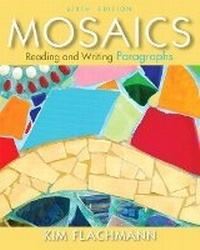
Mosaics
Reading and Writing Paragraphs
6th Edition
Published on 9. October 2013
Book
Paperback/Softback
704 pages
978-0-205-89054-5 (ISBN)
Description
Acclaimed instructor and author Kim Flachmann capitalizes on the growing trend of studying reading to sharpen writing skills. Throughout the text, students are shown the interrelationship among thinking, reading, and writing as they move back and forth through the tasks of pre-reading and reading, prewriting and writing, and revising and editing. Reading strategies are introduced in Chapter 1 and then integrated throughout the text. Meanwhile, as they are employing these reading strategies, students learn from their own writing-revising and editing their own writing.
Mosaics illustrates how thinking, reading, and writing are part of a interrelated process, and encourages students to discover how the "mosaics" of their own thinking, reading, and writing processes work together to form a coherent whole.
Mosaics illustrates how thinking, reading, and writing are part of a interrelated process, and encourages students to discover how the "mosaics" of their own thinking, reading, and writing processes work together to form a coherent whole.
More details
Edition
6th edition
Language
English
Place of publication
United States
Publishing group
Pearson Education (US)
Target group
Adult education
Dimensions
Height: 230 mm
Width: 187 mm
Thickness: 24 mm
Weight
960 gr
ISBN-13
978-0-205-89054-5 (9780205890545)
Copyright in bibliographic data and cover images is held by Nielsen Book Services Limited or by the publishers or by their respective licensors: all rights reserved.
Schweitzer Classification
Other editions
Person
Kim Flachmann received her doctorate in Rhetoric and Twentieth-Century American Literature at the University of Oregon. Her dissertation was a stylistic analysis of William Carlos Williams' poetry. Kim has been teaching at California State University, Bakersfield, where she also administers the Composition Program-from remedial English through the Graduate Teaching Assistants. She has published numerous articles on rhetoric and American literature and has written six textbooks-among them a very successful college reader for Pearson (The Prose Reader, in its ninth edition) and a series of three books for Pearson, called Mosaics, for developmental English, progressing from sentence-level to paragraph-level and finally to essay work. In addition, she received the Outstanding Professor Award for 1998-99 at California State University, Bakersfield; the Rhetorician of the Year Award from the Young Rhetoricians' Conference in 2007; and an award from California Association of Teachers of English for Classroom Excellence in 2009.
Content
Part I: Reading and Writing for Success in College
Chapter 1 Reading and Writing as Critical Thinking
Chapter 2 Reading Critically
Chapter 3 Writing Critically
Chapter 4 Revising
Chapter 5 Editing
Part II: Reading and Writing Effective Paragraphs
Chapter 6 Describing
Chapter 7 Narrating
Chapter 8 Illustrating
Chapter 9 Analyzing a Process
Chapter 10 Comparing and Contrasting
Chapter 11 Dividing and Classifying
Chapter 12 Defining
Chapter 13 Analyzing Causes and Effects
Chapter 14 Arguing
Part III: Essays: Paragraphs in Context
Chapter 15 Recognizing an Essay
Chapter 16 How to Read an Essay
Chapter 17 How to Write an Essay
Chapter 18 Revising and Editing a Student Essay
Chapter 19 Revising and Editing Your Own Essay
Chapter 20 Writing Workshop
Part IV: The Handbook
Chapter 21 Introduction 359
Unit 1 Sentences
Chapter 22 Subjects and Verbs
Chapter 23 Fragments
Chapter 24 Fused Sentences and Comma Splices
Unit 2 Verbs
Chapter 25 Regular and Irregular Verbs
Chapter 26 Verb Tense
Chapter 27 Subject-Verb Agreement
Chapter 28 More on Verbs
Unit 3 Pronouns
Chapter 29 Pronoun Problems
Chapter 30 Pronoun Reference and Point of View
Chapter 31 Pronoun Agreement
Unit 4 Modifiers
Chapter 32 Adjectives
Chapter 33 Adverbs
Chapter 34 Modifier Errors
Unit 5 Punctuation
Chapter 35 End Punctuation
Chapter 36 Commas
Chapter 37 Apostrophes
Chapter 38 Quotation Marks
Chapter 39 Other Punctuation Marks
Unit 6 Mechanics
Chapter 40 Capitalization
Chapter 41 Abbreviations and Numbers
Unit 7 Effective Sentences
Chapter 42 Varying Sentence Structure
Chapter 43 Parallelism
Chapter 44 Combining Sentences
Unit 8 Choosing the Right Words
Chapter 45 Standard and Nonstandard English
Chapter 46 Easily Confused Words
Chapter 47 Spelling
Chapter 1 Reading and Writing as Critical Thinking
Chapter 2 Reading Critically
Chapter 3 Writing Critically
Chapter 4 Revising
Chapter 5 Editing
Part II: Reading and Writing Effective Paragraphs
Chapter 6 Describing
Chapter 7 Narrating
Chapter 8 Illustrating
Chapter 9 Analyzing a Process
Chapter 10 Comparing and Contrasting
Chapter 11 Dividing and Classifying
Chapter 12 Defining
Chapter 13 Analyzing Causes and Effects
Chapter 14 Arguing
Part III: Essays: Paragraphs in Context
Chapter 15 Recognizing an Essay
Chapter 16 How to Read an Essay
Chapter 17 How to Write an Essay
Chapter 18 Revising and Editing a Student Essay
Chapter 19 Revising and Editing Your Own Essay
Chapter 20 Writing Workshop
Part IV: The Handbook
Chapter 21 Introduction 359
Unit 1 Sentences
Chapter 22 Subjects and Verbs
Chapter 23 Fragments
Chapter 24 Fused Sentences and Comma Splices
Unit 2 Verbs
Chapter 25 Regular and Irregular Verbs
Chapter 26 Verb Tense
Chapter 27 Subject-Verb Agreement
Chapter 28 More on Verbs
Unit 3 Pronouns
Chapter 29 Pronoun Problems
Chapter 30 Pronoun Reference and Point of View
Chapter 31 Pronoun Agreement
Unit 4 Modifiers
Chapter 32 Adjectives
Chapter 33 Adverbs
Chapter 34 Modifier Errors
Unit 5 Punctuation
Chapter 35 End Punctuation
Chapter 36 Commas
Chapter 37 Apostrophes
Chapter 38 Quotation Marks
Chapter 39 Other Punctuation Marks
Unit 6 Mechanics
Chapter 40 Capitalization
Chapter 41 Abbreviations and Numbers
Unit 7 Effective Sentences
Chapter 42 Varying Sentence Structure
Chapter 43 Parallelism
Chapter 44 Combining Sentences
Unit 8 Choosing the Right Words
Chapter 45 Standard and Nonstandard English
Chapter 46 Easily Confused Words
Chapter 47 Spelling