

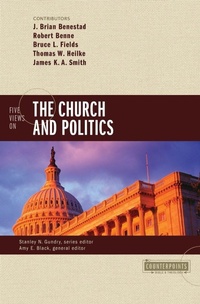
Five Views on the Church and Politics
Zondervan Academic (Publisher)
Published on 14. January 2016
Book
Paperback/Softback
240 pages
978-0-310-51792-4 (ISBN)
Description
Learn to think deeply about the relationship between church and state in a way that goes beyond mere policy debates and current campaigns.
Few topics can grab headlines and stir passions quite like politics, especially when the church is involved. Considering the attention that many Christian parachurch groups, churches, and individual believers give to politics--and of the varying and sometimes divergent political ideals and aims among them--Five Views on the Church and Politics provides a helpful breakdown of the possible Christian approaches to political involvement.
General Editor Amy Black brings together five top-notch political theologians in the book, each representing one of the five key political traditions within Christianity:
Anabaptist (Separationist: the most limited possible Christian involvement in politics) - represented by Thomas Heilke
Lutheran (Paradoxical: strong separation of church and state) - represented by Robert Benne
Black Church (Prophetic: the church's mission is to be a voice for communal reform) - represented by Bruce Fields
Reformed (Transformationist: emphasizes God's sovereignty over all things, including churches and governments) - represented by James K. A. Smith
Catholic (Synthetic: encouragement of political participation as a means to further the common good of all people) - represented by J. Brian Benestad
Each author addresses his tradition's theological distinctives, the role of government, the place of individual Christian participation in government and politics, and how churches should (or should not) address political questions. Responses by each contributor to opposing views will highlight key areas of difference and disagreement.
Thorough and even-handed, Five Views on the Church and Politics will enable readers to consider the strengths and weaknesses of the most significant Christian views on political engagement and to draw their own, informed conclusions.
Few topics can grab headlines and stir passions quite like politics, especially when the church is involved. Considering the attention that many Christian parachurch groups, churches, and individual believers give to politics--and of the varying and sometimes divergent political ideals and aims among them--Five Views on the Church and Politics provides a helpful breakdown of the possible Christian approaches to political involvement.
General Editor Amy Black brings together five top-notch political theologians in the book, each representing one of the five key political traditions within Christianity:
Anabaptist (Separationist: the most limited possible Christian involvement in politics) - represented by Thomas Heilke
Lutheran (Paradoxical: strong separation of church and state) - represented by Robert Benne
Black Church (Prophetic: the church's mission is to be a voice for communal reform) - represented by Bruce Fields
Reformed (Transformationist: emphasizes God's sovereignty over all things, including churches and governments) - represented by James K. A. Smith
Catholic (Synthetic: encouragement of political participation as a means to further the common good of all people) - represented by J. Brian Benestad
Each author addresses his tradition's theological distinctives, the role of government, the place of individual Christian participation in government and politics, and how churches should (or should not) address political questions. Responses by each contributor to opposing views will highlight key areas of difference and disagreement.
Thorough and even-handed, Five Views on the Church and Politics will enable readers to consider the strengths and weaknesses of the most significant Christian views on political engagement and to draw their own, informed conclusions.
More details
Series
Language
English
Place of publication
United States
Publishing group
Zondervan
Target group
College/higher education
Dimensions
Height: 203 mm
Width: 133 mm
Thickness: 14 mm
Weight
310 gr
ISBN-13
978-0-310-51792-4 (9780310517924)
Copyright in bibliographic data and cover images is held by Nielsen Book Services Limited or by the publishers or by their respective licensors: all rights reserved.
Schweitzer Classification
Other editions
Additional editions
J. Brian Benestad | Robert Benne | Bruce Fields
Five Views on the Church and Politics
E-Book
12/2015
Zondervan Academic
€8.99
Available for download
Persons
J. Brian Benestad (PhD, Boston College) is the D-Amour Chair of Catholic Thought at Assumption College in Worcester, Massachusetts. The editor of Fellowship of Catholic Scholars Quarterly, his published works include The Pursuit of a Just Social Order and Church, State, and Society: An Introduction to Catholic Social Doctrine.
Robert Benne (Ph.D., University of Chicago) is Jordan-Trexler Professor Emeritus and research associate at Roanoke College. He founded the Roanoke College Center for Religion in 1982 and is the author of twelve books including Good and Bad Ways to Think About Religion and Politics, Reasonable Ethics, and A Christian Approach to Social, Economic, and Political Concerns.
Bruce L. Fields (Ph.D., Marquette University) is associate professor of biblical and systematic theology and chair of the biblical and systematic theology department at Trinity Evangelical Divinity School. He is the author of Introducing Black Theology: Three Crucial Questions for the Evangelical Church.
Thomas W. Heilke (Ph.D., Duke University) is associate dean of graduate studies and professor of political science at the University of British Columbia, Okanagan. He is author, co-author, or co-editor of more than 40 publications, including Voegelin on the Idea of Race and Nietzsche's Tragic Regime: Culture, Aesthetics, and Political Education.
James K. A. Smith is professor of philosophy at Calvin College where he holds the Gary & Henrietta Byker Chair in Applied Reformed Theology & Worldview. The author of many books, including the award-winning Who's Afraid of Postmodernism? and Desiring the Kingdom, Smith is a Cardus senior fellow and serves as editor of Comment magazine.
Amy E. Black (Ph.D., Massachusetts Institute of Technology) is professor of political science at Wheaton College. She is the author of Honoring God in Red or Blue, Beyond Left and Right, and Helping Christians Make Sense of American Politics, as well as many articles, reviews, and commentaries that have appeared in publications such as Christianity Today, Books & Culture, and the Christian Science Monitor.
Stanley N. Gundry is executive vice president and editor-in-chief for the Zondervan Corporation. He has been an influential figure in the Evangelical Theological Society, serving as president of ETS and on its executive committee, and is adjunct professor of Historical Theology at Grand Rapids Theological Seminary. He is the author of seven books and has written many articles appearing in popular and academic periodicals.
Robert Benne (Ph.D., University of Chicago) is Jordan-Trexler Professor Emeritus and research associate at Roanoke College. He founded the Roanoke College Center for Religion in 1982 and is the author of twelve books including Good and Bad Ways to Think About Religion and Politics, Reasonable Ethics, and A Christian Approach to Social, Economic, and Political Concerns.
Bruce L. Fields (Ph.D., Marquette University) is associate professor of biblical and systematic theology and chair of the biblical and systematic theology department at Trinity Evangelical Divinity School. He is the author of Introducing Black Theology: Three Crucial Questions for the Evangelical Church.
Thomas W. Heilke (Ph.D., Duke University) is associate dean of graduate studies and professor of political science at the University of British Columbia, Okanagan. He is author, co-author, or co-editor of more than 40 publications, including Voegelin on the Idea of Race and Nietzsche's Tragic Regime: Culture, Aesthetics, and Political Education.
James K. A. Smith is professor of philosophy at Calvin College where he holds the Gary & Henrietta Byker Chair in Applied Reformed Theology & Worldview. The author of many books, including the award-winning Who's Afraid of Postmodernism? and Desiring the Kingdom, Smith is a Cardus senior fellow and serves as editor of Comment magazine.
Amy E. Black (Ph.D., Massachusetts Institute of Technology) is professor of political science at Wheaton College. She is the author of Honoring God in Red or Blue, Beyond Left and Right, and Helping Christians Make Sense of American Politics, as well as many articles, reviews, and commentaries that have appeared in publications such as Christianity Today, Books & Culture, and the Christian Science Monitor.
Stanley N. Gundry is executive vice president and editor-in-chief for the Zondervan Corporation. He has been an influential figure in the Evangelical Theological Society, serving as president of ETS and on its executive committee, and is adjunct professor of Historical Theology at Grand Rapids Theological Seminary. He is the author of seven books and has written many articles appearing in popular and academic periodicals.
Content
Introduction A brief overview of the five main views on church and state, the historic contexts of Christian reflection on politics, the significance of the topic for the contemporary church, and the key questions each contributor has been asked to cover. 1. Separationist (Anabaptist) Christian goals are only advanced through the church, and Christians only participate as believers in the church. 2. Two-Kingdom (Lutheran) Christians operate in the realms of both church and state as believers; however, they have different roles and goals in each realm. 3. In-Tension (Catholic) The church both cooperates with and challenges the state in order to bring about Christian social goals. 4. Integrationist (Reformed) The church seeks spiritual redemption while the church seeks social redemption, yet these goals overlap and complement each other. 5. Prophetic (Black Church) An integrationist perspective similar to the Catholic and Reformed views, but marked by an emphasis on the church's role in challenging the state and by a unique blend of theological conservatism married to political liberalism. Conclusion Each view is placed within the context of contemporary politics and compared to the goals and policies of the Democratic and Republican parties, so that readers can see clearly how both parties align and conflict with the five Christian traditions of political thought.