

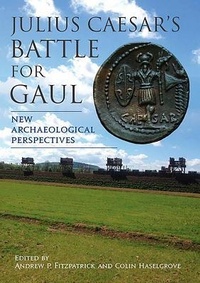
Julius Caesar's Battle for Gaul
New Archaeological Perspectives
Published on 31. August 2019
Book
Paperback/Softback
336 pages
978-1-78925-050-3 (ISBN)
Description
Between 58 and 51 BC Julius Caesar conquered Gaul. He campaigned across much of present day France and the Low Countries, crossed the Rhine to Germany, and sailed the Channel to invade Britain. In doing this he achieved immense personal wealth and glory and the loyalty of a battle-hardened army of veterans. Caesar's eventual return to Rome began with the crossing of the Rubicon which started a bloody civil war from which he emerged victorious and as dictator.
Roman historians have little to say on the consequences of the war on the Iron Age communities of north-west Europe. Their story is told instead by archaeology and numismatics. Huge numbers were involved in the war, at a vast cost in people and wealth. In the aftermath, leaders sympathetic to Rome were installed and sometimes whole peoples were resettled. The diplomatic relations created at this time directly affected the eventual incorporation of these peoples into the Roman Empire.
This book presents the latest archaeological research on the Battle for Gaul and its aftermath. Based on an acclaimed 2017 conference, it is the first Europe-wide overview and much of the research is published here in English for the first time. After an introduction to recent trends in historical studies, thematic studies and regional surveys analyse the archaeological and numismatic evidence from across north-west Europe. Comparative evidence for the Roman conquest of Spain is also examined, along with the fundamental role that the study of the Battle for Gaul played in shaping the development of Iron Age archaeology. Written by leading international experts, this book will be of interest to archaeologists, numismatists, ancient historians and military historians.
Roman historians have little to say on the consequences of the war on the Iron Age communities of north-west Europe. Their story is told instead by archaeology and numismatics. Huge numbers were involved in the war, at a vast cost in people and wealth. In the aftermath, leaders sympathetic to Rome were installed and sometimes whole peoples were resettled. The diplomatic relations created at this time directly affected the eventual incorporation of these peoples into the Roman Empire.
This book presents the latest archaeological research on the Battle for Gaul and its aftermath. Based on an acclaimed 2017 conference, it is the first Europe-wide overview and much of the research is published here in English for the first time. After an introduction to recent trends in historical studies, thematic studies and regional surveys analyse the archaeological and numismatic evidence from across north-west Europe. Comparative evidence for the Roman conquest of Spain is also examined, along with the fundamental role that the study of the Battle for Gaul played in shaping the development of Iron Age archaeology. Written by leading international experts, this book will be of interest to archaeologists, numismatists, ancient historians and military historians.
Reviews / Votes
...an essential contribution to the dissemination of knowledge outside the circle of specialists, will undoubtedly become a reference work, by the timeliness and quality of the information provided, by its remarkable iconography (photos, diagrams, maps) perfectly coordinated with the text, and by the wealth of bibliographies that follow each chapter. * Ancient West & East * Several important and timely theoretical considerations weave through the chapters, from reflections on the price of Roman imperialism paid by local communities and the global impact of Rome's politics, to the challenges of discussing ethnicity and identity in the absence of the written record. * Britannia * The conference proceedings impress with carefully researched and extremely important studies that provide insight into new excavations and investigations, and skilfully combine them with older research. * Bonner Jahrbuecher * But how much do you know about [Caesar's] campaigns in Gaul, his main battleground and the focus of his books? [...] This substantial book is here to help. It collects papers by archaeologists and historians from Britain, Spain, Germany, Switzerland, France, the Netherlands and the us, all in English, presented at a conference in Leicester in 2017. Together they bring up-todate perspectives on history and excavations. * British Archaeology * The contributions gathered here combine syntheses and case studies, crossing the study of texts with archeology and numismatics, to offer a rich overview of recent developments in research on the Gallic Wars. * Bryn Mawr Classical Review *More details
Language
English
Place of publication
Oxford
United Kingdom
Target group
Professional and scholarly
Product notice
Paperback (trade)
Unsewn / adhesive bound
Dimensions
Height: 239 mm
Width: 170 mm
Thickness: 18 mm
Weight
816 gr
ISBN-13
978-1-78925-050-3 (9781789250503)
Copyright in bibliographic data and cover images is held by Nielsen Book Services Limited or by the publishers or by their respective licensors: all rights reserved.
Schweitzer Classification
Other editions
Additional editions
Fitzpatrick Andrew P. Fitzpatrick | Haselgrove Colin Haselgrove
Julius Caesar's Battle for Gaul
New Archaeological Perspectives
E-Book
10/2019
Oxbow Books
€27.99
Available for download
Fitzpatrick Andrew P. Fitzpatrick | Haselgrove Colin Haselgrove
Julius Caesar's Battle for Gaul
New Archaeological Perspectives
E-Book
10/2019
OXBOW BOOKS
€27.99
Available for download
Persons
Andrew Fitzpatrick is Research Associate at the University of Leicester. He has published widely on European later prehistory with a focus on the Iron Age and edited numerous excavation reports, including a number of monographs. Professor of Archaeology, Univ of Leicester.
Content
List of figures
List of tables
List of contributors
Introduction
Andrew P. Fitzpatrick and Colin Haselgrove
1. Scylla, Caesar and Charybdis: (Mis)readings of the Gallic War
Christopher B. Krebs
2. The Gallic Wars in Roman history
Greg Woolf
3. The Gauls on the eve of the Roman conquest
Ian Ralston
4. The Sertorian Wars in the conquest of Hispania: From data to archaeological assessment
Angel Morillo and Feliciana Sala-Selles
5. 58 BC: The Helvetii, from the Swiss plateau to Bibracte... and back
Gilbert Kaenel
6. Recent archaeological research on Roman military engineering works of the Gallic War
Michel Redde
7. Caesar's conquest and the archaeology of mass violence in the Germanic frontier zone
Nico Roymans
8. Caesar's landing sites in Britain and Gaul in 55 and 54 BC: Critical places, natural places
Andrew P. Fitzpatrick
9. Gauls under siege: Defending against Rome
Sophie Krausz
10. Fighting for Caesar: The archaeology and history of Gallic auxiliaries in the 2nd-1st centuries BC
Lionel Pernet
11. The Hermeskeil fortress: New light on the Caesarian conquest of eastern Belgic Gaul and its aftermath
Sabine Hornung
12. Archaeology of the Roman Civil Wars: The destruction of Puig Ciutat (Catalonia, Spain) and Caesar's campaign in Ilerda (49 BC)
Angels Pujol, Manuel Fernandez-Goetz, Roger Sala, Carles Padros, Eduard Ble, Robert Tamba and Xavier Rubio-Campillo
13. The Gallic War in the chronology of Iron Age coinage
Colin Haselgrove
14. The island of Jersey: Focus of resistance or field of last resort?
Philip de Jersey
15. The second battle of Alesia: The 19th-century investigations at Alise-Sainte-Reine and international recognition of the Gallic period of the late Iron Age
Laurent Olivier
List of tables
List of contributors
Introduction
Andrew P. Fitzpatrick and Colin Haselgrove
1. Scylla, Caesar and Charybdis: (Mis)readings of the Gallic War
Christopher B. Krebs
2. The Gallic Wars in Roman history
Greg Woolf
3. The Gauls on the eve of the Roman conquest
Ian Ralston
4. The Sertorian Wars in the conquest of Hispania: From data to archaeological assessment
Angel Morillo and Feliciana Sala-Selles
5. 58 BC: The Helvetii, from the Swiss plateau to Bibracte... and back
Gilbert Kaenel
6. Recent archaeological research on Roman military engineering works of the Gallic War
Michel Redde
7. Caesar's conquest and the archaeology of mass violence in the Germanic frontier zone
Nico Roymans
8. Caesar's landing sites in Britain and Gaul in 55 and 54 BC: Critical places, natural places
Andrew P. Fitzpatrick
9. Gauls under siege: Defending against Rome
Sophie Krausz
10. Fighting for Caesar: The archaeology and history of Gallic auxiliaries in the 2nd-1st centuries BC
Lionel Pernet
11. The Hermeskeil fortress: New light on the Caesarian conquest of eastern Belgic Gaul and its aftermath
Sabine Hornung
12. Archaeology of the Roman Civil Wars: The destruction of Puig Ciutat (Catalonia, Spain) and Caesar's campaign in Ilerda (49 BC)
Angels Pujol, Manuel Fernandez-Goetz, Roger Sala, Carles Padros, Eduard Ble, Robert Tamba and Xavier Rubio-Campillo
13. The Gallic War in the chronology of Iron Age coinage
Colin Haselgrove
14. The island of Jersey: Focus of resistance or field of last resort?
Philip de Jersey
15. The second battle of Alesia: The 19th-century investigations at Alise-Sainte-Reine and international recognition of the Gallic period of the late Iron Age
Laurent Olivier