

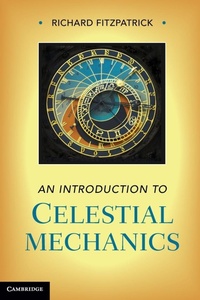
An Introduction to Celestial Mechanics
Published on 28. June 2012
Book
Hardback
276 pages
978-1-107-02381-9 (ISBN)
Description
This accessible text on classical celestial mechanics, the principles governing the motions of bodies in the Solar System, provides a clear and concise treatment of virtually all of the major features of solar system dynamics. Building on advanced topics in classical mechanics such as rigid body rotation, Langrangian mechanics and orbital perturbation theory, this text has been written for advanced undergraduates and beginning graduate students in astronomy, physics, mathematics and related fields. Specific topics covered include Keplerian orbits, the perihelion precession of the planets, tidal interactions between the Earth, Moon and Sun, the Roche radius, the stability of Lagrange points in the three-body problem and lunar motion. More than 100 exercises allow students to gauge their understanding and a solutions manual is available to instructors. Suitable for a first course in celestial mechanics, this text is the ideal bridge to higher level treatments.
Reviews / Votes
'Fitzpatrick presents a clear exposition of the main principles of celestial mechanics ... Each chapter ends with a number of well-thought-out problems with a nice range of difficulty from straightforward to quite challenging. The author designed the book for upper-level undergraduates and beginning graduate students who have completed courses in classical mechanics and multivariate vector calculus. Professionals from other branches of astronomy will also find this a handy review and reference ... Highly recommended.' R. R. Erickson, Choice 'I found the text well written and illustrated, and the material has clearly undergone several tests in the classroom ... I recommend this stimulating book to anyone interested in making first steps in celestial mechanics.' Thomas Peters, Contemporary Physics 'This is a first-rate text to use as a senior-undergraduate text in celestial mechanics. I recommend it strongly without reservation.' The Observatory: A Review of Astronomy 'Fitzpatrick's text is excellent ... [his] exposition is relatively flawless in its execution ... [this book] is a valuable addition to the pedagogy of the field and has perhaps the clearest exposition of any celestial mechanics text for upper-level undergraduate students. For some students, Fitzpatrick will be approaching perfection.' Arlin Crotts, Physics TodayMore details
Language
English
Place of publication
Cambridge
United Kingdom
Target group
College/higher education
Professional and scholarly
Illustrations
Worked examples or Exercises; 8 Tables, unspecified; 73 Halftones, unspecified
Dimensions
Height: 260 mm
Width: 183 mm
Thickness: 20 mm
Weight
723 gr
ISBN-13
978-1-107-02381-9 (9781107023819)
Copyright in bibliographic data and cover images is held by Nielsen Book Services Limited or by the publishers or by their respective licensors: all rights reserved.
Schweitzer Classification
Other editions
Additional editions
Richard Fitzpatrick
Introduction to Celestial Mechanics
E-Book
06/2012
Cambridge University Press
€50.49
Available for download
Richard Fitzpatrick
An Introduction to Celestial Mechanics
E-Book
06/2012
1st Edition
Cambridge University Press
€58.99
Available for download
Person
Richard Fitzpatrick is Professor of Physics at the University of Texas, Austin, where he has been a faculty member since 1994. He earned his Master's degree in Physics at the University of Cambridge and his DPhil in Astronomy at the University of Sussex. He is a longstanding Fellow of the Royal Astronomical Society and author of Maxwell's Equations and the Principles of Electromagnetism (2008).
Content
Preface; 1. Newtonian mechanics; 2. Newtonian gravity; 3. Keplerian orbits; 4. Orbits in central force-fields; 5. Rotating reference frames; 6. Lagrangian mechanics; 7. Rigid body rotation; 8. Three-body problem; 9. Secular perturbation theory; 10. Lunar motion; Appendix A: useful mathematics; Appendix B: derivation of Lagrange planetary equations; Appendix C: expansion of orbital evolution equations; Bibliography; Index.