

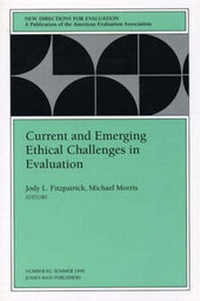
Current and Emerging Ethical Challenges in Evaluation
New Directions for Evaluation, Number 82
Published on 14. July 1999
Book
Paperback/Softback
103 pages
978-0-7879-4902-0 (ISBN)
Description
With recent developments in the evaluation field such as
privatization and mandated outcome-focused evaluation, evaluators
today face new and complex ethical challenges regarding
stakeholders, the public good, and utility. This volume of New
Directions for Evaluation explores how evaluators can avoid,
reduce, or resolve the ethical conflicts that arise. The authors
offer a cost-benefit approach to exploring the ethics of various
research designs and make recommendations for achieving a balance
between neutrality and advocacy. They shed light on the ethical
challenges evaluators face when collaborating with foundations and
communities; working in a culture different from their own; and
determining the nature of stakeholder involvement.
This is the 82nd issue of the quarterly journal New
Directions for Evaluation.
With recent developments in the evaluation field such as
privatization and mandated outcome-focused evaluation, evaluators
today face new and complex ethical challenges regarding
stakeholders, the public good, and utility. This volume of New
Directions for Evaluation explores how evaluators can avoid,
reduce, or resolve the ethical conflicts that arise. The authors
offer a cost-benefit approach to exploring the ethics of various
research designs and make recommendations for achieving a balance
between neutrality and advocacy. They shed light on the ethical
challenges evaluators face when collaborating with foundations and
communities; working in a culture different from their own; and
determining the nature of stakeholder involvement.
This is the 82nd issue of the quarterly journal New
Directions for Evaluation.
privatization and mandated outcome-focused evaluation, evaluators
today face new and complex ethical challenges regarding
stakeholders, the public good, and utility. This volume of New
Directions for Evaluation explores how evaluators can avoid,
reduce, or resolve the ethical conflicts that arise. The authors
offer a cost-benefit approach to exploring the ethics of various
research designs and make recommendations for achieving a balance
between neutrality and advocacy. They shed light on the ethical
challenges evaluators face when collaborating with foundations and
communities; working in a culture different from their own; and
determining the nature of stakeholder involvement.
This is the 82nd issue of the quarterly journal New
Directions for Evaluation.
With recent developments in the evaluation field such as
privatization and mandated outcome-focused evaluation, evaluators
today face new and complex ethical challenges regarding
stakeholders, the public good, and utility. This volume of New
Directions for Evaluation explores how evaluators can avoid,
reduce, or resolve the ethical conflicts that arise. The authors
offer a cost-benefit approach to exploring the ethics of various
research designs and make recommendations for achieving a balance
between neutrality and advocacy. They shed light on the ethical
challenges evaluators face when collaborating with foundations and
communities; working in a culture different from their own; and
determining the nature of stakeholder involvement.
This is the 82nd issue of the quarterly journal New
Directions for Evaluation.
More details
Series
Language
English
Place of publication
New York
United States
Publishing group
John Wiley & Sons Inc
Target group
College/higher education
Dimensions
Height: 230 mm
Width: 150 mm
Thickness: 8 mm
Weight
161 gr
ISBN-13
978-0-7879-4902-0 (9780787949020)
Copyright in bibliographic data and cover images is held by Nielsen Book Services Limited or by the publishers or by their respective licensors: all rights reserved.
Schweitzer Classification
Persons
JODY L. FITZPATRICK is associate professor of public administration at the University Of Colorado. She maintains an active practice in evaluation and is interested in the ethical nuances of evaluator-client relations. She serves on the board of the American Evaluation Association and is working on a book of case studies for the association. MICHAEL MORRIS is professor of psychology and director of graduate field training in community psychology at the University of New Haven. He edits the column "Ethical Challenges" in the American Journal of Evaluation.
JODY L. FITZPATRICK is associate professor of public administration at the University Of Colorado. She maintains an active practice in evaluation and is interested in the ethical nuances of evaluator-client relations. She serves on the board of the American Evaluation Association and is working on a book of case studies for the association. MICHAEL MORRIS is professor of psychology and director of graduate field training in community psychology at the University of New Haven. He edits the column "Ethical Challenges" in the American Journal of Evaluation.
JODY L. FITZPATRICK is associate professor of public administration at the University Of Colorado. She maintains an active practice in evaluation and is interested in the ethical nuances of evaluator-client relations. She serves on the board of the American Evaluation Association and is working on a book of case studies for the association. MICHAEL MORRIS is professor of psychology and director of graduate field training in community psychology at the University of New Haven. He edits the column "Ethical Challenges" in the American Journal of Evaluation.
Content
1. Ethics in Disciplines and Professions Related to Evaluation(Jody
L. Fitzpatrick)
2. Research on Evaluation Ethics: What Have We Learned and Why Is
It Important?(Michael Morris)
3. Rights, Responsibilities, and Duties: A Comparison of Ethics for
Internal and External Evaluators(Sandra Mathison)
4. Ethical Challenges in Evaluation with Communities: A Manager's
Perspective(David Nee, Maria Mojica)
5. The Ethics of Data Collection and Analysis(Melvin M. Mark,
Kristen M. Eyssell, Bernadette Campbell)
6. Ethical Dimensions of Stakeholder Participation and Evaluation
Use(Rosalie T. Torres and Hallie Preskill)
7. Education and Training in Evaluation Ethics(Dianna L.
Newman)
8. The Ethics of Evaluation Neutrality and Advocacy(Lois-ellin
Datta)
9. Ethical Issues in Conducting Evaluation in International
Settings(Michael Bamberger)
L. Fitzpatrick)
2. Research on Evaluation Ethics: What Have We Learned and Why Is
It Important?(Michael Morris)
3. Rights, Responsibilities, and Duties: A Comparison of Ethics for
Internal and External Evaluators(Sandra Mathison)
4. Ethical Challenges in Evaluation with Communities: A Manager's
Perspective(David Nee, Maria Mojica)
5. The Ethics of Data Collection and Analysis(Melvin M. Mark,
Kristen M. Eyssell, Bernadette Campbell)
6. Ethical Dimensions of Stakeholder Participation and Evaluation
Use(Rosalie T. Torres and Hallie Preskill)
7. Education and Training in Evaluation Ethics(Dianna L.
Newman)
8. The Ethics of Evaluation Neutrality and Advocacy(Lois-ellin
Datta)
9. Ethical Issues in Conducting Evaluation in International
Settings(Michael Bamberger)