

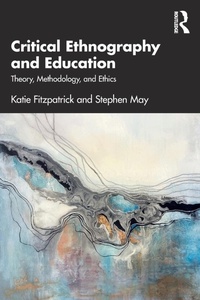
Critical Ethnography and Education
Theory, Methodology, and Ethics
1st Edition
Published on 29. April 2022
Book
Paperback/Softback
185 pages
978-1-138-63196-0 (ISBN)
Description
In this book, Fitzpatrick and May make the case for a reimagined approach to critical ethnography in education. Working with an expansive understanding of critical, they argue that many researchers already do the kind of critical ethnography suggested in this book, whether they call their studies critical or not.
Drawing on a wide range of educational studies, the authors demonstrate that a methodology that is lived, embodied, and personal-and fundamentally connected to notions of power-is essential to exploring and understanding the many social and political issues facing education today. By grounding studies in work that reimagines, troubles, and questions notions of power, injustice, inequity, and marginalization, such studies engage with the tenets of critical ethnography.
Offering a wide-ranging and insightful commentary on the influences of critical ethnography over time, Fitzpatrick and May interrogate the ongoing theoretical developments, including poststructuralism, postcolonialism, and posthumanism. With extensive examples, excerpts, and personal discussions, the book thus repositions critical ethnography as an expansive, eclectic, and inclusive methodology that has a great deal to offer educational inquiries. Overviewing theoretical and methodological arguments, the book provides insight into issues of ethics and positionality as well as an in-depth focus on how ethnographic research illuminates such topics as racism, language, gender and sexuality in educational settings. It is essential reading for students, scholars, and researchers in qualitative inquiry, ethnography, educational anthropology, educational research methods, sociology of education, and philosophy of education.
Drawing on a wide range of educational studies, the authors demonstrate that a methodology that is lived, embodied, and personal-and fundamentally connected to notions of power-is essential to exploring and understanding the many social and political issues facing education today. By grounding studies in work that reimagines, troubles, and questions notions of power, injustice, inequity, and marginalization, such studies engage with the tenets of critical ethnography.
Offering a wide-ranging and insightful commentary on the influences of critical ethnography over time, Fitzpatrick and May interrogate the ongoing theoretical developments, including poststructuralism, postcolonialism, and posthumanism. With extensive examples, excerpts, and personal discussions, the book thus repositions critical ethnography as an expansive, eclectic, and inclusive methodology that has a great deal to offer educational inquiries. Overviewing theoretical and methodological arguments, the book provides insight into issues of ethics and positionality as well as an in-depth focus on how ethnographic research illuminates such topics as racism, language, gender and sexuality in educational settings. It is essential reading for students, scholars, and researchers in qualitative inquiry, ethnography, educational anthropology, educational research methods, sociology of education, and philosophy of education.
Reviews / Votes
"This book is timely, inclusive and inviting to read. Essential reading for postgraduate research students who are interested in ethnography and critical research."--Patti Lather, Emeritus Professor, The Ohio State University, USA
"Fitzpatrick and May have crafted a volume that cultivates courage, theorizing, and provocation; a volume designed to accompany novice and experienced researchers, with joy and tears, insight and incite; a volume that documents and theorizes struggles on the ground, in the classroom, entrenched in community life, and held in bodies. They encourage us to reflect on why we are asking THESE questions, and then to chronicle the wounds and also the rich, sensual forms of resistance, imagination, the going on living that young people engage in the midst.
"This volume is a sensual invitation to critical ethnography where theory is sutured to methodology; where interrogation of power is the project; an antidote to neoliberal speed up research, and a seductive call to slow - deep - critical inquiry, rooted in relationships, stitched in theory and designed to reveal and provoke the radical imagination for what else is possible."
-- Michelle Fine, Distinguished Professor of Critical Psychology, Gender/Women's Studies and Urban Education, The Graduate Center, CUNY, USA, and Visiting Professor at the University of South Africa
More details
Language
English
Place of publication
London
United Kingdom
Publishing group
Taylor & Francis Ltd
Target group
College/higher education
Dimensions
Height: 229 mm
Width: 152 mm
Thickness: 11 mm
Weight
298 gr
ISBN-13
978-1-138-63196-0 (9781138631960)
Copyright in bibliographic data and cover images is held by Nielsen Book Services Limited or by the publishers or by their respective licensors: all rights reserved.
Schweitzer Classification
Other editions
Additional editions
Book
05/2022
1st Edition
Routledge
€207.40
Shipment within 10-20 days
E-Book
04/2022
1st Edition
Routledge
€55.49
Available for download
E-Book
04/2022
1st Edition
Routledge
€55.49
Available for download
Persons
Katie Fitzpatrick is an Associate Professor and Head of School in the Faculty of Education and Social Work at the University of Auckland, New Zealand. Her research and teaching are focused on health education, physical education, and sexuality education, as well as critical ethnographic and poetic research methods.
Stephen May is Professor of Education in Te Puna Wananga (School of Maori and Indigenous Education) at the University of Auckland, New Zealand. He is an international authority on language rights, language policy, bilingual education, and critical multiculturalism, as well as having a longstanding interest in critical ethnography.
Stephen May is Professor of Education in Te Puna Wananga (School of Maori and Indigenous Education) at the University of Auckland, New Zealand. He is an international authority on language rights, language policy, bilingual education, and critical multiculturalism, as well as having a longstanding interest in critical ethnography.
Content
1. Reimagining Critical Ethnography 2. Critical Ethnography as Methodological Guide: Some Key Tenets 3. Working the Theory (and Context) in Critical Ethnography 4. Considering Ethical Practices in Critical Ethnographic research 5. Being and Doing Critical Ethnography: Ethnographic Writing and Field/Work 6. Language, Race/ism, and In/Equity in Education: Critical Ethnographic Approaches 7. Gender, sexuality and (critical) education ethnography 8. Getting lost