

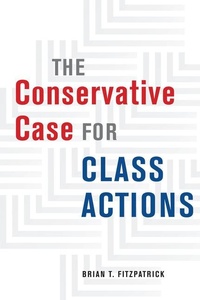
The Conservative Case for Class Actions
Published on 19. February 2022
Book
Paperback/Softback
272 pages
978-0-226-81673-9 (ISBN)
Description
Since the 1960s, the class action lawsuit has been a powerful tool for holding businesses accountable. Yet years of attacks by corporate America and unfavorable rulings by the Supreme Court have left its future uncertain. In this book, Brian T. Fitzpatrick makes the case for the importance of class action litigation from a surprising political perspective: an unabashedly conservative point of view.
Conservatives have opposed class actions in recent years, but Fitzpatrick argues that they should see such litigation not as a danger to the economy, but as a form of private enforcement of the law. He starts from the premise that all of us, conservatives and libertarians included, believe that markets need at least some rules to thrive, from laws that enforce contracts to laws that prevent companies from committing fraud. He also reminds us that conservatives consider the private sector to be superior to the government in most areas. And the relatively little-discussed intersection of those two beliefs is where the benefits of class action lawsuits become clear: when corporations commit misdeeds, class action lawsuits enlist the private sector to intervene, resulting in a smaller role for the government, lower taxes, and, ultimately, more effective solutions.
Offering a novel argument that will surprise partisans on all sides, The Conservative Case for Class Actions is sure to breathe new life into this long-running debate.
Conservatives have opposed class actions in recent years, but Fitzpatrick argues that they should see such litigation not as a danger to the economy, but as a form of private enforcement of the law. He starts from the premise that all of us, conservatives and libertarians included, believe that markets need at least some rules to thrive, from laws that enforce contracts to laws that prevent companies from committing fraud. He also reminds us that conservatives consider the private sector to be superior to the government in most areas. And the relatively little-discussed intersection of those two beliefs is where the benefits of class action lawsuits become clear: when corporations commit misdeeds, class action lawsuits enlist the private sector to intervene, resulting in a smaller role for the government, lower taxes, and, ultimately, more effective solutions.
Offering a novel argument that will surprise partisans on all sides, The Conservative Case for Class Actions is sure to breathe new life into this long-running debate.
Reviews / Votes
"Fitzpatrick starts from the premise that conservatives and libertarians believe that markets need at least some rules to thrive and that they consider the private sector to be superior to the government in most areas. He argues that the relatively little-discussed intersection of those two beliefs is where the benefits of class action lawsuits become clear: when corporations commit misdeeds, class action lawsuits enlist the private sector to intervene, resulting in a smaller role for the government, lower taxes, and, ultimately, more effective solutions." * Law & Social Inquiry * "Class action litigation has too often, Fitzgerald argues, been seen by conservatives as an example of oppressive law; this book holds that, once reformed, class actions offer the possibility of being among 'the laws we [conservatives] do like.' Indeed, as law religion scholarship argues, conservatives need laws-or, better put, need such a faith in a worldview of law, a faith articulated in this book in relation to class action litigation-in order to maintain belief in the sovereignty of the individual." * Religious Studies Review * "Provocative." -- Leonard Leo, former executive vice president, Federalist Society "Stunning." -- Erwin Chemerinsky, Dean, University of California Berkeley School of Law "Dazzlingly brilliant." -- Ken Starr, former US Solicitor General and Court of Appeals Judge "Will undoubtedly contribute to debates in the halls of Congress for years to come." -- John Cornyn, US Senator, TexasMore details
Language
English
Place of publication
Chicago
United States
Publishing group
The University of Chicago Press
Target group
Professional and scholarly
Product notice
Paperback (trade)
Unsewn / adhesive bound
Dimensions
Height: 229 mm
Width: 152 mm
Thickness: 15 mm
Weight
381 gr
ISBN-13
978-0-226-81673-9 (9780226816739)
Copyright in bibliographic data and cover images is held by Nielsen Book Services Limited or by the publishers or by their respective licensors: all rights reserved.
Schweitzer Classification
Other editions
Additional editions
Brian T. Fitzpatrick
The Conservative Case for Class Actions
E-Book
05/2024
1st Edition
University of Chicago Press
from
€30.00
Available for download
Person
Brian T. Fitzpatrick is the Milton R. Underwood Chair in Free Enterprise and Professor of Law at Vanderbilt Law School. He graduated first in his class from Harvard Law School and with a degree in Chemical Engineering from the University of Notre Dame. He served as a law clerk to Supreme Court Justice Antonin Scalia and a Special Counsel to US Senator John Cornyn.
Content
Acknowledgments
Introduction
Chapter 1?The Ironic History of Class Actions
Chapter 2?The Conservative Case for Regulation
Chapter 3?The Conservative Case for Private Enforcement
Chapter 4?The Conservative Case against Private Enforcement
Chapter 5?Why Private Enforcement Needs Class Actions
Chapter 6?Are Class Actions Meritless?
Chapter 7?Do Class Action Lawyers Get All the Money?
Chapter 8? Do Class Actions Deter Wrongdoing?
Chapter 9?The Conservative Class Action
Notes
Bibliography
Index
Introduction
Chapter 1?The Ironic History of Class Actions
Chapter 2?The Conservative Case for Regulation
Chapter 3?The Conservative Case for Private Enforcement
Chapter 4?The Conservative Case against Private Enforcement
Chapter 5?Why Private Enforcement Needs Class Actions
Chapter 6?Are Class Actions Meritless?
Chapter 7?Do Class Action Lawyers Get All the Money?
Chapter 8? Do Class Actions Deter Wrongdoing?
Chapter 9?The Conservative Class Action
Notes
Bibliography
Index