

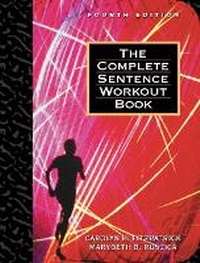
The Complete Sentence Workout Book
4th Edition
Published on 9. November 2001
Book
Paperback/Softback
469 pages
978-0-205-30566-7 (ISBN)
Description
The Complete Sentence Workout Book develops students' acquisition of skills in grammar, punctuation, and mechanics through an unparalleled assortment of exercise activities and an emphasis on learning these skills in the context of longer pieces of writing.
The book works to make grammar and punctuation accessible to students. Although traditional terminology is used, activities are focused on an application of grammatical forms rather than the memorization of rules. The book's goal is to make students confident about sentence skills so that they can focus on writing.
The book is carefully sequenced. Each chapter builds upon skills students master in previous chapters. Beginning with the sentence core, subjects and verbs, students learn to develop their sentence writing abilities through increasingly complex levels. Self-contained chapters can easily be adapted to the needs of individual students. Each chapter progresses in a developmental sequence. Chapter objectives and benefits to help students link the value of grammar to good writing are at the start of each chapter. Sentence exercises following explanatory material help students apply newly learned concepts, and later exercises encourage students to use their own writing and to put grammar concepts in their own words. Chapters conclude with review exercises which provide sentence level work initially and then progress to paragraphs and essays, many of which are by students, for editing and revision.
The book works to make grammar and punctuation accessible to students. Although traditional terminology is used, activities are focused on an application of grammatical forms rather than the memorization of rules. The book's goal is to make students confident about sentence skills so that they can focus on writing.
The book is carefully sequenced. Each chapter builds upon skills students master in previous chapters. Beginning with the sentence core, subjects and verbs, students learn to develop their sentence writing abilities through increasingly complex levels. Self-contained chapters can easily be adapted to the needs of individual students. Each chapter progresses in a developmental sequence. Chapter objectives and benefits to help students link the value of grammar to good writing are at the start of each chapter. Sentence exercises following explanatory material help students apply newly learned concepts, and later exercises encourage students to use their own writing and to put grammar concepts in their own words. Chapters conclude with review exercises which provide sentence level work initially and then progress to paragraphs and essays, many of which are by students, for editing and revision.
More details
Edition
4th edition
Language
English
Place of publication
United States
Publishing group
Pearson Education (US)
Target group
Professional and scholarly
Dimensions
Height: 279 mm
Width: 210 mm
Weight
1000 gr
ISBN-13
978-0-205-30566-7 (9780205305667)
Copyright in bibliographic data and cover images is held by Nielsen Book Services Limited or by the publishers or by their respective licensors: all rights reserved.
Schweitzer Classification
Other editions
New editions
Carolyn H. Fitzpatrick | Marybeth B. Ruscica | Vincent Fitzpatrick
The Complete Sentence Workout Book with Readings
Book
08/2003
5th Edition
Pearson
€101.50
Article is exhausted; no reprint
Content
Most chapters contain "Chapter Reviews" and "Chapter Review Writing Assignment."
Preface.
I.THE COMPOSING PROCESS.
1.Exploring Topics for Paragraphs.
Generating Ideas.
Prewriting.
Narrowing Topics.
Identifying Audience and Purpose.
2.Developing Paragraphs.
Topic Sentences.
Primary Support Sentences.
Secondary Support Sentences.
Concluding Sentences.
3.Revising Paragraphs.
Revising Strategies.
Editing.
Proofreading.
4.Writing Essays.
Structuring Essays.
Introductions.
Conclusions.
II.THE SENTENCE CORE: SUBJECTS AND VERBS.
5.Identifying Subjects and Verbs.
Subjects.
Verbs.
Identifying Subjects and Verbs.
Prepositional Phrases.
Style.
6.Sentence Formats.
Sentence Formats.
Verbals.
Parts of Speech and Their Functions.
Classes of Sentences.
7.Subject-Verb Agreement.
Singular and Plural Forms.
Verbs.
Subjects.
III.VERBS.
8.The Simple Tenses.
Action Verbs and Linking Verbs.
Conjugating Verbs.
The Present Tense.
The Past Tense.
The Future Tense.
Consistency of Verb Tenses.
9.The Perfect Forms.
The Perfect Tenses.
The Present Perfect Tense.
The Past Perfect Tense.
The Future Perfect Tense.
10.The Progressive Forms.
The Progressive Forms.
The Simple Progressive Forms.
The Perfect Progressive Forms.
Helping Verbs.
Consistency of Verb Tenses.
IV.CORRECT SENTENCE FORMATION.
11.Types of Sentences.
Clauses.
Simple Sentences.
Compound Sentences.
Complex Sentences.
Compound-Complex Sentences.
A Final Hint.
Style.
12.Fragments.
Fragment Type I: No Subject.
Fragment Type 2: No Verb.
Fragment Type 3: -ing Verb with No Helping Verb.
Fragment Type 4: No Complete Thought.
13.Comma Splices.
Identifying the Problem.
Correcting the Problem.
14.Run-Ons.
Identifying the Problem.
Correcting the Problem.
V.SENTENCE CHOICES-STYLE.
15.Sentence Combinations.
Adjectives and Other Modifiers.
Appositives and Relative-Pronoun Clauses.
Participles.
Coordination.
Subordination.
Parallelism.
Beginning Sentences.
16.Diction.
Vocabularies.
Using Appropriate Language.
Denotation and Connotation.
Euphemisms and Neologisms (Invented Words or Meanings).
Wordiness and Redundancy (Unnecessary Repetition).
17.Finer Points of Verbs.
Transitive and Intransitive Verbs.
Voice.
Mood.
Verbals.
Style.
VI.SENTENCE TOOLS.
18.Capitals and End Punctuation.
Capitals.
End Punctuation.
19.Commas to Separate.
Independent Clauses.
Items in a Series.
Coordinate Adjectives.
Long Introductory Elements.
Dates and Addresses.
Elements That Might Be Misread or Misunderstood.
20.Commas to Enclose.
Direct Address.
Dialogue.
Appositives.
Out-of-Place Adjectives.
Nonrestrictive Clauses and Phrases.
Parenthetical Expressions.
21.Apostrophes.
Indicating Possession.
Forming Contractions.
Forming Plurals.
22.Other Types of Punctuation.
Quotation Marks (" ").
Colons (:).
Ellipsis Points (...).
Hyphens (-) and Dashes (-).
Parentheses ( ) and Brackets [ ].
VII.CORRECT FORMS.
23.Pronoun Reference.
Personal Pronouns and Cases.
Pronoun Agreement.
Special Problems.
24.Misplaced and Dangling Modifiers.
Misplaced Modifiers.
Dangling Participles and Dangling Modifiers.
Split Infinitives.
25.Adjectives and Adverbs.
Functions of Adjectives and Adverbs.
26.Confusing Words.
27.Spelling.
Types of Spelling Errors.
Rule #1: Words with ie or ei.
Rule #2: Adding Prefixes.
Rule #3: Changing y to i.
Rule #4: Silent e.
Rule #5: Doubling the Final Consonant.
VIII. READING TO WRITE.
28.Analytical Reading.
Reading as Thinking.
The Analytical Reading Process (SQ3R).
Survey.
Question.
Read.
Record.
Review.
29.Readings for Writing.
Narratives.
Jack London, An Eye-Witness's View of the San Francisco Earthquake.
Robin Lampson, Man at His Best.
Richard Wright, The Library Card.
Joe Liberatore (student), The All-American Job.
Paragraph Assignments.
Descriptions.
Anne Morrow Lindbergh, The Beach.
Alison McLean, Together They Stay a World Apart.
Regina Rafferty (student), Paradise Can Be a Concentration Camp.
Paragraph Assignments.
Comparisons and Contrasts.
Peter DeJonge, A 90's Kind of Rivalry.
Deborah Soloman, 1899: The Names Have Changed, But the Worries Remain.
Doug Eppler (student), Lives Beyond the Beltway.
Paragraph Assignments.
Causes and Effects.
Martin Luther King, Jr., The Arrest of Rosa Parks.
Dorothy Foltz-Gray, Did You Lose Something?
Ryan Bromwell (student), A Place to Come Home To.
Paragraph Assignments.
Definitions.
The Economist, Incident at Rifle River.
Linda Bridges, The Tomato as an Endangered Species.
Ray Stolle (student), War Games.
Paragraph Assignments.
Classifications.
E. B. White, Three New Yorks.
Rachel Carson, Whales.
Shellie Smith (Student), Baseball Spectators.
Paragraph Assignments.
Appendix: Common ESL Mistakes.
Answer Key.
Index.
Preface.
I.THE COMPOSING PROCESS.
1.Exploring Topics for Paragraphs.
Generating Ideas.
Prewriting.
Narrowing Topics.
Identifying Audience and Purpose.
2.Developing Paragraphs.
Topic Sentences.
Primary Support Sentences.
Secondary Support Sentences.
Concluding Sentences.
3.Revising Paragraphs.
Revising Strategies.
Editing.
Proofreading.
4.Writing Essays.
Structuring Essays.
Introductions.
Conclusions.
II.THE SENTENCE CORE: SUBJECTS AND VERBS.
5.Identifying Subjects and Verbs.
Subjects.
Verbs.
Identifying Subjects and Verbs.
Prepositional Phrases.
Style.
6.Sentence Formats.
Sentence Formats.
Verbals.
Parts of Speech and Their Functions.
Classes of Sentences.
7.Subject-Verb Agreement.
Singular and Plural Forms.
Verbs.
Subjects.
III.VERBS.
8.The Simple Tenses.
Action Verbs and Linking Verbs.
Conjugating Verbs.
The Present Tense.
The Past Tense.
The Future Tense.
Consistency of Verb Tenses.
9.The Perfect Forms.
The Perfect Tenses.
The Present Perfect Tense.
The Past Perfect Tense.
The Future Perfect Tense.
10.The Progressive Forms.
The Progressive Forms.
The Simple Progressive Forms.
The Perfect Progressive Forms.
Helping Verbs.
Consistency of Verb Tenses.
IV.CORRECT SENTENCE FORMATION.
11.Types of Sentences.
Clauses.
Simple Sentences.
Compound Sentences.
Complex Sentences.
Compound-Complex Sentences.
A Final Hint.
Style.
12.Fragments.
Fragment Type I: No Subject.
Fragment Type 2: No Verb.
Fragment Type 3: -ing Verb with No Helping Verb.
Fragment Type 4: No Complete Thought.
13.Comma Splices.
Identifying the Problem.
Correcting the Problem.
14.Run-Ons.
Identifying the Problem.
Correcting the Problem.
V.SENTENCE CHOICES-STYLE.
15.Sentence Combinations.
Adjectives and Other Modifiers.
Appositives and Relative-Pronoun Clauses.
Participles.
Coordination.
Subordination.
Parallelism.
Beginning Sentences.
16.Diction.
Vocabularies.
Using Appropriate Language.
Denotation and Connotation.
Euphemisms and Neologisms (Invented Words or Meanings).
Wordiness and Redundancy (Unnecessary Repetition).
17.Finer Points of Verbs.
Transitive and Intransitive Verbs.
Voice.
Mood.
Verbals.
Style.
VI.SENTENCE TOOLS.
18.Capitals and End Punctuation.
Capitals.
End Punctuation.
19.Commas to Separate.
Independent Clauses.
Items in a Series.
Coordinate Adjectives.
Long Introductory Elements.
Dates and Addresses.
Elements That Might Be Misread or Misunderstood.
20.Commas to Enclose.
Direct Address.
Dialogue.
Appositives.
Out-of-Place Adjectives.
Nonrestrictive Clauses and Phrases.
Parenthetical Expressions.
21.Apostrophes.
Indicating Possession.
Forming Contractions.
Forming Plurals.
22.Other Types of Punctuation.
Quotation Marks (" ").
Colons (:).
Ellipsis Points (...).
Hyphens (-) and Dashes (-).
Parentheses ( ) and Brackets [ ].
VII.CORRECT FORMS.
23.Pronoun Reference.
Personal Pronouns and Cases.
Pronoun Agreement.
Special Problems.
24.Misplaced and Dangling Modifiers.
Misplaced Modifiers.
Dangling Participles and Dangling Modifiers.
Split Infinitives.
25.Adjectives and Adverbs.
Functions of Adjectives and Adverbs.
26.Confusing Words.
27.Spelling.
Types of Spelling Errors.
Rule #1: Words with ie or ei.
Rule #2: Adding Prefixes.
Rule #3: Changing y to i.
Rule #4: Silent e.
Rule #5: Doubling the Final Consonant.
VIII. READING TO WRITE.
28.Analytical Reading.
Reading as Thinking.
The Analytical Reading Process (SQ3R).
Survey.
Question.
Read.
Record.
Review.
29.Readings for Writing.
Narratives.
Jack London, An Eye-Witness's View of the San Francisco Earthquake.
Robin Lampson, Man at His Best.
Richard Wright, The Library Card.
Joe Liberatore (student), The All-American Job.
Paragraph Assignments.
Descriptions.
Anne Morrow Lindbergh, The Beach.
Alison McLean, Together They Stay a World Apart.
Regina Rafferty (student), Paradise Can Be a Concentration Camp.
Paragraph Assignments.
Comparisons and Contrasts.
Peter DeJonge, A 90's Kind of Rivalry.
Deborah Soloman, 1899: The Names Have Changed, But the Worries Remain.
Doug Eppler (student), Lives Beyond the Beltway.
Paragraph Assignments.
Causes and Effects.
Martin Luther King, Jr., The Arrest of Rosa Parks.
Dorothy Foltz-Gray, Did You Lose Something?
Ryan Bromwell (student), A Place to Come Home To.
Paragraph Assignments.
Definitions.
The Economist, Incident at Rifle River.
Linda Bridges, The Tomato as an Endangered Species.
Ray Stolle (student), War Games.
Paragraph Assignments.
Classifications.
E. B. White, Three New Yorks.
Rachel Carson, Whales.
Shellie Smith (Student), Baseball Spectators.
Paragraph Assignments.
Appendix: Common ESL Mistakes.
Answer Key.
Index.