

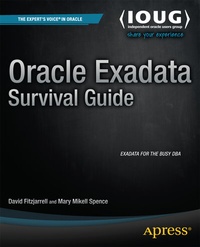
Oracle Exadata Survival Guide
Published on 13. November 2013
Book
Paperback/Softback
XV, 284 pages
978-1-4302-6010-3 (ISBN)
Description
Oracle Exadata Survival Guide is a hands-on guide for busy Oracle database administrators who are migrating their skill sets to Oracle's Exadata database appliance. The book covers the concepts behind Exadata, and the available configurations for features such as smart scans, storage indexes, Smart Flash Cache, hybrid columnar compression, and more. You'll learn about performance metrics and execution plans, and how to optimize SQL running in Oracle's powerful, new environment. The authors also cover migration from other servers. Oracle Exadata is fast becoming the standard for large installations such as those running data warehouse, business intelligence, and large-scale OLTP systems. Exadata is like no other platform, and is new ground even for experienced Oracle database administrators. The Oracle Exadata Survival Guide helps you navigate the ins and outs of this new platform, de-mystifying this amazing appliance and its exceptional performance. The book takes a highly practical approach, not diving too deeply into the details, but giving you just the right depth of information to quickly transfer your skills to Oracle's important new platform.Helps transfer your skills to the platform of the future Covers the important ground without going too deep Takes a practical and hands-on approach to everyday tasks
More details
Edition
1st ed.
Language
English
Place of publication
Berkeley
United States
Target group
Popular/general
Illustrations
17 s/w Abbildungen
XV, 284 p. 17 illus.
Dimensions
Height: 235 mm
Width: 191 mm
Thickness: 16 mm
Weight
536 gr
ISBN-13
978-1-4302-6010-3 (9781430260103)
DOI
10.1007/978-1-4302-6011-0
Schweitzer Classification
Other editions
Additional editions
David Fitzjarrell | Mary Spence
Oracle Exadata Survival Guide
E-Book
11/2013
APress
€66.99
Available for download
Persons
David Fitzjarrell is a Senior Oracle Database Administrator living in the Denver/Boulder area of Colorado. He has over 23 years experience in various industries, and is currently working with Exadata in a large-scale, OLTP and ERP retail environment. He started with Oracle Version 6.0, and has worked with almost every release since, concentrating on the areas of physical administration and performance tuning. David is the Social Media Director for the Rocky Mountain Oracle Users Group, contributes monthly articles for databasejournal.com, participates in various Oracle forums and newsgroups and writes an Oracle-centric blog at http://dfitzjarrell.wordpress.com.
Content
* Exadata Basics * Smart Scans and Offloading * Storage Indexes * Smart Flash Cache * Parallel Query * Compression * Exadata Wait Events * Measuring Performance * Storage Cell Monitoring * Monitoring Exadata * Storage Reconfiguration * Migrating Databases to Exadata * Migrating ERP Applications * Final Thoughts